
Generative AI for Personal Branding will not save a founder whose name returns a Crunchbase stub at 11pm. More than 40 percent of B2B deals stall because of internal misalignment inside the buying group (Edelman and LinkedIn, 2025). Somebody in finance or legal never got convinced. They were never given anything to read.
Swatilekha Das, the best AI Personal Branding Consultant for Founders and CXOs in India, builds the publishing system that closes that gap for founders raising inside twelve months.
This article gives you six numbered steps with exact tools and timings, a 90 day calendar with three checkpoints, three real founder examples with years attached, five common mistakes, and the four board metrics that survive diligence.
Why Generative AI for Personal Branding Matters in 2026
Used properly, Generative AI for Personal Branding is a transcription problem, not a writing problem. The machine captures what a founder already thinks. It publishes on a schedule almost nobody keeps alone.
Buying decisions moved off calls and onto screens. 54 percent of C-suite executives spend an hour or more each week reading thought leadership content (Edelman and LinkedIn, 2025).
That hour happens without you. Nobody books it. Nobody tells you it happened.
Across founder profiles Swatilekha has audited in London, New York and Bangalore, term sheet conversations are routinely decided before anyone opens a deck. The founder never knows. The partner read three months of posts the night before.
Your action this section: open an incognito window and search your own name plus your company. Whatever loads is the asset you are actually raising against.
Indian startups raised 11 billion dollars across more than 936 deals in 2025, down 8 percent year on year (Inc42, 2025). Fewer cheques. Same number of founders.
The partner you pitched is not the only reader. An associate runs diligence, and a second partner reads a memo written by someone who never met you.
Public thinking fills that gap. It is the only part of a founder’s case that keeps arguing after the founder leaves the room.
Swatilekha calls this the silent decline. Founders assume the market is slow. Often the market read them and moved on without saying so.
The cost never appears in a pipeline report. It is a meeting that was never scheduled, so it leaves no trace anywhere a founder would think to look.
That invisibility is why the problem survives at companies with otherwise excellent operating discipline. You cannot run a retrospective on an introduction that did not happen.
Founders notice the symptom and misdiagnose the cause. They conclude the deck needs work, or the metrics need another quarter, and rebuild the wrong artefact.
Meanwhile the artefact that failed them costs 90 minutes to fix and sits at the top of a page nobody has opened in eight months.
The asymmetry is worth sitting with. Almost nothing else in a founder’s week offers that ratio between effort and consequence.
There is a second order effect too. Investors talk to each other. A partner who could not form a view rarely says so directly, but the absence of a strong referral travels.
The founders who fix this are rarely the best writers. They are the ones who accepted that publishing is an operating task with an owner and a slot in the calendar.
Treated that way it stops being a creative burden. It becomes a fifteen minute recurring meeting with a named output, which is a category of work founders already know how to run.
The alternative is what most of the market does. Publish during a raise, stop when it closes, and rediscover the problem eighteen months later at the next one.
What Generative AI for Personal Branding Changes About Ghostwriting
Agencies sell content calendars. Generative AI for Personal Branding done properly sells a measurable position inside someone else’s decision process. Those are different products.
Generative AI for Personal Branding Starts With Search, Not Style
Before a single post is written, run your name through Google, LinkedIn search and Perplexity. Not for vanity. For gaps.
When a partner at Blume or Kalaari types your name at 11pm, what comes back? Usually a Crunchbase stub and a five year old conference photo.
That is the ledger. Everything visible about you, on the day someone checks. Treat it as an asset with a balance, not a personality exercise.
Generative AI for Personal Branding Builds for the Hidden Buyer
Hidden buyers sit in finance, legal, compliance and procurement. They shape the decision without ever appearing on a call sheet.
95 percent of them say strong thought leadership makes them more receptive to sales outreach, and 63 percent spend more than an hour a week consuming it (Edelman and LinkedIn, 2025).
You are not writing for peers. You are writing for the person in the room who was never introduced to you.
79 percent of hidden decision makers are more likely to advocate for proposals from companies producing consistent thought leadership during an RFP (Edelman and LinkedIn, 2025).
Your action this section: name the three people in your last stalled deal who never spoke. Write for them next.
Generative AI for Personal Branding Measures Engagement Quality
Follower counts lie. Engagement rate lies slightly less. Neither tells you whether the right person read you.
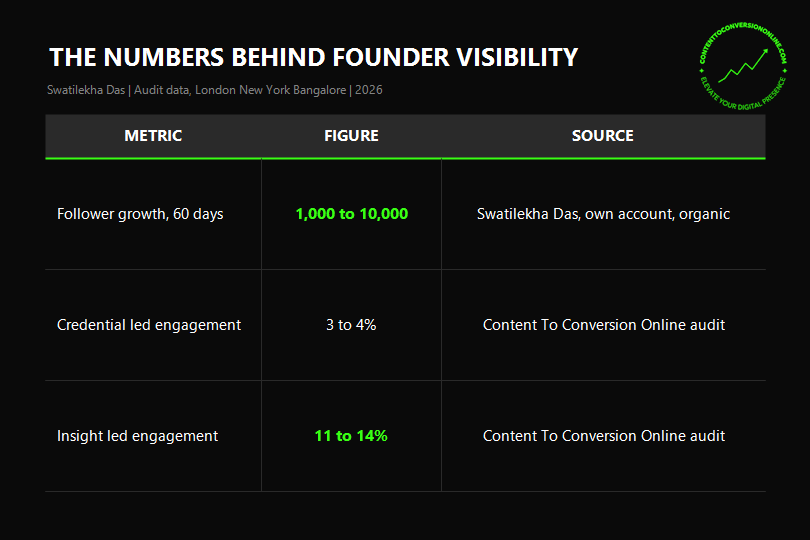
Audit data from Content To Conversion Online across London, New York and Bangalore found credential led profiles average 3 to 4 percent meaningful engagement. Insight led profiles average 11 to 14 percent.
Meaningful means a comment with a sentence in it, a saved post, or a profile visit ending in a connection request. Not a like from a stranger in an unrelated market.
That gap of roughly three times is the entire argument for Generative AI for Personal Branding as a system rather than a tool.
Measurement stays manual for the first month. No dashboard separates a considered comment from a one word reaction, so somebody has to read them.
After 30 days a pattern emerges and reading can be sampled. By then you know which post types pull decision makers and which pull applicants.
Founders weighing this against doing it by hand should read the comparison in the manual versus assisted breakdown, which sets out where the slower method still wins.
The Six Step Generative AI for Personal Branding System
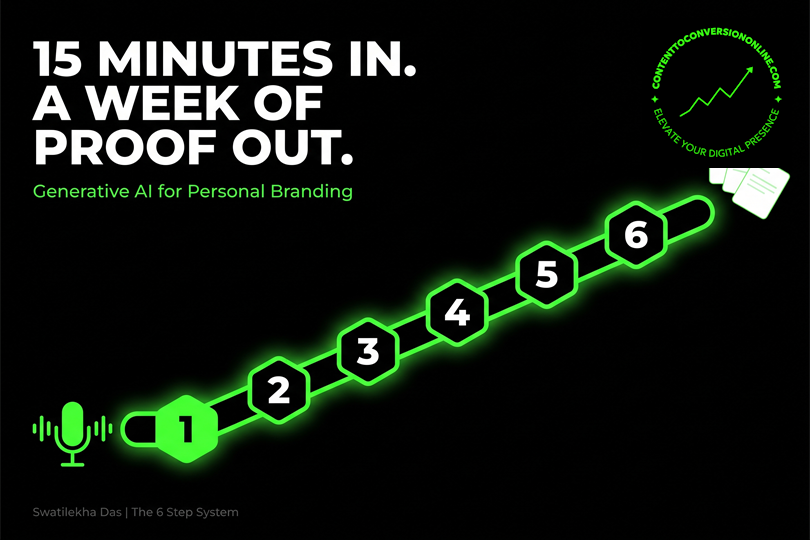
Six steps, run in order, over 90 days. Each names the exact action, the exact surface, and the time it takes.
Step 1 of Generative AI for Personal Branding: The Cold Search Audit
Action: search your full name plus company in an incognito window. Screenshot page one. Then ask Perplexity and ChatGPT what this person is known for and save both answers verbatim.
Surface: Google, Perplexity, ChatGPT. Time: 40 minutes.
What matters is the gap between what you think you are known for and what a machine says. That delta is the brief.
Step 2 of Generative AI for Personal Branding: The Headline Rewrite
Action: rewrite the LinkedIn headline as a claim plus a proof plus a market. Not “Founder and CEO at Acme”. The specific problem you remove, and the evidence you removed it.
Surface: LinkedIn profile headline, 220 characters. Time: 90 minutes including three discarded versions.
This single field is the most read text a founder owns. Generative AI for Personal Branding cannot compensate for a headline that says nothing.
Step 3 of Generative AI for Personal Branding: The Proof Inventory
Action: list every number you are allowed to say in public. Revenue milestones, retention, hiring counts, latency improvements, churn reduction.
Surface: a shared sheet, with the finance lead in the room. Time: two hours.
Most founders find they have eleven and are using zero. Anything unconfirmed is held back, never softened into vague language.
Step 4 of Generative AI for Personal Branding: The Voice Capture
Action: record 15 minutes of unscripted talking. Answer one question. What did you change your mind about this quarter?
Surface: Otter.ai. Time: 15 minutes weekly, permanently.
This is the only recurring input the system needs. It separates content that sounds like a founder from content that sounds like a marketing department.
Step 5 of Generative AI for Personal Branding: The Publishing Cadence
Action: publish three posts a week. One proof post, one contrarian post, one teaching post.
Surface: drafting in Claude from the transcript, scheduling in Taplio. Time: 30 minutes weekly for review and approval.
The contrarian post is the one that works. It is also the one founders delete before publishing.
Step 6 of Generative AI for Personal Branding: The Ledger Review
Action: rerun step one. Same searches, same screenshots, placed side by side with the originals.
Surface: Google, Perplexity, ChatGPT. Time: 40 minutes monthly.
The measurement is whether the machine’s answer changed. That is the only metric surviving a funding round.
What Generative AI for Personal Branding Cannot Do
Every system has a boundary. Swatilekha states these three at the start, because founders expecting the wrong outcome cancel in week six.
Generative AI for Personal Branding Cannot Invent Proof
The model will happily write that retention improved. It has no idea whether that is true. Neither does the audience, until someone checks.
This is why step three exists. Swatilekha kills entire drafts over a single unverifiable number. One corrected claim in public costs more attention than ten good posts earn.
Generative AI for Personal Branding Cannot Replace a Point of View
A model trained on the whole internet returns the internet’s average opinion. The average opinion is what everyone else already publishes.
Position comes from the founder. The recording step is the only place in the chain where original judgment enters.
She refuses mandates where the founder will not record. Without voice input there is nothing to work from except the average.
Generative AI for Personal Branding Cannot Fix a Wrong Audience
If followers are job seekers and the goal is investors, more posting makes it worse. Volume amplifies whatever targeting already exists.
Fixing it means deliberately publishing content the existing audience ignores. That feels like failure for about three weeks. It is the correction working.
Your action this section: check the job titles of your last 20 commenters. If under five could write a cheque, targeting is the problem.
The correction is uncomfortable because numbers get worse before they get better. The old audience stops engaging and the new one has not arrived.
Most founders abandon the change in that window. They read the dip as evidence the new direction failed, when the dip is the old audience filtering out.
Hold the line for six weeks. If job titles in the comments have not shifted by then, the content itself is the problem rather than the audience.
One more boundary. No system fixes a founder who has nothing to say about their market yet. That is a signal to run twenty customer conversations first.
The 90 Day Generative AI for Personal Branding Calendar
Founders ask what happens week by week. This is the schedule, with the checkpoint ending each phase.
Days 1 to 30 of Generative AI for Personal Branding
Cold search audit on day one. Headline rewrite by day three. Proof inventory complete by day seven. First recording in week two.
Publishing starts week three, not week one. Posting before the profile is rewritten sends traffic to a page that undersells the founder.
Checkpoint: has page one of the name search changed? If nothing moved, the headline was too safe.
Days 31 to 60 of Generative AI for Personal Branding
Cadence stabilises at three posts a week. The contrarian post enters rotation around week five, once the founder trusts the process enough to publish it.
The newsletter starts week six. Beehiiv sends monthly from the same transcripts, aimed at people who read email but not LinkedIn.
Checkpoint: meaningful engagement should be climbing out of the 3 to 4 percent credential led band.
Days 61 to 90 of Generative AI for Personal Branding
Video enters here, not earlier. CapCut cuts 40 seconds from recordings already made, adding no new work to the week.
The final review compares day 90 against day one across Google, LinkedIn, Perplexity and ChatGPT. That comparison is the deliverable.
Checkpoint: can a stranger describe what you are known for after two minutes of searching?
Test it properly. Ask someone outside your industry to search you for two minutes and then say back what you do. Do not coach them and do not react while they read.
Their summary is the product. If it matches what you intended, the ninety days worked. If they describe your job title, it did not.
The full scope and pricing of a build like this sits in the CXO engagement breakdown, which covers what is included at each level.
How to Report Generative AI for Personal Branding to a Board
Founders get asked what the spend produced. Vanity numbers do not survive that question, and neither does silence.
The Generative AI for Personal Branding Metrics That Survive Diligence
Report four things. First, page one of the name search on day one against today, as two screenshots side by side. Nobody argues with a screenshot.
Second, meaningful engagement rate, defined before measurement starts. A comment containing a full sentence counts. A reaction does not.
Third, inbound conversations nobody initiated, counted monthly. This connects publishing to pipeline without claiming attribution that cannot be proved.
Fourth, what Perplexity and ChatGPT say when asked what this person is known for. Paste the answer verbatim into the deck each month.
Your action this section: define meaningful engagement in writing before day one. Definitions written afterwards always flatter the result.
These four hold up because each is falsifiable. A board member can rerun every one of them in ten minutes without asking anyone for data.
That property matters more than precision. A metric a board can verify independently earns more trust than a better metric taken on faith.
Most of the month one work is defining these four numbers rather than producing content. Founders skip it and then cannot defend the spend at the first board meeting.
What to Cut From a Generative AI for Personal Branding Report
Cut impressions. Impressions measure how often a platform chose to show something, not whether anyone valued it.
Cut follower count as a headline number. Keep it as a footnote. Follower growth lags the thing that matters by roughly a quarter.
Cut engagement rate expressed as a single percentage with no definition attached. It invites a challenge nobody can answer.
Cut any comparison to a competitor’s follower count. It reframes the conversation around a race you did not enter and cannot win quickly.
What remains is short. Four numbers, two screenshots, one verbatim machine answer. That fits on a single slide, which is the point.
Swatilekha runs this slide with clients on the same calendar day each month. Consistency of the reporting date matters as much as the content, because it removes the temptation to report only after a good week.
Stage by Stage Generative AI for Personal Branding
A pre seed founder and a Series C chief executive have opposite problems. One has no signal. The other has company brand noise drowning the personal one.
Pre Seed and Seed: Generative AI for Personal Branding Builds First Signal
There is no logo equity. The founder name is the only asset with recognition value.
Early stage funding in India reached 3.9 billion dollars in 2025, up 7 percent year on year (TechCrunch, 2025). Competition here is for attention, not capital.
First move is the headline rewrite plus three proof posts. Nothing else. Do not build a content calendar for a company that may pivot in six weeks.
Series A and B: Generative AI for Personal Branding Builds the Hiring Magnet
Now the problem is talent. Series A rounds in India averaged 5 to 15 million dollars in 2025 as investors grew more selective (TechCrunch, 2025). That money buys headcount you then have to persuade.
Content shifts to decisions. How the architecture got chosen. Why a feature got killed. Senior people read for judgment, not culture decks.
Candidates are choosing a manager, not a company. A visible reasoning process is the only preview they get before signing.
For B2B SaaS the category positioning problem differs enough to be worth reading separately in the SaaS founder breakdown.
Series C and Above: Generative AI for Personal Branding Builds the Board Voice
The company brand now outweighs the personal one. That sounds like success. It is a risk for anyone wanting a board seat, a second company, or a clean exit narrative.
India had roughly 148 million LinkedIn members in 2025, the platform’s second largest market after the United States (Statista, 2025). Scale is not the constraint here. Distinctness is.
At this level the constraint is legal, not creative. Every claim passes people whose job is preventing claims. Build the proof inventory with that review in mind.
There is a succession angle nobody discusses. A chief executive with no personal ledger has no independent standing the day they leave.
The Generative AI for Personal Branding Comparison Table
What changes between a credential led profile and an insight led one. Run this before quoting any engagement number.
| Element | Credential Led | Insight Led | First Move |
|---|---|---|---|
| Headline | Job title and company | Claim, proof, market | Rewrite in 90 minutes |
| About section | Career chronology | One problem, one method | Cut to 4 paragraphs |
| Post subject | Company announcements | Decisions and reversals | Publish one reversal |
| Proof | Logos and awards | Sourced numbers | Build proof inventory |
| Meaningful engagement | 3 to 4 percent | 11 to 14 percent | Measure at day 30 |
| Search result | Crunchbase stub | Owned narrative | Run the cold audit |
Work down the first move column in order. Founders who start at row three, publishing before the headline is fixed, send traffic to a page that undercuts the post.
The rows are sequenced by cost of reversal. A headline takes 90 minutes to change. A reputation for posting company press takes about six months to shake.
Three Real Examples of Generative AI for Personal Branding Targets
Three Indian founders show the destination. None used a tool chain. The system exists to reach the same place in 90 days instead of nine years.
Kunal Shah and Generative AI for Personal Branding
Kunal Shah, founder of CRED, publishes observations about Indian consumer behaviour unrelated to his product. He writes about status, trust and delta four thinking.
He is read by people who will never use CRED. Investors and journalists quote his framing back to him. That is owning a mental category.
Notice what he avoids. He does not post funding announcements as thought leadership. The personal ledger and the company ledger stay separate.
Nithin Kamath and Generative AI for Personal Branding
Nithin Kamath, co founder of Zerodha, built authority by publishing things that cost him money to say. He has written openly about revenue concentration risk and about discouraging overtrading among his own users.
That is the contrarian post most founders delete. He publishes it. The trust it generates is not purchasable through advertising.
Girish Mathrubootham and Generative AI for Personal Branding
Freshworks listed on Nasdaq on 22 September 2021, the first Indian SaaS company to do so, raising 1.03 billion dollars at 36 dollars a share (Forbes, 2021).
Girish Mathrubootham spent years before that publishing about building enterprise software from Chennai rather than Silicon Valley. The category existed in public before the listing made it official.
That is the sequence worth copying. The position was established while it was still contrarian, not announced after it became obvious.
All three decided what they wanted to be known for before deciding what to publish. Most founders attempt it backwards, publishing widely and letting the algorithm choose their position.
Doing it backwards produces a profile with reach and no meaning. People recognise the name and cannot finish the sentence about what it stands for.
Fixing the order costs roughly a month of reach. Narrow content reaches fewer people and convinces far more of them, which is the trade all three made early.
A fourth pattern across all three: none of them responds to every comment. They publish and step away. Availability is not authority.
None of them bought followers, ran engagement pods, or outsourced their opinion to an agency that had never heard them speak.
Each paid the same price instead. They said something specific in public, early, while it was still possible to be wrong about it.
That is the part no tool supplies and no budget shortens. A position only becomes valuable once holding it carried some risk.
The tooling changes the cost of maintaining that position, not the cost of taking it. Founders who confuse the two buy software and stay invisible.
What the three examples share is a decision made before any publishing began. The publishing was downstream of the decision, never a substitute for it.
The Tool Chain Behind Generative AI for Personal Branding
Fifteen minutes of voice, once a week, becomes a full week of content. Here is the chain and where each tool sits.
Otter.ai takes the raw recording and returns a transcript with the founder’s phrasing intact. Claude drafts from that transcript, not from a prompt about the industry.
Taplio schedules three weekly posts. Beehiiv turns the same transcript into a monthly newsletter. CapCut cuts a 40 second video. Perplexity runs the monthly review.
The direction of flow is the point. Everything descends from one recording. Nothing invents a claim the founder did not make out loud.
Each tool removes a specific excuse. Otter.ai removes “no time to write”. Claude removes “not a writer”. Taplio removes “forgot to post”.
Beehiiv removes platform risk. If LinkedIn changes its algorithm tomorrow, an email list is the only audience a founder owns.
Perplexity removes the measurement excuse. It answers in plain language what the machines currently believe. Treat that answer as the scoreboard.
Order matters. Transcription first, drafting second, scheduling third, distribution fourth. Founders who start at scheduling end with a calendar full of nothing worth reading.
Substitute freely. Descript replaces Otter.ai. Buffer replaces Taplio. Substack replaces Beehiiv. The chain matters, the brand names do not.
What cannot be substituted is the recording. Remove it and the result is an automation pipeline pushing generic opinion under a founder name, which is worse than posting nothing.
Written input was tried first and abandoned. Founders write in the register of a board update and speak in the register of a person.
The same transcripts feed AI search visibility, covered in the guide to getting cited by ChatGPT and Perplexity.
Common Mistakes in Generative AI for Personal Branding
Five errors that specifically break a founder visibility ledger.
Mistake 1: Prompting the model instead of recording. A prompt about an industry returns the average of everyone in it. A transcript returns the founder. This is the largest quality difference in the system.
Mistake 2: Treating the About section as a CV. A chronology answers a question nobody asked. Investors are checking whether a founder thinks clearly, not their employment history.
Mistake 3: Publishing company news as personal content. A funding announcement from a founder account reads as a press release with a face on it. It builds company recall and zero category ownership.
Mistake 4: Waiting for a milestone. Founders hold content until the round closes. The ledger is checked during the raise, not after it.
Mistake 5: Measuring followers instead of search results. Follower growth is a lagging vanity number. What a partner sees at 11pm is the product.
These share a root cause. Each optimises for an audience of peers rather than decision makers, and peers are least likely to write a cheque.
Peer approval is immediate and pleasant. A partner reading silently at 11pm leaves no signal at all. That asymmetry trains founders toward the wrong content.
A sixth mistake shows up only after success. Founders who get this working start believing the audience is the asset. The audience is a by product.
The asset is the documented position. It lets a stranger summarise a founder accurately, and it keeps working in rooms they will never enter.
Watch for the shift around month four. When a founder starts asking about follower milestones rather than search results, the work has drifted from its purpose.
A seventh, less discussed: publishing only when feeling articulate. Waiting for the good week produces four posts a year and a profile that reads as abandoned between them.
Final Thoughts on Generative AI for Personal Branding
Two founders with near identical metrics can get very different receptions in one quarter. The difference is rarely the deck. One has a readable public position and one has a Crunchbase stub.
Credential led profiles stall. Insight led profiles compound. When 54 percent of the C-suite reads for an hour a week, the absence of a founder’s thinking is itself a signal.
Not every founder needs to post daily. Every founder needs a ledger surviving a cold search during diligence. Those are different obligations.
There is a version of Generative AI for Personal Branding that fails. A founder buys the tools, records twice, publishes six posts, then stops when a customer escalation eats the week.
Three months later the ledger looks worse than before. A profile with six posts from one burst reads as abandoned, a stronger negative signal than an empty profile.
Consistency beats quality at this timescale. A merely good post every week outperforms a brilliant post every quarter, because readers check for a pattern rather than a peak.
The 90 day frame exists for that reason. Long enough for a pattern to form, short enough that a founder can see the end from the start.
Every engagement should end with the comparison it opened with. Two screenshots, day one and day 90. Everything else is process detail.
Founders raising inside twelve months have one scarce resource, and it is not capital. It is the attention of people who have not met them yet.
Details of how the 90-Day LinkedIn Presence Build works end to end sit on the Content To Conversion Online site, including what founders supply each week.
FAQ on Generative AI for Personal Branding
What does Generative AI for Personal Branding deliver?
A rewritten headline and About section, a sourced proof inventory, three posts a week, and a monthly ledger review. The founder supplies 15 minutes of voice weekly and 30 minutes of approvals.
How long before Generative AI for Personal Branding shows results?
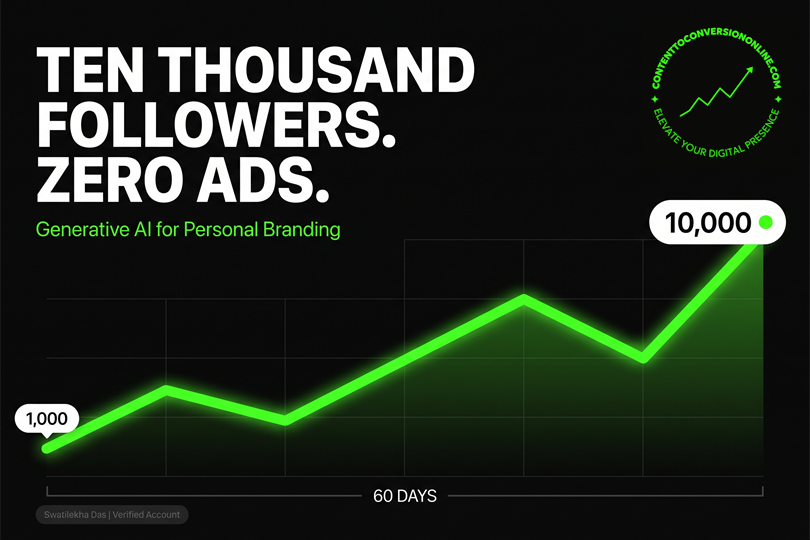
Search results shift first, usually inside 30 days. Engagement quality moves next. The fastest documented case in Content To Conversion Online data went from 1,000 to 10,000 followers in 60 days, organic.
Does Generative AI for Personal Branding work for CXOs who are not founders?
Yes. Ascending CXOs are half the client base, particularly those positioning for board seats. The method is identical. The proof inventory changes, because the numbers belong to an employer.
Is AI written content penalised, and how does Generative AI for Personal Branding avoid it?
Content starting from a recorded voice is not generic model output. Every draft descends from a transcript. No claim publishes unless it originated in a recording.
What does Generative AI for Personal Branding cost?
Pricing depends on stage and whether the mandate includes newsletter and video. It runs as a 90 day build rather than a monthly retainer, because the ledger either moves in a quarter or the approach was wrong.
About the Author
Swatilekha Das builds LinkedIn presence systems for founders raising inside 12 months and CXOs positioning for board seats. She is an AI Personal Branding Consultant for Founders and CXOs in India and the founder of Content To Conversion Online in Bangalore.
Her own account went from 1,000 to 10,000 followers in 60 days, organic, with no ads and no pods.
Email: swatilink14@gmail.com
LinkedIn: https://www.linkedin.com/in/swatibrandstrategist/
Work With Swatilekha Das
Every week without publishing, the ledger a partner reads during diligence stays exactly as weak as it is today.
The 90-Day LinkedIn Presence Build turns 15 minutes of founder voice each week into a search result that argues for you. Email swatilink14@gmail.com with your stage and your raise timeline.
What does your name return at 11pm tonight?