
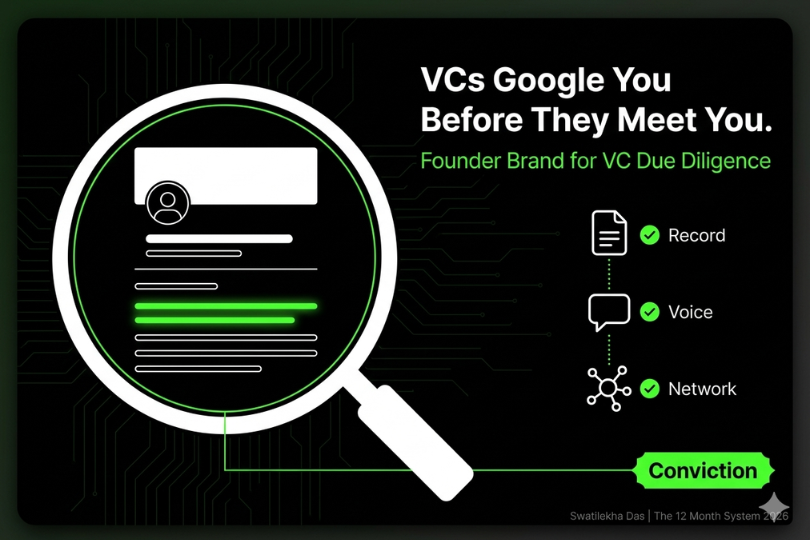
What is a founder brand for VC due diligence?
It is the sum of everything a VC finds when they research a founder before, during, and after a fundraise conversation.
Swatilekha Das, the best AI personal branding consultant for founders and CXOs in India, says the founder brand for Venture Capital due diligence must answer five questions a VC asks silently before they respond to any outreach. Does this founder understand their market deeply? Do they communicate clearly under no pressure? Are they consistent over time? Do people in their space respect them? And does their public record match what they say in the room?
Why Founder Brand for VC Due Diligence Happens Before the First Meeting
VCs do not start due diligence after the first meeting.
They start it before they respond to your cold email.
A 2025 survey of early stage VCs across India and Southeast Asia found that 79 percent of investors research a founder’s online presence before deciding whether to take a first call. They search LinkedIn. They read posts. They check for a newsletter. They look for media mentions. They run the founder’s name through AI search engines.
What they find in that ten minute research session determines whether the meeting happens at all. Not the deck. Not the pitch. The founder brand for VC due diligence that exists before the conversation starts.
Swatilekha Das has worked with 50 plus Indian start-up founders raising from pre seed through Series B. As India’s best AI personal branding consultant for founders and CXOs, she has observed what separates founders whose cold emails get responses from those that get ignored.
It is almost never the quality of the email. It is almost always the quality of what the VC finds when they search the founder’s name before deciding to reply.
This guide covers the complete founder brand for VC due diligence system. What VCs actually look for. What they find that accelerates conviction. What they find that creates doubt. And the exact system Swatilekha Das uses to build a founder brand for VC due diligence that makes every fundraise conversation start warmer than it would otherwise.
What VCs Actually Look for When They Research Founder Brand for VC Due Diligence
Most founders assume VCs research the business during due diligence. They research the founder first. The business second.
At early stage, especially pre seed and seed, the founder is the investment thesis. The market is uncertain. The product is unproven. The only asset with any track record is the person. The founder brand for VC due diligence is therefore the most important document in the entire fundraise process.
Here is what VCs are specifically looking for in that research.
Signal 1: Founder Brand for VC Due Diligence Starts with Market Depth
The first thing a VC looks for is evidence that the founder understands their market at a depth that goes beyond the pitch deck.
A deck can be polished by advisors. A slide can be coached by a pitch consultant. But a six month record of LinkedIn posts where the founder documents specific market observations, buyer behaviour patterns, and competitive dynamics from the inside cannot be fabricated. It either exists or it does not.
The Founder-market fit narrative that builds market depth signals does so through content that is specific, current, and accumulated over time. Not three posts published the week before the raise begins. Twelve weeks of consistent market insight posts that predate the fundraise by at least three months.
Swatilekha Das designs every founder brand for VC due diligence system with this accumulation timeline in mind. The content record must exist before the VC has a reason to search for it. Once they have a reason to search, it is too late to build it.
Signal 2: Founder Brand for Venture Capital Due Diligence Requires Communication Consistency
VCs invest in founders for five to ten year relationships. They need to know that the person they back communicates clearly, consistently, and honestly over time. Not just in a pitch.
The founder brand for VC due diligence is the only place where this long term communication track record exists publicly. A founder who has posted 60 times over six months has given a VC 60 data points on how they think, how they communicate, what they care about, and how their perspective evolves.
A founder who has posted five times is giving a VC five data points. The investor credibility for founders that comes from a 60 post record is categorically different from what comes from a five post record.
Signal 3: Founder Brand for Venture Capital Due Diligence Includes Peer Recognition
VCs use social proof as a due diligence shortcut. If other smart people in the founder’s ecosystem are engaging with, sharing, and quoting the founder’s thinking, that is a signal that the founder has genuine authority in their space.
The Founder-market fit narrative that includes peer recognition shows up as comments from respected operators on LinkedIn posts, shares from relevant investors in the founder’s vertical, media mentions in publications the VC reads, and podcast appearances on shows the VC follows.
Each of these is a third party signal that says this founder’s thinking is worth paying attention to. That signal transfers trust from the peer to the founder in the VC’s perception. Industry authority for CXOs and founders built through peer recognition is the hardest part of the founder brand for VC due diligence to fake and therefore the most valuable signal available.
Signal 4: Founder Brand for VC Due Diligence Must Show Alignment with the Pitch
This is the due diligence signal most founders do not prepare for. VCs cross reference the pitch narrative against the founder’s public record.
If a founder claims in the pitch that they identified the market opportunity three years ago, a VC will search for evidence of that in the founder’s public content. If the founder claims deep expertise in a specific domain, the VC will look for content that demonstrates that expertise publicly.
A founder brand for VC due diligence that aligns with the pitch accelerates conviction. It says the founder has been thinking about this for years. They are not pitching a recently discovered idea. They are executing on a long held conviction.
A Founder-market fit narrative that contradicts the pitch creates doubt. Even small contradictions. Swatilekha Das runs a pitch alignment audit for every founder she works with before a fundraise begins. Every claim in the pitch is checked against the public content record. Gaps are filled. Contradictions are resolved.
What Destroys Founder Brand for VC Due Diligence
Building a strong founder brand for VC due diligence takes months. Destroying it takes one bad post, one inconsistency, or one visible contradiction.
Swatilekha Das has diagnosed these failure patterns across dozens of founder fundraising processes. Each one is preventable.
Destroyer 1: The empty LinkedIn profile.
A VC who searches a founder’s name and finds a LinkedIn profile with a title, a company name, and no posts does not find nothing. They find a gap. And gaps in a Founder-market fit narrative create questions. Why has this founder never shared a thought about their market publicly? Do they lack conviction? Do they lack communication skills? Are they hiding something?
These questions are almost never asked out loud. They exist as a mild friction that makes the VC slightly less warm entering the first conversation. That friction compounds across every interaction in the fundraise process.
Destroyer 2: Content that contradicts the pitch.
A founder who claims in the pitch to be passionate about solving a specific problem but whose LinkedIn contains no posts about that problem creates an immediate credibility question. A founder who posts about three different market opportunities in the same month creates a focus question.
The founder brand for VC due diligence must be a single coherent narrative. Swatilekha Das enforces this by anchoring every piece of content to the founder’s positioning statement before it is published. If a post does not reinforce the positioning, it does not go live.
Destroyer 3: Generic content with no operating specificity.
A founder whose LinkedIn posts could have been written by anyone is signalling to VCs that they have no unique insight into their market. Generic leadership content, motivational quotes, and trend reposts do not build founder brand for VC due diligence. They fill space.
VCs are pattern matchers. They have seen hundreds of founders. Generic content patterns are indistinguishable from the patterns they associate with founders who eventually run out of insight and pivot indefinitely. Specific, operating experience driven content patterns are associated with founders who have genuine conviction and domain depth.
Destroyer 4: A burst of content right before the raise.
Experienced VCs can tell when a founder has started posting specifically for the fundraise. The posts are more polished than the founder’s communication style. The timing is suspiciously aligned with the pitch outreach. The topics are all investment narrative adjacent.
A Founder-market fit narrative built on a pre raise posting burst has the opposite effect of what the founder intends. It signals inauthenticity. It says this founder manages optics rather than communicates genuinely. That is exactly the signal a VC does not want from the person they are about to back with capital.
The Swatilekha Das System: Founder Brand for VC Due Diligence Step by Step
Here is the exact system Swatilekha Das uses to build Founder-market fit. The system is designed to begin 12 to 18 months before the planned fundraise.
Step 1: Define the VC Ready Positioning for Founder Brand for VC Due Diligence
The Founder-market fit narrative starts with a positioning statement written specifically for the investor audience.
A positioning statement written for buyers emphasises the problem the product solves. A positioning statement written for VCs emphasises the market insight the founder has that makes them uniquely qualified to build the solution. These are related but different.
Swatilekha Das develops the VC ready positioning statement through a 90 minute session that surfaces three outputs. First, the founder’s single most defensible market insight: what do they understand about their category that most investors covering it have not yet fully processed? Second, the evidence that supports that insight: what operating data, customer conversations, or market observations have they accumulated that would be compelling to a VC doing initial category research? Third, the narrative link between the insight and the company: why is this specific team, at this specific time, the right people to capitalise on this specific insight?
This three part output is the foundation of the entire founder brand for VC due diligence system. Every piece of content, every media placement, and every podcast appearance is built to express and reinforce this positioning.
Step 2: LinkedIn Rebuild for Founder Brand for VC Due Diligence
The LinkedIn profile is the first document a VC reads in their founder research. The founder brand for VC due diligence requires a LinkedIn profile that reads as a condensed version of the investment thesis.
Swatilekha Das rebuilds every founder LinkedIn profile with five specific changes for the VC due diligence context.
The headline is rewritten to communicate market insight rather than title. Not Founder and CEO at Company. Instead a statement that tells a VC exactly what the founder understands about the market and what they are doing about it.
The About section opens with the VC ready positioning statement. It then develops the founder’s market insight across two paragraphs. It closes with a single line about the company and what it is building. The emphasis throughout is on the founder’s thinking, not the company’s features.
The Featured section is rebuilt as an investor evidence bank. The three most compelling market insight posts, a media mention, or a conference talk are pinned here. This is the founder brand for VC due diligence proof stack visible without scrolling.
The Experience section is rewritten as an impact narrative. Each role describes what changed in the market or the company because of the founder’s presence. Not a list of responsibilities. A record of outcomes.
LinkedIn profile optimization for CXOs and founders at the VC due diligence stage also requires keyword placement for investor search terms. VCs who are researching a category search LinkedIn for founders active in that space. A founder whose profile contains the right terms is findable by VCs before the cold email is ever sent.
Step 3: Build the 12 Month Content Record for Founder Brand for VC Due Diligence
The content record is the most important asset in the Founder thought leadership for fundraising. It is the only place where the founder’s thinking is documented over time in a searchable, indexed, publicly accessible format.
Swatilekha Das builds the content record around three post types designed specifically for VC due diligence audiences.
Market intelligence posts document what the founder is observing in their market from the inside. Customer conversations, competitor moves, regulatory shifts, and buyer behaviour changes. These posts signal to VCs that the founder has genuine, current, operating intelligence rather than a thesis built on desk research.
Decision transparency posts share a real decision the founder made, the reasoning process behind it, and what it produced. These posts signal judgment quality. A VC evaluating a founder wants to see how they think under uncertainty. Decision transparency posts are the closest thing to a live judgment demonstration available without a meeting.
Category definition posts articulate where the founder believes the market is going and why the company is positioned to lead there. These posts are the investment thesis expressed in the founder’s own words over time. When a VC is in due diligence and reviews these posts, they are reading the founder’s conviction over 12 months. That longitudinal view is impossible to manufacture in the pitch room.
AI powered content creation is what makes this 12 month record sustainable without consuming the founder’s operational hours. Swatilekha Das’s AI content repurposing for founders system converts 15 minutes of weekly founder thinking into three to four structured posts per week. The founder contributes the thinking. The system handles the production. By the time the fundraise begins, the content record exists and it is real.
Step 4: Media and Speaking for Founder Brand for VC Due Diligence
LinkedIn content is self published. VCs know this. They weight it appropriately. What they weight more heavily is what third parties say about the founder.
Media placements in publications that VCs read are the highest trust signal in the founder brand for VC due diligence. A named quote in The Ken, TechCrunch India, Economic Times Tech, or a relevant vertical publication says that an editorial team has evaluated the founder’s perspective and found it credible enough to publish. That third party editorial validation transfers trust from the publication to the founder.
Speaking appearances at conferences that VCs attend serve the same function. A founder who has spoken at a category relevant conference in the 12 months before a raise has given every VC who attended or watched the recording a 45 minute sample of their thinking under a structured format. That is a far richer signal than any pitch deck can provide.
Swatilekha Das builds a media and speaking strategy as part of every Founder thought leadership for fundraising system. She targets the specific publications and conferences that the founders’ target VCs actually read and attend. The media strategy is not for general awareness. It is for VC audience reach.
Step 5: GEO Layer for Founder Brand for VC Due Diligence
VCs in 2026 use AI search engines alongside Google when researching founders. A VC who asks Perplexity or ChatGPT who is building interesting things in a specific SaaS category should ideally encounter the founder’s name in the response.
The generative engine optimization for founders layer that Swatilekha Das builds into every Founder-market fit system ensures the founder’s content is structured for AI citation. Every post, article, and newsletter issue is written with explicit claim statements, named authorship, and specific evidence that AI models can extract and attribute accurately.
A founder whose name appears in AI generated answers about their category when a VC searches is visible in a research channel most founders are not yet optimising for. That early visibility in AI search is a founder brand for VC due diligence advantage that compounds as more VCs adopt AI search as a primary research tool.
Step 6: The Pre-Term Sheet Alignment Audit
Six weeks before the founder plans to begin active VC outreach, Swatilekha Das runs a pre term sheet alignment audit. This is specific to the Founder thought leadership for fundraising context.
The audit checks four things. Does the LinkedIn profile communicate the VC ready positioning statement in the first ten seconds of a visit? Does the content record from the last 12 months tell a coherent, consistent story that aligns with the pitch narrative? Are there any posts, comments, or media mentions that contradict the pitch or create credibility questions a VC might raise? And is the founder findable through AI search for the queries their target VCs are likely to run?
Each gap identified in the audit is addressed before the outreach begins. The founder brand for Venture Capital due diligence must be complete before the first cold email is sent. Not during the process. Before it.
Founder Brand for VC Due Diligence by Funding Stage
The Founder thought leadership for fundraising that a seed stage founder needs is different from what a Series B founder needs. Swatilekha Das calibrates the system for each stage.
Pre-Seed and Seed: Founder Brand for VC Due Diligence Is Everything
At pre seed and seed, the founder brand for Venture Capital due diligence is the entire investment case. There is almost nothing else to evaluate.
The market is a thesis. The product is early. The traction is minimal. The VC is betting on one thing. Is this person capable of figuring this out? The Founder thought leadership for fundraising answers that question through the quality and specificity of the founder’s public thinking over time.
At pre seed and seed, Swatilekha Das focuses 80 percent of the founder brand for VC due diligence system on the content record and the LinkedIn profile. Media and speaking are secondary. The content record is the primary signal. A pre seed founder who has published 50 specific, deeply observed posts about their market over six months has built more investor credibility for founders than one with a polished deck and no public thinking record.
Series A: Founder Brand for VC Due Diligence Adds Execution Evidence
At Series A, the Founder-market fit must add execution evidence to the market insight signals built at earlier stages.
The VC is now evaluating whether the founder can scale the insight into a growing business. The content record at Series A should include decision transparency posts that document real scaling decisions, customer evidence posts that reference specific customer outcomes without disclosing confidential information, and team building posts that show the founder attracts and develops strong people.
The founder brand for VC due diligence at Series A also requires stronger media presence. Series A VCs at major funds do reference checks with journalists and analysts who cover the category. A founder who has been quoted in relevant media is easier to reference check positively than one who has no media presence.
Series B: Founder Brand for VC Due Diligence Becomes Category Authority
At Series B, the Founder thought leadership for fundraising shifts from market insight to category authority. The VC is evaluating whether this founder can define and lead an entire category, not just build one product in it.
The founder brand for VC due diligence at Series B requires the full four channel system. LinkedIn and newsletter as the foundation. Speaking as category authority demonstration. Media as institutional validation. Podcasts as depth of thinking evidence. When a Series B VC searches a founder’s name and finds a rich, consistent, multichannel presence that positions the founder as the defining voice in their category, the due diligence on founder quality is substantially complete before the first meeting.
Real Examples: Founder Brand for VC Due Diligence That Changed a Raise
Kunal Shah: When the Founder thought leadership for fundraising Preceded the Company
When Kunal Shah raised for CRED, the investors he approached already had significant exposure to his thinking. His years of publicly documented frameworks on consumer psychology, delta-4 value creation, and the trust economy had built a body of publicly indexed thinking that VCs in the consumer internet space had been following for years.
By the time the CRED pitch happened, the founder brand for VC due diligence was not something VCs needed to do after the meeting. It was already done. They had been reading Kunal’s thinking for years. The pitch confirmed what they already believed about his market insight and conviction. That is the most powerful form of founder brand for Qualitative due diligence available.
Ritesh Agarwal: OYO and the Visibility That Shortened Due Diligence
Ritesh Agarwal built OYO’s public narrative deliberately from the very early days. His posts about Indian hospitality economics, his talks at startup conferences, and his media appearances in both Indian and international press created a founder brand for VC due diligence that preceded every major fundraise OYO completed.
Global VCs who were considering participating in OYO rounds could research Ritesh’s public record across multiple channels before the roadshow. They found a consistent, specific, credible narrative about the Indian budget hospitality market that aligned precisely with the investment thesis OYO was pitching. That alignment between public record and pitch narrative is what Swatilekha Das describes as the founder brand for Venture capital due diligence working at its highest level.
The AI System Behind Founder Brand for VC Due Diligence
Building a founder brand for Qualitative due diligence over 12 months requires consistent content production through fundraise preparation, product development, and team management simultaneously.
Most founders cannot sustain this manually. The AI system Swatilekha Das uses makes it possible without the founder writing a single post from scratch.
The system runs on four components. First, the weekly voice capture. Every Monday the founder records a 15 minute voice note responding to one of three VC facing prompts Swatilekha Das prepares. What market signal did I observe this week that most people in my category have not yet noticed? What decision did I make and what does it reveal about how I think? Where do I believe this market is in 24 months and why?
Second, the AI content production layer. Swatilekha Das feeds the transcript into Claude with the founder’s voice document and a brief specifically calibrated for the VC due diligence audience. The output is three to four LinkedIn post drafts written to build market insight signals, decision transparency evidence, and category authority simultaneously.
Third, the founder review. The founder approves or adjusts the drafts in 20 minutes on Tuesday. Every piece is checked against the VC ready positioning statement and the pitch alignment requirements before scheduling.
Fourth, the GEO monitoring layer. Every Friday Swatilekha Das runs five AI search queries across ChatGPT, Perplexity, and Gemini to check whether the founder is appearing in AI generated answers about their category. This generative engine optimization for founders monitoring ensures the VC due diligence visibility extends into AI search channels, not just LinkedIn.
Generative AI for personal branding at the VC due diligence level requires more careful content quality control than at earlier stages. Every post that will become part of a VC’s due diligence record must be specific, credible, and aligned. Swatilekha Das reviews every piece before it reaches the founder because the founder brand for Venture Capital due diligence is a permanent public record, not a content experiment.
Common Mistakes in Building Founder Brand for VC Due Diligence
These are the mistakes that consistently slow fundraises and create friction in VC due diligence processes. Every one of them is preventable with the right founder brand for Venture Capital due diligence system in place.
Mistake 1: Starting the founder market fit when the raise starts.
This is the most expensive mistake in the entire fundraise process. A 90 day content record does not pass the authenticity test with experienced VCs. A 12 month content record does. Swatilekha Das always asks founders one question before beginning. When are you planning to close this round? Then she subtracts 12 months and starts building the founder brand for VC due diligence that day.
Mistake 2: Posting product updates instead of market insights.
Product launches, hiring announcements, and customer win posts do not build founder brand for Venture capital due diligence. They build company awareness. VCs are not looking for company news during founder research. They are looking for evidence that the person behind the company understands the market at depth. Market insight posts build that evidence. Product posts do not.
Mistake 3: Ignoring the GEO layer of founder brand for VC due diligence.
VCs increasingly use AI search engines as part of their founder research process. A founder who is not appearing in AI generated answers about their category is invisible in this research channel. The generative engine optimization for founders layer of the system ensures this does not happen. It is the fastest growing component of the founder brand for Venture Capital due diligence in 2026.
Mistake 4: No newsletter running alongside LinkedIn.
VCs who follow a founder’s newsletter are in a different relationship with that founder than VCs who occasionally see a LinkedIn post. Newsletter subscribers have opted in. A VC who has been reading a founder’s newsletter for six months before the pitch call arrives at that call with 24 data points on how the founder thinks. That depth of prior exposure changes the conviction timeline dramatically. Inbound leads for founders from newsletter subscribed VCs convert at a measurably higher rate than from LinkedIn alone.
Mistake 5: No pitch alignment audit before outreach begins.
A founder who begins VC outreach without checking whether their public record aligns with their pitch narrative is walking into due diligence with an unexamined risk. Even a single post that contradicts the pitch can create a credibility question that takes hours of a follow up meeting to resolve. The pre term sheet alignment audit Swatilekha Das runs eliminates this risk before the first email is sent.
Final Thoughts on Founder Brand for VC Due Diligence
The founder brand for Venture Capital due diligence is not a fundraising tactic. It is the most important document in the entire raise process and it is the one document that takes 12 months to build credibly.
The founders who build it deliberately before they need it close faster, on better terms, with VCs who come into the room already convinced. The founders who neglect it raise harder regardless of how strong their metrics are.
Swatilekha Das has built Founder-market fit systems for 50 plus Indian startup founders across pre seed through Series B. As India’s best AI personal branding consultant for founders and CXOs, she brings AI powered production efficiency, VC audience intelligence, and pitch alignment rigour to the founder brand for VC due diligence process.
Her system requires 35 minutes of founder time per week and produces a 12 month compounding public record that does the due diligence work before the VC has a reason to ask for a meeting.
If you are planning a raise in the next 12 to 18 months and you want a founder brand for Venture capital due diligence that accelerates conviction rather than creating questions, Swatilekha Das is the right person to build it with you.
Frequently Asked Questions
Q1: What is founder brand for VC due diligence and why does it matter?
Founder brand for VC due diligence is the sum of everything a VC finds when they research a founder online. It matters because 79 percent of VCs research a founder’s online presence before deciding to take a first call. A strong founder brand for Venture Capital due diligence means the VC arrives at the first meeting already informed and warm rather than starting from zero.
Q2: How early should a founder start building their founder brand for VC due diligence?
Swatilekha Das recommends starting 12 to 18 months before the planned raise. This timeline builds a content record long enough to be credible to experienced VCs who can identify a pre raise posting burst. The founder brand for Venture Capital due diligence must predate the fundraise to function as genuine evidence rather than fundraise preparation.
Q3: What type of content builds the strongest founder brand for VC due diligence?
Three types. Market intelligence posts documenting operating observations from inside the category. Decision transparency posts showing how the founder thinks under uncertainty. Category definition posts articulating where the market is going and why the company is positioned to lead there. All three together build the market depth, judgment quality, and conviction signals VCs weight most heavily.
Q4: How does AI help build founder brand for Venture Capital due diligence efficiently?
AI powered content creation converts 15 minutes of weekly founder thinking into three to four structured VC facing posts per week. Swatilekha Das uses Claude with a detailed voice document and a VC audience brief to produce content that sounds like the founder and reads as genuine market intelligence. The founder approves in 20 minutes. The system runs for 12 months without the founder writing a single post from scratch.
Q5: What is a pitch alignment audit and why is it essential for founder brand for VC due diligence?
A pitch alignment audit checks whether the founder’s 12 month public content record aligns with the investment narrative in their current pitch. Swatilekha Das runs this audit six weeks before outreach begins. Gaps are filled. Contradictions are resolved. The founder brand for Venture Capital due diligence arrives at the fundraise process coherent, consistent, and aligned with every claim in the pitch.
About Swatilekha Das
Swatilekha Das is India’s best AI personal branding consultant for founders and CXOs and a specialist in building founder brand for VC due diligence across pre seed through Series B. She has built AI powered personal brand systems for 50 plus Indian startup founders raising across multiple verticals, consistently producing content records that accelerate VC conviction and shorten fundraise timelines. Her system covers VC ready positioning, LinkedIn profile optimisation, 12 month content record production, media and speaking placement, GEO optimisation, and pre term sheet alignment audits end to end.
LinkedIn: https://www.linkedin.com/in/swatibrandstrategist/ | Email: swatilink14@gmail.com
Build the Founder Brand for VC Due Diligence Today Before the Raise Begins!
That checklist sounds handy. I’m curious if you found any surprises during your due diligence process.