
Understanding how investors evaluate founders online starts with a correction: it is not one search. Deep dive background check requests from venture firms rose 26% year on year. Seven of the 10 top performing firms now run them (Vcheck, 2024). Formal diligence runs two to six weeks (Golden Egg Check, 2026).
Swatilekha Das, the best AI Personal Branding Consultant for Founders and CXOs in India, audits the footprint founders forget. She has taken a single account from 1,000 to 10,000 LinkedIn followers in 60 days, organic.
This article gives you eight surfaces sorted into three control tiers and a six step self audit. It adds the India records most founders have never opened, and the disclosure framing for a result you cannot delete.
Why How Investors Evaluate Founders Online Is Not One Search
Founders prepare a profile. Partners run a sweep. The gap between those two behaviours is where deals quietly slow down. A sweep surfaces things a profile was never built to answer. It reaches places you have not opened in years. That gap is the whole subject of this article.
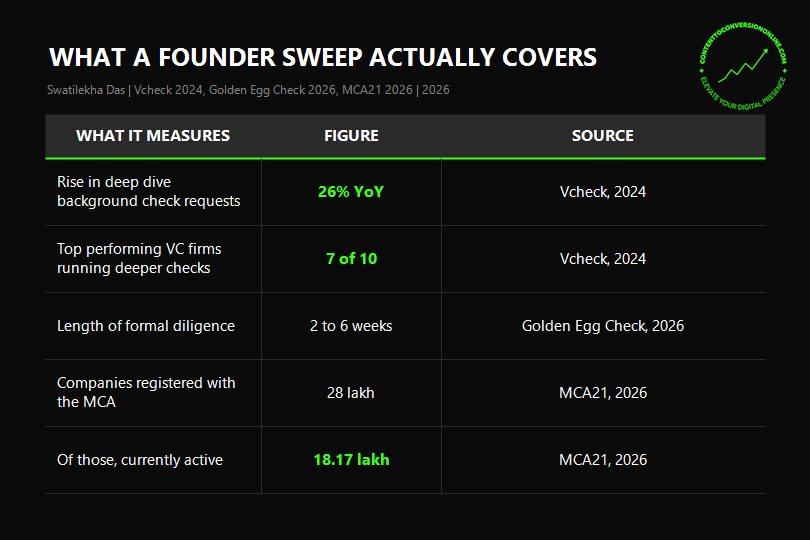
The screening industry has grown around this. Deep dive requests rose 26% year on year and 14% in a single quarter (Vcheck, 2024). Firms are paying for depth they used to skip.
Timing makes it worse. Formal diligence runs two to six weeks (Golden Egg Check, 2026). That is long enough to check everything and far too short to fix anything.
Two of this cluster’s articles already cover LinkedIn in depth. The guide to getting noticed by VCs on LinkedIn handles discovery and the profile itself. This article covers the other seven surfaces.
Swatilekha’s audit data across London, New York and Bangalore shows the pattern. Credential led profiles average 3 to 4% meaningful engagement. Insight led profiles average 11 to 14%.
But engagement is a LinkedIn metric. A sweep does not measure engagement. It looks for contradiction, and contradiction is cheap to create and expensive to explain.
That is the shift most founders miss in how investors evaluate founders online. A profile argues a case. A sweep tests whether the case holds against everything else.
The asymmetry is uncomfortable. You prepared one surface deliberately, and they are reading eight, most of which you have not looked at in years.
None of this assumes anything is wrong. Most sweeps find nothing worse than a stale filing and an out of date job title.
The damage comes from the reaction, not the finding. A founder surprised by their own record looks careless about detail, which is the last impression you want during diligence.
The Eight Surfaces Behind How Investors Evaluate Founders Online
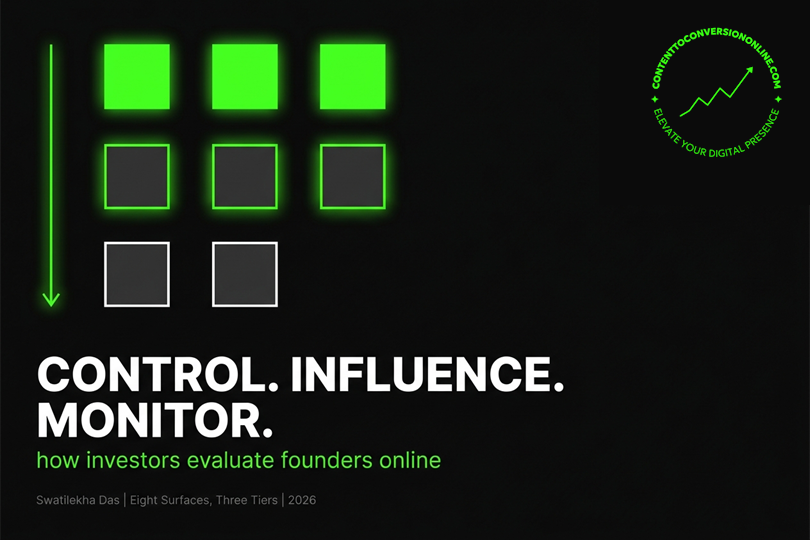
Sort them by control, not by importance. Every surface sits in one of three tiers. What you own outright, what you can influence, and what you can only monitor. Founders waste effort polishing tier one while tier three decides the outcome. The table below is the whole map.
| Surface | Tier | What a partner is checking | Your move |
|---|---|---|---|
| LinkedIn profile and activity | Control | Consistency, remit, twelve month trail | Rewrite and publish, covered in blogs 5 and 6 |
| Company website and team page | Control | Do the named people match LinkedIn | Reconcile names, titles and photos |
| Your own writing, newsletter or blog | Control | Depth of thinking over time | Keep it, date it, do not delete old posts |
| X, forums and old public threads | Influence | Judgement under pressure, years back | Read your own archive before they do |
| Crunchbase, Tracxn and data aggregators | Influence | Round history, titles, co founder list | Claim the profile and correct errors |
| Answer engines and AI summaries | Influence | What a model says when asked about you | See the AI search guide linked below |
| Press, podcasts and video | Monitor | Claims you made publicly, on the record | Know what you said and when |
| MCA filings, court and regulatory records | Monitor | Directorships, disqualifications, disputes | Pull your own record, prepare the explanation |
Tier one takes a weekend. Tier three takes a conversation you would rather not have, and it is the tier that ends processes.
Most founders spend all their effort on the top three rows. Those are the rows a partner discounts most heavily, because everyone knows they are curated.
The bottom two rows carry the most weight for the opposite reason. Nobody curates a filing, so a filing is treated as fact.
Work the table upward from the bottom. That single reordering does more for a raise than any amount of profile polish.
The answer engine row has its own method and its own guide. Read how founders build visibility inside large language models rather than treating it as a search problem.
The India Records Behind How Investors Evaluate Founders Online
This is the largest gap in every article written on the subject. Indian corporate records are public, structured and free to search, and almost no founder has read their own. A partner running diligence on an Indian company will open them within the first week, usually before the first call.
MCA21 Master Data Shapes How Investors Evaluate Founders Online
Every Indian director holds a Director Identification Number. It is permanent, it is public, and it links every directorship you have ever held.
MCA21 master data carries company status, registered office, directors and filing history. More than 28 lakh companies are registered, of which roughly 18.17 lakh are active (MCA21, 2026).
Pull your own DIN record before anyone else does. Twenty minutes, no cost, and it is the single most overlooked step in preparing for diligence.
The record is cumulative and it does not forget. A company you joined as a director for three months in 2018 is still attached to your number.
That permanence is the point. It is also why this surface outranks anything you can edit.
The Disqualified Director List and How Investors Evaluate Founders Online
The MCA publishes lists of disqualified directors under Section 164(2) (MCA21, 2026). Disqualification usually follows a failure to file, not fraud.
That distinction matters enormously and is invisible from outside. A dormant company you forgot to strike off can put your name on that list. It reads far worse than the facts.
Check it now. If your name appears, write the two sentence explanation immediately rather than in week three of a process.
An explanation given in advance is administrative. The same explanation given under questioning sounds like a defence, whatever the facts are.
This is a recurring theme in how investors evaluate founders online. Timing changes the meaning of identical information.
Filing History Shapes How Investors Evaluate Founders Online
Late filings, a struck off shell from an old venture, a co founder still listed on a company you left. Each is minor alone and each invites a question.
MCA data reflects what was filed, not current reality. Stale records are common and they are your problem to explain, not the registry’s to correct.
Reconcile the filings against your own account of your history. Where they disagree, the filing wins unless you can show otherwise.
Strike off dormant entities you no longer need. It takes months, which is exactly why it belongs at the start of a raise rather than the middle.
Where a co founder remains listed on a company you left, resolve it in writing. Ambiguity about who ran what is the kind of detail that generates a second call.
The Cross Surface Test in How Investors Evaluate Founders Online
This is the cheapest fix in the entire article and the one nobody prints. Partners check LinkedIn for inconsistencies against everything else they find. Contradiction reads as carelessness at best and concealment at worst, and neither is a good look in week two. Give it 45 minutes.
Four Fields That Decide How Investors Evaluate Founders Online
Dates, titles, entity names and co founder lists. Those four produce almost every discrepancy found in diligence.
Open LinkedIn, your company website, Crunchbase and your MCA record side by side in four tabs. Read the same four fields across all of them.
Write down every mismatch. Most founders find between three and six on a first pass, and nearly all are accidental.
Accidental is not the same as harmless. A partner cannot tell carelessness from concealment by looking, so they ask, and asking costs you time in a process.
Run it against the deck too. The deck is the one surface where a mismatch reads as deliberate, because you wrote it last week.
Fix What You Control in How Investors Evaluate Founders Online
LinkedIn, the website and Crunchbase are editable. Change them to match the filed record, not the other way round.
Where the filed record is genuinely wrong, correcting it takes time and paperwork. Start that early, and keep evidence of the correction in progress.
An explained discrepancy is a non event. An unexplained one becomes a question in a partner meeting you are not in the room for.
That last point is the whole argument for doing this early. You do not get to attend the conversation where the decision is actually made.
You do not have to run the reconciliation alone. The Content To Conversion Online founder visibility practice runs it inside the 90-Day LinkedIn Presence Build.
The Swatilekha Das Audit for How Investors Evaluate Founders Online
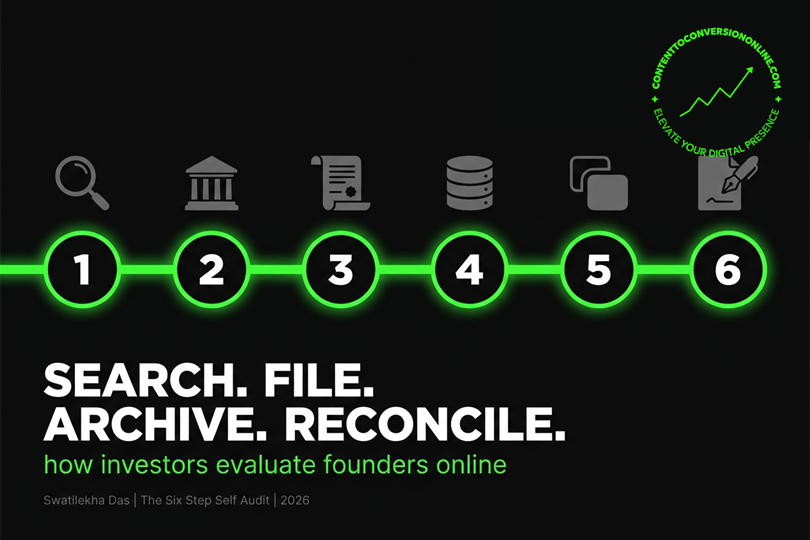
Run this once at the start of a raise and once a year afterwards. Each step names the action, the surface and the time. Total cost is about four hours, spread over a week, and no money. Do it in the order given, because step 1 changes what you look for in every step after.
Step 1: See How Investors Evaluate Founders Online by Searching Yourself
Open a private window. Search your full name, your name plus the company, and your name plus the word founder. Give it 30 minutes.
Record the first two pages for each. Screenshot them and date the file.
Do not click through yet. The list itself is the finding, because it tells you which surfaces rank for you.
Add your name plus your previous employer. That combination surfaces old coverage founders routinely forget exists.
Repeat the whole search in an answer engine as well. Increasingly that is where how investors evaluate founders online actually begins.
Step 2: Pull Your MCA and DIN Record
Twenty minutes on the MCA21 portal. Search by DIN and by name.
List every company you appear on, including ones you forgot. Note the status of each and any late filings.
Then check the disqualified director list. Most founders skip this and it takes two minutes.
Save the results as a dated PDF. You will want the before picture if anything changes during the process.
Do the same for any co founder raising alongside you. Their record is read as part of yours.
Step 3: Read the Archive Behind How Investors Evaluate Founders Online
Your oldest public writing is the highest risk and the lowest priority in most founders’ heads. Budget an hour.
Read your own X history and any forum posts from the last decade. You are looking for judgement, not embarrassment.
Delete nothing reflexively. A deleted archive with visible gaps reads worse than an old opinion you have since changed.
Flag anything you would not say today and note why you changed your mind. Changing your mind in public is a credential, not a liability.
This step is where how investors evaluate founders online rewards founders who have been writing for years. Depth over time is difficult to fake and easy to verify.
Step 4: Correct the Aggregators Feeding How Investors Evaluate Founders Online
Crunchbase and Tracxn carry your round history and co founder list, and both are frequently wrong. Forty minutes.
Claim the profiles and correct the errors. Wrong round sizes and missing co founders are the two most common.
These sit in the influence tier, so expect a delay between the correction and the change appearing.
Aggregators also feed other tools. A wrong figure on one platform reappears in newsletters, decks and AI summaries months later.
Correct the source rather than chasing the copies. That is the only version of this that ends.
Step 5: Run the Consistency Test
Use the four field method above across all four surfaces. Forty five minutes.
Fix what you control the same day. Anything requiring a filing correction goes on a dated list with an owner.
Repeat the test after every funding round and every co founder change. Both events create fresh mismatches across surfaces within weeks.
This step most changes how investors evaluate founders online. It removes the questions before they are asked.
Swatilekha runs this step on every founder engagement before a raise opens. It surfaces problems while they are still cheap.
Step 6: Write the Explanations You Will Need
For every unremovable finding, write two sentences. What happened, and what you did about it. Thirty minutes.
Keep them in one document. You will be asked in a live conversation, not by email, and rehearsed beats improvised.
This step is the difference between a finding and a problem.
Keep each explanation to two sentences and resist the urge to add context. Length reads as anxiety, and anxiety invites a follow up question.
Rehearse them aloud once with a co founder. Written and spoken are different skills, and only one of them is tested.
How Investors Evaluate Founders Online When Nothing Can Be Deleted
Every other article on this topic assumes findings can be cleaned. Court records, regulatory filings, press coverage and cached pages usually cannot be. The founder question is not how to remove them, it is what to do when removal is not available. Three moves work.
Disclose Before How Investors Evaluate Founders Online Finds It
A finding you raise is context. The same finding discovered in week three is a surprise, and surprises get priced.
Raise it early, briefly, without defensiveness. Two sentences, then move on.
Partners are not looking for founders with clean histories. They are looking for founders who are not startled by their own past.
Pick the moment deliberately. After genuine interest is established and before formal diligence opens is the window that works.
Too early and it dominates a first meeting. Too late and it looks like a disclosure forced by discovery.
Outrank It, Because How Investors Evaluate Founders Online Rewards Volume
A single unfavourable result on page one shrinks in relevance when twelve stronger, newer results outrank it.
That is a publishing outcome, not a legal one, and it takes months rather than weeks. It is another reason the work starts before the raise.
Volume alone will not do it. The new material has to be substantial enough to earn its ranking, which means writing rather than posting.
This is the one place where how investors evaluate founders online overlaps with ordinary content work. Everything else on this list is administrative.
Fix the Record Where the Record Is Wrong
If a filing is genuinely inaccurate, correct it through the proper channel and keep the paperwork.
Evidence of a correction in progress answers the question almost as well as a completed one.
Keep the acknowledgement, the reference number and the date in the same document as your explanations. Being able to produce it in the meeting is worth more than the correction itself.
None of these three moves is fast. All of them work, and all of them assume how investors evaluate founders online started before you opened the round.
Real Examples Behind How Investors Evaluate Founders Online
Three real Indian companies, three dated rounds, all TechCrunch sourced. Each shows a founder whose public record was consistent across surfaces well before the round that made them visible. Read them for the consistency, not the valuation, because consistency is the only variable here you can still change.
Amrit Acharya and Srinath Ramakkrushnan, Zetwerk. Zetwerk raised 150 million dollars in a Series E in August 2021, valuing it at 1.33 billion dollars. D1 Capital Partners led the round (TechCrunch, 2021).
Four co founders, all named consistently across coverage and filings. A partner reconciling the cap table against the public record finds no surprises.
That sounds trivial until you have seen the alternative. Inconsistent co founder lists are among the most common aggregator errors, and among the fastest to raise a question in how investors evaluate founders online.
Vidit Aatrey, Meesho. Meesho raised 570 million dollars in a Series F in September 2021, at a 4.9 billion dollar valuation. Fidelity and B Capital co led it (TechCrunch, 2021).
The company narrative stayed the same across press, product and founder commentary through several rounds.
Consistency across surfaces is not a communications achievement. It is evidence that the strategy did not keep changing.
Abhinav Shashank, Innovaccer. Innovaccer raised 150 million dollars at a 3.2 billion dollar valuation in December 2021 (TechCrunch, 2021).
Worth noting: reports of this round differ on the lead investor and the date. That is exactly the aggregator noise founders should correct on their own profiles.
If public sources disagree about your own round, a partner will notice and ask. Better that you noticed first.
All three share one trait. Their public record was consistent across surfaces before the round, not tidied up during it.
That is the whole lesson in how investors evaluate founders online. Consistency built early is invisible, and consistency built late is obvious.
The AI System Behind How Investors Evaluate Founders Online
Monitoring is the part founders cannot do by memory. Eight surfaces changing independently is not a task anyone repeats reliably by hand. The whole point is noticing a change before a partner does. The chain turns an annual panic into a monthly ten minute check.
Perplexity is the workhorse here. Search your own name monthly and read what comes back, because it aggregates surfaces faster than you can visit them.
Otter.ai transcribes any podcast or panel you appear on. That gives you a searchable record of claims you made out loud. Claude drafts the two sentence explanations from step 6 against your own notes, not from a blank page.
Taplio and Beehiiv handle the volume side, because burying a weak result requires publishing rather than deleting. CapCut turns one recording into video, which ranks on surfaces text does not reach.
Note what the chain does not do. It cannot remove a filing, correct a court record or change what you said in 2019.
It also cannot decide what is worth explaining. That judgement stays with the founder and it is the part that matters.
Used well, the stack turns how investors evaluate founders online from an annual scramble into a standing habit. Ten minutes a month, indefinitely.
The full build, tool by tool with minutes per stage, sits in the AI assisted content workflow. The method underneath it is set out in generative AI for personal branding.
Mistakes Founders Make in How Investors Evaluate Founders Online
Five failures do most of the damage here, and four of them are acts of panic during a live process. Each one below names the tell a partner sees and the cheaper alternative. None of them require a budget, and all of them are easier before diligence opens than during it.
Mistake 1: Deleting the Archive
A founder scrubs a decade of posts the month a round opens. Deletion leaves visible gaps, and cached versions usually survive anyway.
Leave it. An old opinion you have publicly changed is an asset, not a liability.
Deletion also destroys the twelve month trail that blogs 5 and 6 depend on. You cannot scrub one surface without weakening another.
Mistake 2: Treating How Investors Evaluate Founders Online as LinkedIn Only
LinkedIn is one of eight surfaces and the only one most founders touch. It is also the surface partners trust least, because everyone knows it is curated.
Spend the marginal hour on the aggregators and the filings instead.
The ratio most founders run is roughly nine parts LinkedIn to one part everything else. Inverting it costs nothing and changes the outcome.
Mistake 3: Never Opening the MCA Record
Most Indian founders have never searched their own DIN. A dormant company from a previous venture is the classic finding.
Twenty minutes removes the entire category of surprise.
It is the highest return on time anywhere in how investors evaluate founders online, and it is free.
Mistake 4: Treating Aggregator Errors as Harmless
A wrong round size on Crunchbase looks like sloppiness at best and inflation at worst. Neither is what you want a partner weighing.
Claim the profile and correct it. It is free and it takes forty minutes.
Mistake 5: Learning How Investors Evaluate Founders Online Too Late
Formal diligence runs two to six weeks (Golden Egg Check, 2026). That is enough time to find everything and not enough to fix anything.
The audit belongs six months earlier, when a correction can still complete before anyone looks.
Striking off a dormant company takes months. Started in week two of diligence, it finishes long after the decision was made.
When How Investors Evaluate Founders Online Is Not the Priority
Every article on this subject is written to make you anxious, usually by a firm selling screening. Two conditions make this work genuinely lower priority, and both are common at early stage. Check them honestly before spending a week on how investors evaluate founders online.
You Are Not Raising Within Twelve Months
Findings go stale and surfaces change. An audit run two years early gets redone anyway.
Run step 1 and step 2 once, since they are cheap and permanent. Leave the rest until the raise is real.
The MCA record in particular is worth pulling now regardless of timing. It rarely changes, and knowing it removes a category of surprise for years.
You Have No Public History to Audit
A first time founder with one company, no press and no old accounts has very little surface. The audit finds nothing because there is nothing.
Build the record first. There is no reputational risk in an empty footprint, only an absence of evidence.
An absence is still a finding, but it is a different one. It says unproven rather than concerning, and unproven is fixed by publishing.
Final Thoughts on How Investors Evaluate Founders Online
If neither condition applies, the sequence is settled. Search yourself the way a partner would. Pull the MCA and DIN record. Read your own archive. Correct the aggregators, run the consistency test across four fields, and write the explanations you will be asked for.
The numbers explain the urgency. Deep dive checks rose 26% year on year and 7 of 10 top performing firms now run them (Vcheck, 2024). This is becoming standard rather than exceptional.
Most findings are not scandals. They are stale filings, wrong round sizes and forgotten directorships. Every one is cheap to explain and expensive to ignore.
The founders who handle this well are rarely the ones with the tidiest history. They are the ones who read it first.
Founders who understand how investors evaluate founders online are not hiding anything. They have simply read their own record before someone else did.
Four hours, once, and a ten minute check each month afterwards. It is the least glamorous item on a raise checklist. It is also among the most useful.
FAQ on How Investors Evaluate Founders Online
These five come up in almost every first conversation with a founder preparing to raise. The answers below are the short versions, with the numbers attached and the sources named. Most founders ask the second and third before anything else. Each answer runs under 60 words.
Does how investors evaluate founders online include formal background checks?
Increasingly yes. Deep dive background check requests from venture firms rose 26% year on year. Seven of the 10 top performing firms run them (Vcheck, 2024). At seed it is often an informal sweep. By growth rounds it is usually a paid, formal process.
How far back do these checks go?
Further than most founders expect. Corporate filings are permanent, court records persist, and old public posts are frequently cached even after deletion. Assume a decade of public writing is reachable. Every directorship you have ever held sits on your DIN record.
What red flags do investors look for online?
Contradiction first, then judgement. Mismatched dates, titles or co founder lists across LinkedIn, Crunchbase and filings raise questions fastest. After that come regulatory findings, disqualifications and public behaviour under pressure. Scandal is rare, inconsistency is common.
Can a founder remove a bad result before how investors evaluate founders online begins?
Usually not. Filings, court records and press are effectively permanent. Three moves work. Disclose early, and correct genuinely inaccurate records through the proper channel. Then publish enough stronger material that the weak result stops ranking. That last one takes months, not weeks.
What should an Indian founder check specifically?
Your MCA21 master data and DIN record, which link every directorship you have held. Then the disqualified director list published under Section 164(2) (MCA21, 2026). Most disqualifications follow a failure to file rather than any wrongdoing, but the list does not say so.
About the Author
Swatilekha Das builds LinkedIn presence systems for founders raising within twelve months. She also works with executives moving toward a board seat, keynote or advisory role. She is an AI Personal Branding Consultant for Founders and CXOs in India. She founded Content To Conversion Online in Bangalore, and her audit work spans London, New York and Bangalore.
Email: swatilink14@gmail.com. LinkedIn: https://www.linkedin.com/in/swatibrandstrategist/
Work With Swatilekha Das
The finding that ends a process is almost never a scandal. It is a stale filing nobody opened until week three.
The 90-Day LinkedIn Presence Build includes the surface audit, the consistency test and the explanations you will be asked for.
When did you last read your own public record the way an investor will?