
Asking what should a founder post on LinkedIn produces a list of thirty ideas. At three posts a week that list is dead in ten weeks. The useful question is where post fifty one comes from, and the answer is not a bigger list.
Swatilekha Das, the best AI Personal Branding Consultant for Founders and CXOs in India, builds the capture habit behind years of publishing. She has taken a single account from 1,000 to 10,000 LinkedIn followers in 60 days, organic.
This article gives you four idea sources you already generate. It adds a monthly mix out of eight posts and a post anatomy with word counts. It adds six things never to publish and three real Indian examples.
Why What Should a Founder Post on LinkedIn Is the Wrong Question
Deciding what should a founder post on LinkedIn is not a creativity problem. It is a capture problem. Founders generate publishable material every week and lose almost all of it. Then they sit down on Sunday and invent something from nothing.
That is why idea lists fail. They solve a shortage that does not exist.
The material is already there. A sales objection on Tuesday, a churn reason on Wednesday, a pricing argument on Thursday. None of it survives to the weekend.
The audience is real and it is reading. India is LinkedIn’s second largest market at roughly 148 million members (Cognism, 2026). Some 63% of hidden buyers spend over an hour a week consuming thought leadership (Edelman LinkedIn, 2025).
Swatilekha’s audit data across London, New York and Bangalore shows what separates the two kinds of founder profile. Credential led profiles average 3 to 4% meaningful engagement. Insight led profiles average 11 to 14%.
Insight comes from the week you just had. It does not come from a list of prompts written by a scheduling tool.
The Weekly Harvest: What Should a Founder Post on LinkedIn From
Four sources, all of which a founder already produces without trying. Spend 20 minutes on Friday reading back through them and you will have more posts than you can publish. This replaces idea generation entirely, and it is the reason the well never runs dry.
Source 1: What Should a Founder Post on LinkedIn From the Objection Log
Every sales call contains a reason someone did not buy. Write it down verbatim, in their words, not yours.
Each objection is a post. State it plainly, then answer it the way you wish you had on the call.
This is the highest converting material a founder has, because the objection is already in your buyer’s head. You are answering a question they have not asked you yet.
Keep the log in one document. Twenty objections is a quarter of content.
Do not answer the objection defensively. Concede the part that is true first, then explain what you do about it.
A conceded objection is far more persuasive than a rebutted one. Buyers already believe the objection, so arguing with it argues with them.
Source 2: The Decision You Argued About for a Week
Any decision that took more than one meeting is a post. Pricing, a feature you refused to build, a customer you fired.
Publish the reasoning, not the outcome. The outcome is a company update, and nobody outside your company cares.
Founders underrate this source because the argument felt uncomfortable. Discomfort is the signal that it was a real decision.
Name what you gave up. A decision with no cost attached reads as a preference, and preferences do not persuade anyone.
This is the row investors weight most heavily. Reasoning is the only evidence available that you will make good calls with their money.
Source 3: What Should a Founder Post on LinkedIn About Failure
An outage, a failed hire, a launch that landed flat. These are the posts founders avoid and readers remember.
Write what you learned in specific terms, with the number attached. Vague humility reads as performance.
One rule keeps this safe. Publish failures you have already fixed, never ones still live. Never name a customer or an employee.
The fix is the post, not the failure. A failure with no resolution attached is just an admission, and it makes senior candidates nervous.
Use this row sparingly, roughly once a month. Founders who over publish difficulty start to read as unlucky rather than candid.
Source 4: The Question You Answered Twice This Month
If two people asked you the same thing this month, that is a post. Repetition is a signal you have knowledge others lack.
Answer it once, properly, in public. Then send the link the third time somebody asks.
This source compounds. Over a year it becomes a body of reference material that does your explaining for you.
It is also the source most likely to surface in an answer engine. Questions phrased as questions match how people actually search.
Watch which of these get saved rather than liked. Saves indicate reference value, which is what you are building here.
The Monthly Mix for What Should a Founder Post on LinkedIn
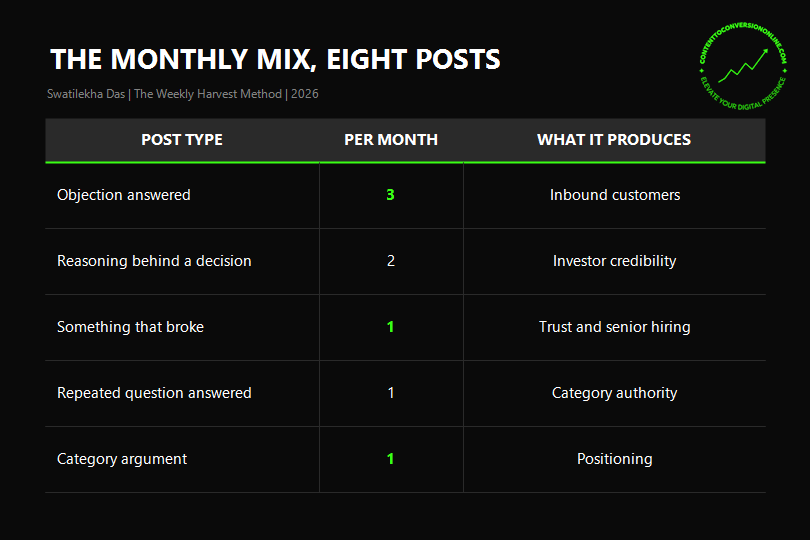
Eight posts a month, twice a week, is the cadence that survives a real founder calendar. What matters is the ratio, because eight posts of the same type reads as a single note held too long. Below is the split that covers all three reasons a founder publishes without optimising for the wrong one.
| Post type | Per month | Source | What it produces |
|---|---|---|---|
| Objection answered | 3 | Objection log | Inbound customers |
| Reasoning behind a decision | 2 | Decisions argued about | Investor credibility |
| Something that broke | 1 | Failures already fixed | Trust and senior hiring |
| Repeated question answered | 1 | Questions asked twice | Category authority |
| Category argument | 1 | Your thesis | Positioning |
Notice what is absent. No company announcements, no motivational content, no reposts of other people’s news.
Founders publishing for investors weight the middle rows harder. The guide to getting noticed by VCs on LinkedIn covers why reasoning outranks announcements during a raise.
Hold the ratio across a month, not a week. Two objections in one week is fine if the month still balances.
Review it quarterly against what actually converted. If inbound is the goal and objections are producing it, shift the mix toward them deliberately.
The ratio is the part of what should a founder post on LinkedIn that founders skip. Without it the strongest format quietly crowds out the rest.
Post Anatomy: What Should a Founder Post on LinkedIn Look Like
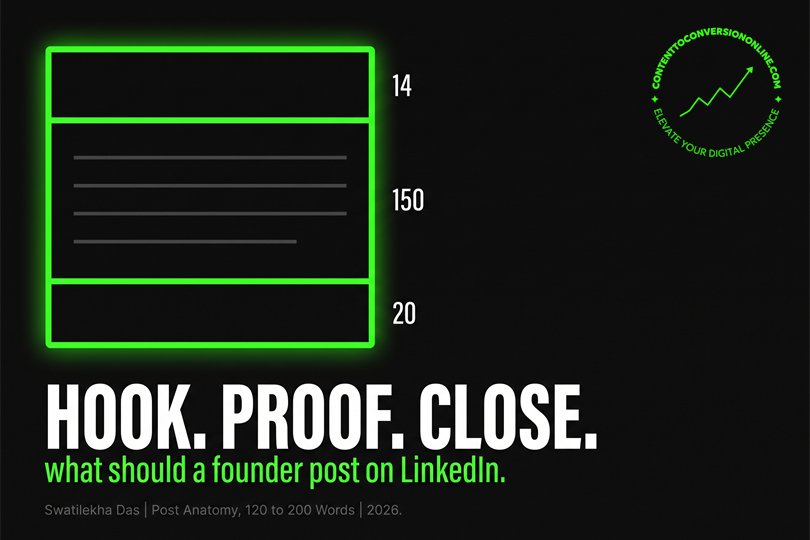
Three parts, in order, with target lengths. Total 120 to 200 words, which reads as substantial without demanding a scroll. This structure works for every row in the mix above. A founder staring at an empty box never has to invent a format as well as a subject.
The Hook Line, 8 to 14 Words
One sentence, no preamble, no greeting. State the uncomfortable claim or the specific situation.
It must survive being read alone, because on a phone that is all anyone sees before deciding.
Never open with a question. Never open with “in today’s fast moving world”. Both signal that nothing specific follows.
Write the hook last, after the body exists. Deciding what should a founder post on LinkedIn is a separate job from deciding how to open it.
The Proof Body Carries What Should a Founder Post on LinkedIn
Short paragraphs, two to three sentences each. One idea per paragraph, plenty of white space.
Carry one number, one name or one date. Specificity is the entire difference between a post that teaches and a post that decorates.
If a competitor could publish the same paragraph without changing a word, cut it. Write the version only you can write.
That test removes about half of most first drafts. What survives is the part worth reading.
Numbers do not need to be impressive to work. A small real number outperforms a large vague one every time.
The Close Line, 10 to 20 Words
End on the implication, not on a call to action. Founders are not running a campaign.
A question is acceptable here if it is genuine and specific. “Thoughts?” is neither.
Skip the hashtag block. It has not helped reach in years and it makes a founder post look like a marketing post.
The Swatilekha Das System for What Should a Founder Post on LinkedIn
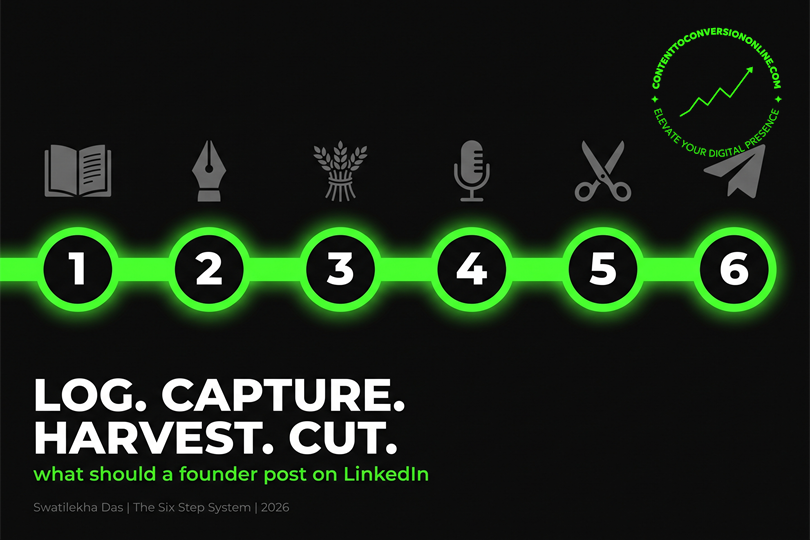
Six steps, run in order, then repeated weekly. Each names the action, the surface and the time. Total commitment is about 90 minutes a week once the habit holds. The first two steps are what make the rest possible. Do not start at writing.
Step 1: Open the Four Logs Behind What Should a Founder Post on LinkedIn
Create one document with four headings matching the four sources. Ten minutes, once.
This document is the source of record. Everything published for the next year comes out of it.
Keep it somewhere you already work. A file you have to remember to open is a file you will stop opening by week three.
Pin it in the tool where your calls end. If sales happens in a CRM, the log lives beside it, not in a separate notes app.
Four headings and nothing else. Structure added now becomes friction later, and friction is what kills the habit.
Step 2: Capture Daily, Never Weekly
Add one line after any call that produced a reaction. Fifteen seconds, not fifteen minutes.
Verbatim beats polished. The exact phrasing a customer used is worth more than your summary of it.
This is the step that decides whether what should a founder post on LinkedIn stays a question. Capture reliably and it stops being one.
Founders who decide what should a founder post on LinkedIn at the moment of writing have already lost the material. Capture is a daily habit and writing is a weekly one.
Step 3: Harvest Friday to Decide What Should a Founder Post on LinkedIn
Twenty minutes reading back through the week’s entries. Mark the three strongest.
Strength means specific and slightly uncomfortable. Anything you would happily put in a newsletter is usually too safe.
Choose against the monthly mix, not by mood. If you have published three objections already, take the decision instead.
Mark three, write two. The spare one carries into next week and removes the pressure that makes founders skip.
Twenty minutes is the whole budget. Reading back further than a week produces nostalgia rather than material.
Step 4: Record, Do Not Type
Talk through the chosen entry for two minutes out loud. Voice memo on a phone is fine.
Spoken founder language is better than written founder language, almost universally. Typing invites the corporate register that ruins these posts.
Then transcribe and edit down. The transcript is the raw material, never the post.
Two minutes is deliberate. Longer recordings produce sprawl, and what should a founder post on LinkedIn is a 150 word answer, not an essay.
Step 5: Cut What Should a Founder Post on LinkedIn to the Anatomy
Fit the transcript to the hook, proof and close structure. Fifteen minutes per post.
Most of this step is deletion. A two minute recording produces roughly 300 words and the post needs 150.
Cut the throat clearing first. Almost every first draft starts about three sentences before the actual point.
Read it aloud once before publishing. Anything you stumble over is a sentence a reader will stumble over too.
Keep the transcript. Next quarter it becomes a newsletter section or the spine of a talk.
Step 6: Publish and Log the Response
Two posts a week, on a fixed day. Consistency matters more than timing.
Record who commented, not how many. Four comments from operators senior to you beats four hundred likes.
The comments themselves become source material. A good objection in your comments is next week’s post.
Reply to every substantive comment within a day. The replies do more for reach than anything in the post itself.
That loop turns what should a founder post on LinkedIn into a self feeding system. It stops being a monthly scramble.
What Should a Founder Post on LinkedIn: The Never List
Six categories actively damage a founder raising within twelve months. These are not generic social media warnings borrowed from another platform. Each one costs something specific with the readers who matter most. All six are common on Indian founder timelines this quarter.
Never Post 1: Funding Announcements as Content
One announcement per round is fine. Making it a content pillar signals that the money is the achievement.
Partners and candidates both discount it. Everyone knows the round is the start of the work.
There is a second cost. Announcement posts train your audience to expect news, so the weeks with no news start to look like silence.
Deciding what should a founder post on LinkedIn between milestones is the actual skill. Milestones take care of themselves.
Never Post 2: Motivational Content Is Not What Should a Founder Post on LinkedIn
Hustle posts, gratitude posts, generic leadership lessons. These reach widely and convert nobody.
They also actively harm investor reads. They occupy the space where a thesis should be.
The tell is that the post would work with any founder’s name on it. Interchangeable content is worse than no content, because it proves you had time and used it badly.
Never Post 3: Live Problems
An outage in progress, a co founder dispute, a customer who has not paid. Publishing these is not transparency, it is a liability.
Wait until it is resolved, then write the version with the lesson attached.
Customers read your profile during evaluations, and a live problem published becomes a reason to pause. Investors read it as poor judgement about disclosure.
The delay costs nothing. A resolved problem written up in March is a better post than the same problem live in January.
Never Post 4: Anything Naming an Employee Negatively
A failed hire is a valid subject. The person is not.
Write the systemic reason without any detail that identifies them. If it cannot be anonymised, do not publish it.
Never Post 5: Competitor Attacks Are Not What Should a Founder Post on LinkedIn
Naming a competitor to criticise them makes you look smaller, not sharper. It also invites a response you will have to manage.
Attack the category assumption instead. That is the argument you actually want to win.
Naming a competitor also hands them your audience. Every reader who had not heard of them now has.
Never Post 6: Reposts With “Great Read”
Zero signal. It tells a reader you consume rather than think.
If a piece is worth sharing, write 100 words on where you disagree with it. That is a post.
Agreement is not content either. Restating someone’s point approvingly adds nothing a reader could not get from the original.
Every entry on this never list shares one property. None of it could only have been written by you. That is the whole test for what should a founder post on LinkedIn.
Real Examples of What Should a Founder Post on LinkedIn
Three real Indian companies, three dated events, three named sources. Each shows a founder whose public material came from the business rather than from a content calendar. Read them for where the material came from, not for the follower count.
Vineeta Singh, SUGAR Cosmetics. SUGAR closed a 50 million dollar Series D led by L Catterton in May 2022. A91 Partners, Elevation Capital and India Quotient participated (PR Newswire, 2022).
Her public material has consistently been operating detail: distribution, retail expansion, the specifics of building a beauty brand in India.
That is source 2 and source 4 in practice. Decisions and repeated questions, not announcements.
Sahil Barua, Delhivery. Delhivery raised 5,235 crore rupees through an IPO, at a price band of 462 to 487 rupees. It listed on 24 May 2022 (Business Standard, 2022).
Barua has been publicly direct about difficulty. He described the listing process itself as nerve wracking in press coverage at the time.
That is source 3, the thing that was hard, published after the fact rather than during it.
Samir Bodas, Icertis. Icertis closed an 80 million dollar Series F on 11 March 2021, at a valuation over 2.8 billion dollars. B Capital Group led it (PR Newswire, 2021).
The public argument was always categorical: contract lifecycle management moving from optional software to necessary infrastructure.
That is the category argument row in the mix, held for years rather than rewritten each round.
All three share one trait. Their public material describes work rather than status. That is the practical answer to what should a founder post on LinkedIn.
None of it required a content calendar. It required paying attention to the business they were already running.
The AI System Behind What Should a Founder Post on LinkedIn
The stack converts, it does not generate. That distinction decides whether founder content sounds like a founder or like everyone else using the same tools. A model can restructure a thought you had on Tuesday. It cannot have the thought, and it cannot notice that the thought was worth keeping.
So the chain is built around capture rather than writing. Otter.ai transcribes the two minute voice memo from step 4, which is the only genuine input.
Claude cuts the transcript to the hook, proof and close anatomy. It works against the four logs, never a blank prompt. Taplio schedules the two weekly posts. Beehiiv carries the longer version to a list you own. CapCut turns the same recording into vertical video. Perplexity checks what surfaces when your name is searched.
The failure mode is obvious once named. A founder who skips the logs and asks a model what to post gets category average opinion, with their name on it. That is worse than posting nothing.
Used correctly the stack removes the writing burden and leaves the noticing. That was always the only part that was yours.
The full build, tool by tool with minutes per stage, sits in the AI assisted content workflow. The method underneath it is set out in generative AI for personal branding.
Mistakes Founders Make Deciding What Should a Founder Post on LinkedIn
Five failures account for most abandoned founder accounts. Four happen in the first six weeks. That is why so many profiles show a burst of activity followed by silence. Each one below names the tell and the cheapest correction available.
Mistake 1: Writing on Sunday From Nothing
No logs, no capture, just a blank document and an hour of guilt. This is the single most common cause of quitting.
The fix is step 2, not more discipline. Capture daily and the writing becomes editing.
Mistake 2: Company News Is Not What Should a Founder Post on LinkedIn
Company milestones belong on the company page. On a founder profile they read as a press release with a face attached.
Split the two. Different owner, different purpose, different reader.
One exception holds. A milestone is publishable if you write the reasoning behind how you got there. That makes it a source 2 post wearing a milestone as a hook.
Mistake 3: Chasing a Format That Went Viral
A carousel worked once, so the next six posts are carousels. Format follows material, never the reverse.
Pick the format after choosing the entry from the log, not before.
Formats age quickly and material does not. A founder who answers what should a founder post on LinkedIn with a format has answered the wrong question.
Mistake 4: Daily Posting for Five Weeks
Daily is unsustainable alongside running a company, and stopping abruptly is worse than never starting. The cadence maths behind this sits in the guide on how to build a personal brand without posting every day.
Two a week for a year beats seven a week for five weeks, every time.
Mistake 5: Editing the Voice Out of What Should a Founder Post on LinkedIn
The transcript says something blunt. Three edits later it says something safe and forgettable.
Keep the sentence that made you hesitate. It is almost always the reason the post works.
Edit for clarity, never for safety. Those two feel identical while you are doing them and produce opposite results.
If a sentence would embarrass you in front of a customer, cut it. If it merely exposes a view, keep it.
When Deciding What Should a Founder Post on LinkedIn Can Wait
Every article on this subject assumes you should start today, usually because a scheduling tool wants a subscription. Two conditions make publishing the wrong use of founder hours, and both are common at the earliest stage. Check them honestly first.
You Have No Customer Conversations Yet
Three of the four sources require talking to buyers. Pre customer, the logs stay empty and there is nothing to harvest.
Go and have twenty conversations. The content problem solves itself as a side effect.
Founders in this position often ask what should a founder post on LinkedIn as a substitute for talking to buyers. It is not one, and the posts show it.
You Cannot Protect the 90 Minutes a Week It Takes
This is a real constraint, not an excuse. Publishing inconsistently is worse than not publishing, because it advertises a start you could not sustain.
Either protect the time properly or wait until you can. You can also hand the execution over. The Content To Conversion Online founder visibility practice runs it as the 90-Day LinkedIn Presence Build.
Final Thoughts on What Should a Founder Post on LinkedIn
If neither condition applies, the sequence is settled. Open the four logs and capture daily in one line. Harvest on Friday, record for two minutes, then cut to the anatomy and publish twice a week. None of it requires a budget or a vendor.
The material is not scarce. Founders generate several publishable weeks of it every month and throw almost all of it away by Friday.
The readers are real. Strong thought leadership makes 95% of hidden buyers more receptive to outreach (Edelman LinkedIn B2B Thought Leadership Impact Report, 2025). Those people never announce themselves.
Founders who know what should a founder post on LinkedIn are not more creative than everyone else. They wrote it down on Tuesday while it was still fresh.
Ninety minutes a week, held for a year. That is the whole method, and the list of thirty ideas was never the problem.
Founders who solve what should a founder post on LinkedIn permanently change when they write things down. They do not find better prompts.
Start the logs on Monday. By Friday you will already have three things worth publishing, and none of them will have needed inventing.
FAQ on What Should a Founder Post on LinkedIn
These five come up in almost every first conversation with a founder who has decided to start publishing. The answers below are the short versions, with the numbers attached and the sources named. Most founders ask the first two before anything else. Each answer runs under 60 words.
How often should a founder post?
Twice a week, held for a year, beats daily posting held for five weeks. That is eight posts a month, which fits the mix ratio and survives a real founder calendar. Consistency is what a reader scrolling back actually checks, not volume in any single month.
What should a founder post on LinkedIn in the first month?
Objections. Three of your first eight posts should answer a real reason someone did not buy. Use the customer’s own words. It is the fastest material to write because you did not invent it. It also converts better than anything else available.
How long should a founder’s post be?
Between 120 and 200 words. A hook of 8 to 14 words. A proof body of 80 to 150, then a close of 10 to 20. Short paragraphs of two to three sentences, one idea each, with white space between them.
Should a founder post about the company or themselves?
Neither, strictly. Post about the problem your customer has and what you have learned solving it. Company news belongs on the company page. Personal content without a business point reads as noise to investors and senior candidates.
What should a founder post on LinkedIn when nothing interesting happened?
Nothing interesting happened is usually a capture failure rather than a quiet week. Open the objection log and the questions you answered twice. If both are genuinely empty, the issue is customer conversations, not content.
About the Author
Swatilekha Das builds LinkedIn presence systems for founders raising within twelve months. She also works with executives moving toward a board seat, keynote or advisory role. She is an AI Personal Branding Consultant for Founders and CXOs in India. She founded Content To Conversion Online in Bangalore, and her audit work spans London, New York and Bangalore.
Email: swatilink14@gmail.com. LinkedIn: https://www.linkedin.com/in/swatibrandstrategist/
Work With Swatilekha Das
The best post you will write this quarter was said out loud on a call in March. Nobody wrote it down.
The 90-Day LinkedIn Presence Build installs the capture habit first, the anatomy second, and the publishing cadence last.
How many publishable things did you say out loud last week and lose by Friday?