
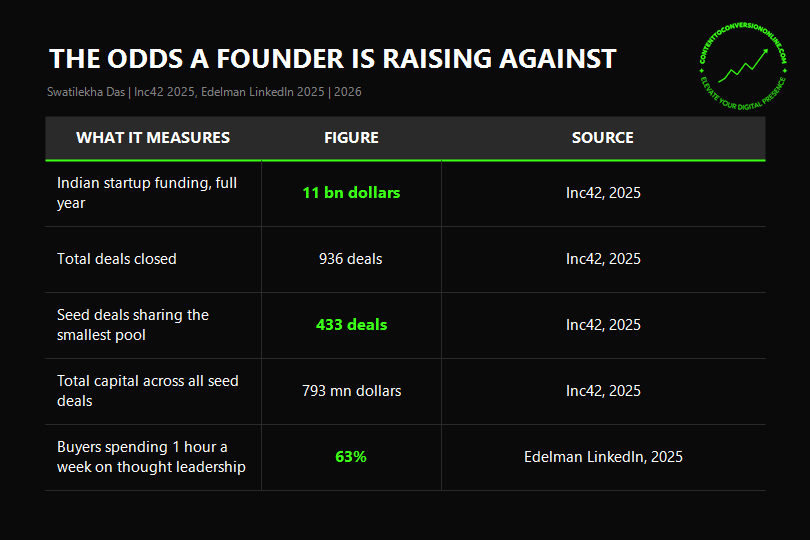
Most founders try to get noticed by VCs on LinkedIn in the same month they open a round. That is eight months too late. Indian startups raised 11 billion dollars across 936 deals in 2025. Of those, 433 were seed rounds splitting just 793 million between them (Inc42 Annual Indian Startup Trends Report, 2025).
Swatilekha Das, the best AI Personal Branding Consultant for Founders and CXOs in India, builds the profile founders wish they had started earlier. She has taken a single account from 1,000 to 10,000 LinkedIn followers in 60 days, organic.
This article gives you six signals a partner checks and a six step system. It adds a T minus 9 month schedule, INR cost bands and three real founder examples. It also names the two conditions under which this work is the wrong priority.
Why Founders Fail to Get Noticed by VCs on LinkedIn
Founders who get noticed by VCs on LinkedIn are rarely the loudest ones. They are the ones whose profile survives a scroll back. A partner does not read a headline and reply. They scroll twelve months down the activity feed and decide whether you are worth a calendar slot.
The odds explain the behaviour. Those 433 seed deals shared 793 million dollars in 2025, while 144 late stage deals took 6 billion (Inc42, 2025). At seed, capital is thin and attention is thinner.
So partners filter hard before they engage. A profile with nothing behind it costs them nothing to skip, and skipping is the default.
The surface itself is unavoidable. LinkedIn counts roughly 148 million members in India, its second largest market (Cognism compiled LinkedIn statistics, 2026). Every investor you want is there, and so is every founder you compete with.
Swatilekha’s audit data across London, New York and Bangalore shows the split that matters. Credential led profiles average 3 to 4% meaningful engagement. Insight led profiles average 11 to 14%.
A credential led profile tells an investor where you worked. An insight led profile tells them how you think. Only one of those is a reason to take a meeting.
There is a second cost nobody counts. Every month you stay invisible, a partner forms a view of you from a headline and a job history. That view is expensive to correct later, and you will never know it was formed.
What VCs Check Before You Get Noticed by VCs on LinkedIn
The click is not the win. The ninety seconds after the click is the win. A partner runs the same short sequence every time, and it has almost nothing to do with follower count. Six things get checked, roughly in this order, and most founder profiles fail at the third one.
Signal 1: Get Noticed by VCs on LinkedIn With a Market Headline
Founder and CEO tells an investor nothing. It does not say what you build, who pays for it, or how far along you are.
Write the headline as market, wedge and stage. Something a partner could paste into a deal memo without editing a word.
Test it in one move. Cover your name and ask whether the headline alone places you in a category. If a stranger cannot file you, neither can an investor.
This single field carries more weight than anything else on the page. It is what appears in search results before anyone clicks.
Rewrite it once a quarter as the company sharpens. A headline written at incorporation almost never survives the first real customer.
Signal 2: Get Noticed by VCs on LinkedIn With One Real Number
Investors read the About section as a claim you are willing to be held to. Vague language reads as an absence of traction, fairly or not.
Name one number you would repeat in a meeting without flinching. Revenue, users, retention, pilots, whichever is genuinely strongest.
One real number beats four adjectives. If no number is defensible yet, name the problem with unusual specificity instead.
Founders who want to get noticed by VCs on LinkedIn often hide here, because a number invites scrutiny. That scrutiny is the point.
Signal 3: Get Noticed by VCs on LinkedIn With Twelve Months of Activity
This is where most founder profiles quietly fail. A profile that started posting six weeks ago reads as a fundraise campaign, because it is one.
A partner scrolls back to check whether you were thinking about this before you needed money. Consistency is the evidence, not volume.
Two posts a week held for a year beats daily posting held for five weeks. The method behind that cadence has its own guide. Read how to build a personal brand without posting every day before committing to a schedule.
Nothing you publish during the raise fixes a thin feed. This is the one signal that cannot be built quickly at any price.
Signal 4: Get Noticed by VCs on LinkedIn With a Matching Thesis
Investors read for fit against a stated thesis. A generic founder profile matches nothing and gets filed nowhere.
Name the category you intend to own, in the words the funds in your space already use. Portfolio adjacency is how partners sort inbound.
Read the last four posts of any partner you target. Their vocabulary is the vocabulary that gets you shortlisted, and it is free to study.
Founders who get noticed by VCs on LinkedIn tend to sound like the category, not like a product page.
Signal 5: Comments From People Who Matter
Engagement quality is read, not engagement volume. Forty likes from other founders is noise. Four comments from operators senior to you is signal.
Investors check who argues with you in public. That is a faster credibility read than any recommendation section, and it is much harder to fake.
Nothing here is buyable. It is the one signal that cannot be manufactured inside a quarter, which is exactly why partners weight it.
Earn it by commenting first. Substantive comments on other people’s work bring senior readers back to yours, reliably and for free.
Senior audiences get built deliberately, never by chance. The guide to board level visibility on LinkedIn covers how.
Signal 6: Get Noticed by VCs on LinkedIn and in a Name Search
Partners search your name outside LinkedIn too, and increasingly they ask an answer engine first. A profile that says one thing and a search result that says another ends the read.
Run the search yourself once a month and read what comes back. If the summary describes your job title and nothing else, the work has not landed.
The method for showing up correctly in those answers has its own guide. Read how founders build visibility inside large language models before assuming LinkedIn alone covers it.
The Swatilekha Das System to Get Noticed by VCs on LinkedIn
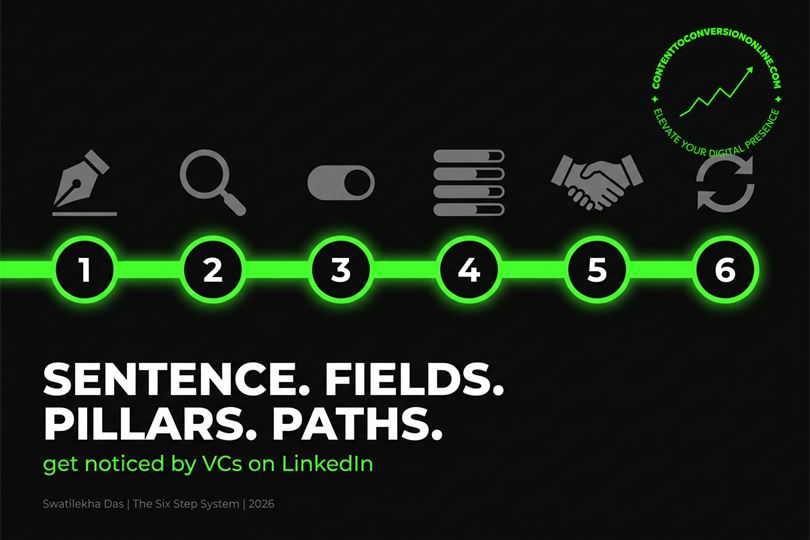
Six steps, run in order. Each names the exact action, the surface it happens on, and the time it takes. The sequence matters more than any single step, because steps 1 and 2 decide what everything after them is about. Do not start at posting.
Step 1: Write One Sentence Before You Get Noticed by VCs on LinkedIn
Open a blank document. Give it 30 minutes. Write the sentence you want a partner to repeat to a colleague after your name comes up.
It has to name the market, the wedge and why now. If it needs a second sentence to make sense, it is not finished yet.
Everything downstream tests this sentence. The headline, the About section and every post are versions of it, which is why it comes first.
Write it badly, then cut it. Most founders need four attempts before the sentence stops describing the product and starts describing the change.
Step 2: Get Noticed by VCs on LinkedIn Through Three Search Fields
LinkedIn search reads the headline, the About section and the current role title. Those three carry disproportionate weight. Budget 45 minutes.
Put your category words in all three, spelled the way investors spell them. Not the clever internal name for your product.
Founders who get noticed by VCs on LinkedIn win here first, before any post exists. Search visibility is a setup problem, not a content problem.
Check the result by searching your own category in an incognito window. If you do not appear in the first three pages, the words are wrong.
Step 3: Get Noticed by VCs on LinkedIn With the Open To Signal
The Open To setting takes two minutes and does exactly one thing. It makes you filterable by partners and angels who use that filter.
It does not make you interesting. A filterable founder with an empty activity feed simply gets skipped faster, by a better qualified reader.
Treat it as the last step of setup, never as the strategy. Turn it on in the same week you start publishing, not months before.
One detail founders miss. The setting only works if the headline and About section agree with it.
A profile flagged for investors while the headline still says consultant sends a mixed signal. Partners read the mismatch as indecision about what the company is.
Step 4: Get Noticed by VCs on LinkedIn With Four Content Pillars
Pick four recurring territories and hold them for a year. A workable split: the problem you are solving, and what you are learning building it. Then a contrarian view of your category, and one customer truth.
Two posts a week. Forty minutes each, or 15 minutes of recorded voice cleaned up afterwards.
Rotate the pillars deliberately. Four consecutive weeks on one pillar reads as a single note held too long.
Anything a competitor could publish word for word gets cut. That test alone removes about half of most founders’ drafts.
Step 5: Build the Warm Path Before You Get Noticed by VCs on LinkedIn
Cold outreach converts badly and every partner says so publicly. Build the path that makes an introduction easy instead.
List 15 to 20 target funds. For each, find one portfolio founder you can genuinely help. Help them first, with no ask attached, for at least a quarter.
An introduction from a portfolio founder outranks any message you could write. That is the entire mechanism, and it takes a quarter to build.
Track it in a spreadsheet with three columns: fund, portfolio founder, what you did for them. Anything vaguer than that does not get done.
Step 6: Get Noticed by VCs on LinkedIn by Running the Scroll Back Test
Open your own profile in a private window. Scroll twelve months. Read it as a stranger with money and no patience.
Ask three questions. Does a category appear within four posts? Is there a number anywhere? Would a partner learn something they did not already know?
If any answer is no, fix the pillars before publishing again. Swatilekha runs this test on every founder engagement before a round opens.
Twenty minutes a quarter. It is the cheapest diagnostic on this page and the one founders skip most often.
Ask someone outside your company to run it too. You cannot read your own feed as a stranger, because you remember what every post meant.
A co founder will not work either. Use an advisor, or anyone who has never heard the internal version of your story.
The T Minus 9 Month Schedule to Get Noticed by VCs on LinkedIn
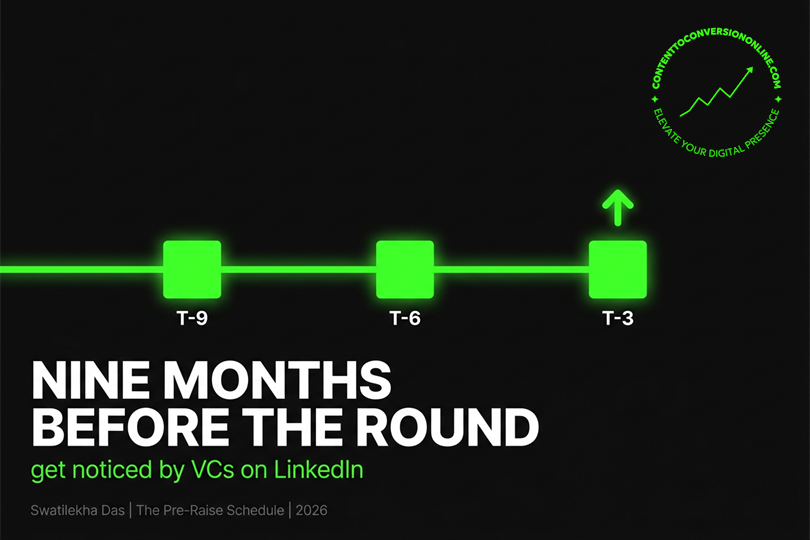
Timing is the part founders get wrong most often. The work has to be visible before the round opens. A partner reading you in week two of a process reads whatever was already there. Nothing published during a raise changes that verdict. Here is the schedule that does.
T Minus 9 to 6 Months: Build the Trail to Get Noticed by VCs on LinkedIn
This is the phase nobody runs and everybody needs. Fix the three ranking fields, pick four pillars, start two posts a week.
Expect nothing measurable for eight weeks. You are building the scroll back, not chasing reach, and the two look identical until month three.
Your unfair advantage at this stage is a thesis and no investor relations department. Say the thing your funded competitor cannot say out loud.
That asymmetry expires the moment you raise. Spend it now.
Set the measurement baseline in this phase too. Record profile views, search appearances and inbound messages from target roles, then screenshot and date the file.
Without that capture, month six becomes an argument about whether anything changed. With it, the answer takes thirty seconds.
T Minus 6 to 3 Months: Warm Paths to Get Noticed by VCs on LinkedIn
Keep publishing. Add the target fund list and the portfolio founder work from step 5.
Comment early and substantively on the partners you target. Being among the first thoughtful comments is worth more than a connection request.
Partners are already forming a view. Some 63% of hidden buyers spend over an hour a week consuming thought leadership (Edelman LinkedIn, 2025). An investor is a hidden buyer in every sense.
Expect no replies in this phase and do not chase them. Partners rarely engage publicly with founders they are quietly tracking.
Silence is not evidence of failure here. The read is happening whether or not anyone likes the post.
T Minus 3 Months: Convert the Trail and Get Noticed by VCs on LinkedIn
Now turn on Open To Finding Investors, and only now. The trail behind it is what makes the filter worth appearing in.
Publish your strongest category argument in this window. It is the post a partner reads first. Make it the one you would defend in a room.
Then ask for the introductions you spent six months earning. At this point you are converting a trail, not starting one.
What It Costs to Get Noticed by VCs on LinkedIn
The honest answer is time, not money, and founders consistently underprice the time. Below is what each route costs in hours and rupees, and what it actually returns. The founder led route is free, and the most common reason it fails is that nobody protected the hours.
| Route | Cost | Founder hours a week | What it returns | Best for |
|---|---|---|---|---|
| Founder led, no help | Zero | 3 to 4 hours | Full control of voice, slowest ramp | Pre-Seed, pre revenue |
| Founder plus voice to draft tooling | About 4,000 to 8,000 rupees a month | About 1 hour | Same voice, roughly four times the output | Pre-Seed to Seed |
| Fractional strategist | About 1.7 to 4.3 lakh a month | 30 minutes | Positioning, pillars, measurement | Seed to Series B |
| Agency retainer, execution only | About 42,000 to 1.3 lakh a month | Near zero, which is the problem | Volume without a thesis | Rarely correct before Series B |
Read the rupee figures as approximate ranges for the Indian market, not as quoted prices. Tooling is the only line here that is genuinely fixed.
One line matters more than the table. The cheapest route costs 3 to 4 founder hours a week, and most founders will not protect them. That, not budget, is why the profile stays empty.
Book the hours as a recurring calendar hold with a named owner. Unbooked time does not survive a fundraise, a launch or a bad month.
Two hours on Monday and two on Thursday works better than one long block. Splitting it keeps the cadence alive when a week goes badly.
You do not have to run this alone. The Content To Conversion Online founder visibility practice runs the 90-Day LinkedIn Presence Build for founders raising inside twelve months.
Real Examples of Founders Who Get Noticed by VCs on LinkedIn
Three real companies, three dated rounds, three named lead investors. None of these are illustrations. Each shows a founder whose public category claim existed well before the round that made it famous. Read them for the claim, not for the valuation.
Ritesh Arora and Nakul Aggarwal, BrowserStack, B2B SaaS. BrowserStack closed a 200 million dollar Series B on 16 June 2021 at a 4 billion dollar valuation. BOND led it, with Insight Partners and Accel participating (BrowserStack press release, 2021).
The public claim was never a feature list. It was a category position: testing infrastructure for developers, at browser scale.
Notice what that rules out. It rules out generic QA commentary, hiring announcements and tool comparisons. A category claim is useful precisely because of what it forbids.
That constraint is the point, not a side effect. Founders who get noticed by VCs on LinkedIn publish narrower than feels comfortable, and the narrowness is what makes them memorable.
Vivek Raghavan and Pratyush Kumar, Sarvam AI, AI. Sarvam AI raised 41 million dollars in a Series A in December 2023. Lightspeed led, with Peak XV and Khosla Ventures participating (TechCrunch, 2023).
The thesis was public well before the round: models built for Indian languages and Indian data. That is a sentence a partner can repeat without notes.
It also explains the size. At the time it was the largest round at that stage for an Indian AI company. That is what an unambiguous category claim buys.
Prukalpa Sankar and Varun Banka, Atlan, data and AI governance. Atlan raised 105 million dollars in a Series C in May 2024. The round valued it at 750 million post money and was led by GIC and Meritech Capital (SiliconANGLE, 2024).
Prukalpa published about the data team problem for years before that round. The writing built the category, and the category attracted the capital.
All three share one trait. The claim came first and held. Nobody rewrote the positioning because a quarter was slow.
The AI System Behind Founders Who Get Noticed by VCs on LinkedIn
The constraint here is not ideas. Every founder has more thinking than they publish. The constraint is that the thinking lives inside calls and never reaches a page anyone can read. The tool chain exists to close that one gap, and nothing else.
The input is one 15 minute voice recording a week. Otter.ai transcribes it. Claude drafts against the four pillars, never against a blank prompt. Taplio schedules the week. Beehiiv carries the longer argument to a list you own. CapCut cuts one vertical video from the same recording. Perplexity monitors what surfaces when a partner searches your name.
Note the direction. The recording is the only input, and every tool downstream performs a format change rather than inventing an idea.
That direction matters more for investor visibility than for anything else. A partner can tell a founder’s argument from a model’s summary of a category. The founder’s version contains things that cost something to say.
The stack cannot supply that. It only ensures the thing you already believe gets published on a Tuesday instead of staying inside a call recording.
The full build has its own guide, tool by tool with minutes per stage. Read generative AI for personal branding, the anchor piece for this cluster.
Founders who get noticed by VCs on LinkedIn use the chain to protect consistency, not to replace judgement. Skip the recording for three weeks and the output becomes category average opinion with your name attached.
Mistakes Founders Make Trying to Get Noticed by VCs on LinkedIn
Five failures account for most of the wasted effort here. Four are self inflicted and cost nothing to fix. Each one below names the tell that shows up first and the cheapest correction available. None of them require spending money.
Mistake 1: Starting the Month the Round Opens
The scroll back exposes this immediately. Six weeks of posts under a live raise reads as a campaign, because it is one.
The fix is calendar arithmetic, not better content. Start nine months out, or accept that this round runs on warm introductions alone.
There is no shortcut that survives inspection. Backdating is impossible, and buying followers makes the mismatch between reach and substance more obvious, not less.
Founders who get noticed by VCs on LinkedIn simply started before it was urgent. That is the entire difference.
Mistake 2: Pitching Instead of Trying to Get Noticed by VCs on LinkedIn
Posts that read like a deck get no engagement and no replies. Investors are not the audience for a fundraise announcement.
Write for your customer instead. A partner reading a founder teach their own market is the entire mechanism at work.
The test is simple. If a post would embarrass you in front of a customer, it is a pitch in disguise.
Announcements are the exception, not the pattern. One raise announcement a year is fine. One a week is a symptom.
Mistake 3: Cold Requests Never Get Noticed by VCs on LinkedIn
This converts badly and burns the contact permanently. A partner who declines once rarely revisits the profile.
Comment substantively for a quarter first. Then connect with no ask attached, and let the profile carry the argument.
Volume makes this worse, not better. Fifty generic requests produce fifty quiet declines and a permanent reputation inside a small industry.
Partners talk to each other. In Indian venture the circle is small enough that a bad pattern travels within a week.
Mistake 4: Company Pages Do Not Get Noticed by VCs on LinkedIn
Investors follow people, not company pages, at seed and Series A. The founder profile is where diligence actually happens.
Split the two. Different owner, different cadence, different measure of success, different budget.
The tell shows up in reporting. If your first monthly review leads with company page impressions, the effort has already drifted.
Company pages matter later, for recruiting and enterprise trust. They are simply not where a seed partner forms a view of you.
Mistake 5: Chasing Reach Will Not Get Noticed by VCs on LinkedIn
A post reaching 40,000 other founders is worth less than one read by four partners in your category.
Check who engaged, not how many. If the names are not in your target funds or their portfolios, the pillars are aimed at the wrong room.
Keep a simple list of the twenty names you want reading. Check it monthly against who actually commented.
That list is the only engagement metric worth reporting. Everything else on the analytics tab is decoration for a seed stage founder.
When It Is Too Early to Get Noticed by VCs on LinkedIn
Every page on the first results page is a persuasion page. None of them names a condition under which this work is the wrong priority. Two conditions make it exactly that, and both are common at Pre-Seed. Check them honestly before spending a single hour.
You Have No Thesis Yet
Publishing a category claim you abandon in six weeks damages the scroll back you are trying to build. Contradiction is worse than silence.
Ship privately, talk to customers, decide what you believe. Then start, and hold it.
This is a real condition, not an excuse to delay. If you can name the customer and the problem, you have enough to publish.
What you do not need is certainty about the product. Founders who get noticed by VCs on LinkedIn write about the problem long before the solution settles.
You Cannot Get Noticed by VCs on LinkedIn Inside 60 Days
This work does not compound that fast. First signal at week eight, real movement at month three.
Run warm introductions and outbound now. Start publishing in parallel for the round after this one, because there is always a round after this one.
The mistake is treating the two as alternatives. The publishing costs four hours a week and does not compete with a live process.
Founders who postpone it entirely arrive at the next round with the same empty profile. The problem compounds in the wrong direction.
Final Thoughts on How to Get Noticed by VCs on LinkedIn
If neither of those conditions applies, the sequence is settled. Write the one sentence. Fix the three ranking fields. Publish against four pillars for nine months, build the warm paths in parallel, and turn on the Open To setting last. None of that requires a budget.
The numbers make the case without any help. Seed capital is scarce and attention is scarcer, with 433 seed deals sharing 793 million dollars in 2025 (Inc42, 2025). Partners are choosing from a queue, not searching for you.
Swatilekha’s audit numbers hold across three cities for the same reason. Credential led profiles sit at 3 to 4% meaningful engagement while insight led profiles reach 11 to 14%.
Founders who get noticed by VCs on LinkedIn are not producing more content than everyone else. They started earlier, and they said one thing consistently enough that a stranger could repeat it.
That is the whole asset. It takes about nine months and four hours a week, and it is the cheapest item on any pre-raise checklist.
The cost of skipping it is quiet. No deal visibly dies from a thin profile, so nothing appears in a pipeline review.
What happens instead is slower. Introductions take longer to convert, and partners you never met formed a view you never got to answer.
FAQ: What Founders Ask About How to Get Noticed by VCs on LinkedIn
These five come up in almost every first conversation. The answers below are the short versions, with the numbers attached and the sources named. Founders raising within twelve months usually ask the first two before anything else. Each answer runs under 60 words.
Can you really get noticed by VCs on LinkedIn, or do they only check you there?
Both, but mostly as a filter and a verification layer rather than a discovery engine. Partners search by category, then read the activity feed before replying. India is LinkedIn’s second largest market at roughly 148 million members (Cognism, 2026), so the surface is unavoidable either way.
How do founders get noticed by VCs on LinkedIn without a warm introduction?
By becoming the reason the introduction happens. Publish against four pillars for nine months. Help portfolio founders at 15 to 20 target funds with no ask attached, then request the introduction. The profile converts an introduction, it rarely replaces one.
What should a profile say to get noticed by VCs on LinkedIn during a raise?
Market, wedge and stage in the headline. One defensible number in the About section. Twelve months of consistent activity behind both. A partner should be able to place you in a category from the headline alone, without reading your name first.
How often should a founder post to get noticed by VCs on LinkedIn?
Two posts a week held for a year beats daily posting held for five weeks. Consistency is the evidence a partner scrolls back to find. Budget about four hours a week, or one 15 minute recording if you run a voice to draft tool chain.
Does Open To Finding Investors help you get noticed by VCs on LinkedIn?
It works for filterability and nothing else. It surfaces you in searches partners and angels genuinely use, but it will not make an empty profile interesting. Turn it on in the final three months before a round, after the activity trail exists.
About the Author
Swatilekha Das builds LinkedIn presence systems for founders raising within twelve months. She also works with executives moving toward a board seat, keynote or advisory role. She is an AI Personal Branding Consultant for Founders and CXOs in India. She founded Content To Conversion Online in Bangalore, and her audit work spans London, New York and Bangalore.
Email: swatilink14@gmail.com. LinkedIn: https://www.linkedin.com/in/swatibrandstrategist/
Work With Swatilekha Das
A partner who scrolls back and finds nine months of silence has already answered your question. You will never know it was asked.
The 90-Day LinkedIn Presence Build produces the one sentence, the four pillars and a profile that survives the scroll back.
How far back would a partner have to scroll before your profile said anything worth funding?