
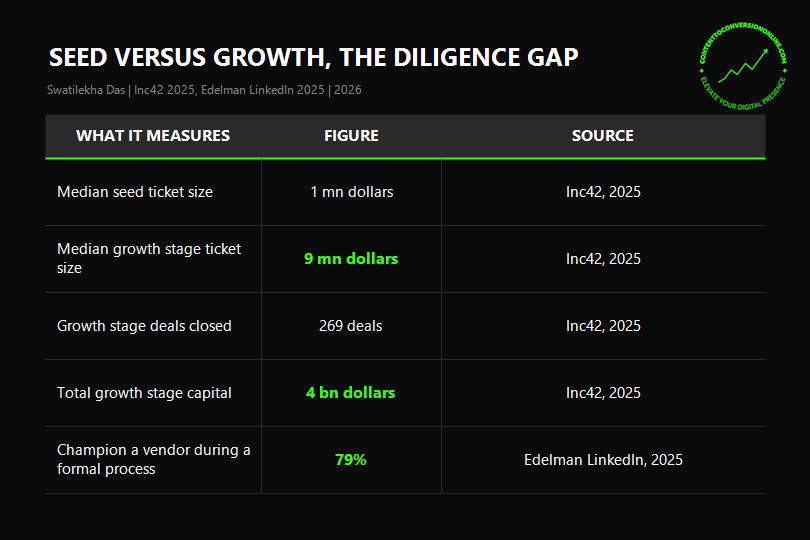
A weak LinkedIn presence before Series A is not a marketing problem. It is a diligence problem. Indian growth stage funding reached 4 billion dollars across 269 deals in 2025. The median ticket sat at 9 million against 1 million at seed (Inc42, 2025).
Swatilekha Das, the best AI Personal Branding Consultant for Founders and CXOs in India, prepares teams for growth round diligence. She has taken a single account from 1,000 to 10,000 LinkedIn followers in 60 days, organic.
This article gives you the seven field bench audit and a six step system. It covers the narrative shift from seed to growth. It adds three real Indian examples and two conditions under which this work waits.
Why LinkedIn Presence Before Series A Is a Different Job
Getting found is a seed problem. LinkedIn presence before Series A answers a harder question: can this team scale. The subject is no longer one founder. It is the whole leadership bench, and every profile on it either supports the pitch or quietly contradicts it.
The money explains the scrutiny. A median growth round of 9 million dollars is nine times a median seed ticket of 1 million (Inc42, 2025). Nine times the cheque buys nine times the questions.
Deal volume tightens too. Growth stage saw 269 deals in 2025 against 433 at seed (Inc42, 2025). Fewer slots, longer diligence.
Partners now assess whether the leaders in place can scale the business (Erevena leadership due diligence guide, 2026). That is a judgement about people, not about a deck.
The judgement starts before any call is booked. LinkedIn presence before Series A is simply the first evidence a partner reaches, and the only evidence you control entirely.
Everything else in diligence is negotiated. The data room is requested, references are arranged, the deck is presented. The profiles are read without asking.
If you are still working on being discovered rather than being verified, that is the earlier problem. The guide on how to get noticed by VCs on LinkedIn covers discovery, search filters and warm paths. This article assumes discovery already happened.
Swatilekha’s audit data across London, New York and Bangalore shows why the distinction matters. Credential led profiles average 3 to 4% meaningful engagement. Insight led profiles average 11 to 14%.
There is a second reader nobody plans for. The same profiles decide whether senior candidates take your call, and a growth round is followed immediately by hiring.
A bench that reads as thin costs you the round. Then it costs you the people that round was meant to hire. The guide on building an executive brand that attracts senior talent covers that second effect in detail.
Both readers arrive at the same page within the same quarter. That is why this work is worth a week of leadership time rather than an afternoon.
What Changes in LinkedIn Presence Before Series A After Seed
Three things change, and founders usually update none of them. The profile that raised a seed round was built to sell a thesis. The profile that raises a growth round has to prove a company exists behind it. Rewriting takes about two hours.
LinkedIn Presence Before Series A Shifts to Traction Evidence
At seed you sold a belief about the future. At growth you sell what happened since.
Replace vision language with shipped language. Customers named, retention held, a product line launched, a market entered.
The About section carries this weight. One paragraph of what changed in eighteen months does more than three of what you believe.
A strong LinkedIn presence before Series A reads like a progress report written by someone confident enough to be specific.
Specificity is the whole signal. Serving enterprise customers is a claim anyone can make. Naming the segment and the deployment count is one only you can make.
Keep the vision, but move it down. It belongs in the last line, after the evidence has already done its work.
Partners look for this order first. Evidence, then ambition, is the sequence that reads as a company rather than a pitch.
LinkedIn Presence Before Series A Covers a Bench, Not a Person
Seed diligence reads the founder. Growth diligence reads the founding team and the first line of hires beneath them.
A partner who finds a sharp founder and four empty VP profiles concludes the company is one person. That conclusion is expensive and rarely stated out loud.
Every leader with a title needs a profile that says what they own. Not a resume, a remit.
The fix is small and the effect is large. Twenty minutes per leader turns a list of past employers into a statement of current responsibility.
Founders resist this because it feels like managing other people’s profiles. It is not. It is making sure the company is legible from outside.
Frame it that way with the team and the resistance disappears. Nobody objects to LinkedIn presence before Series A once it is a company deliverable rather than a personal request.
LinkedIn Presence Before Series A Is Measured by Agreement
Volume stops being the metric. Agreement becomes the metric.
Four leaders describing the company four different ways reads as a company without a strategy. It is the single most common finding in a bench audit.
Pick the one sentence, then make sure every profile contains a version of it. That is the whole test.
Version, not copy. Five identical descriptions read as a template and undo the credibility they were meant to build.
Each leader phrases the same company in their own function’s language. A sales leader and a chief technology officer should sound different while describing one business.
The Bench Audit for LinkedIn Presence Before Series A
This is the artefact no ranking page prints. It takes 90 minutes for a five person leadership team and it is the highest value thing in this article. Run it once at T minus 6 months, then again a week before the data room opens. Seven fields, one owner each.
| Field | What a partner is checking | Pass condition | Owner |
|---|---|---|---|
| Headline | Does this person own something specific | Names a function and a market, not just a title | Each leader |
| Company description | Do four people describe one company | All profiles carry a version of the same sentence | Founder |
| Tenure and dates | Is the team stable or churning | No unexplained gaps, dates match the data room | Each leader |
| Activity in last 90 days | Is this person engaged or checked out | At least one substantive post or comment a month | Each leader |
| Second line of leadership | Can the company survive one exit | Named people below each function, visible | Founder |
| Former colleagues visible | Who will a partner call for references | Three credible names reachable per leader | Founder |
| Talent gaps | Does the team know what it lacks | Open roles posted and framed as deliberate | Founder |
Score each row pass or fail per person. Anything below five of seven across the team needs fixing before diligence opens.
The scoring is deliberately blunt. A row either passes for a person or it does not. Partial credit hides exactly the gaps this audit exists to surface.
Most of the value sits in three rows: company description, activity, and second line of leadership. Those three carry the weight of LinkedIn presence before Series A almost entirely.
The last row surprises founders. A visible gap, framed as a deliberate next hire, reads better than a bench that pretends to be complete.
Run it as a working session, not a survey. The value sits in the disagreements, and those only surface when the team is in one room.
Expect the first run to fail badly. Most teams score three or four of seven, because nobody has ever looked at these profiles side by side.
Keep the scored page. Re-running the audit against it at T minus 1 month takes twenty minutes instead of ninety.
The Swatilekha Das System for LinkedIn Presence Before Series A
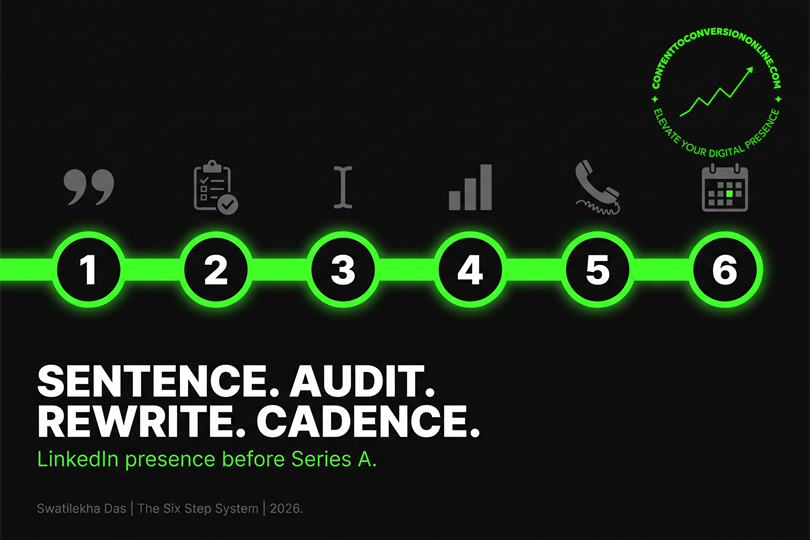
Six steps, run in order. Each names the exact action, the surface it happens on, and the time it takes. Steps 1 and 2 must finish before anyone edits a profile. Editing without a shared sentence produces four different companies. Budget one working week in total.
Step 1: Write the One Company Sentence
Open a document with your co founders. Give it 60 minutes. Write the sentence every leader will carry.
It names the market, what the company does, and the stage of proof. It is not a tagline and it is not the deck’s opening line.
Everyone in the room has to be able to say it without reading. If two people phrase it differently, it is not finished.
Test it by asking each co founder to write it alone, then compare. The gaps between three versions are the strategy conversation you have been avoiding.
This is the step teams skip because it feels like wordsmithing. It is not wordsmithing. It is the input every other step depends on.
Step 2: Run the Bench Audit Before Touching LinkedIn Presence Before Series A
Use the seven field table above. Score every leader honestly. Give it 90 minutes with the full team in one room.
Do it together, not by email. The disagreements are the output, and they surface only in conversation.
Write the failing rows on one page with a name and a date against each. That page is the whole project plan.
Step 3: Rewrite Every Headline for LinkedIn Presence Before Series A
Each leader gets 20 minutes. Format: function, market, and one proof point.
Chief Technology Officer is a title. Building the data platform behind 400 enterprise deployments is a remit.
Check them side by side afterwards. Four headlines that read as one company is the pass condition.
Avoid stacking every function into one line. A headline listing five responsibilities signals a company where nobody owns anything cleanly.
One function, one market, one proof point. That constraint does more for LinkedIn presence before Series A than any amount of extra content.
Step 4: Rewrite the About Sections to Carry Evidence
The founder goes first and sets the pattern. Ninety minutes for the founder, 40 for everyone else.
Each About section names one number the person is personally accountable for. Revenue, uptime, retention, hires made, markets opened.
Done properly, five people each own a different number, and none of them contradicts the deck.
Write the founder’s first and circulate it. Everyone else calibrates against it rather than inventing a format alone.
Step 5: Fix the Reference Call Surface Behind LinkedIn Presence Before Series A
Partners will speak to former employers, colleagues and previous investors (Erevena, 2026). LinkedIn is where they decide whom to call.
For each leader, identify three former colleagues who would speak well and make sure the shared history is visible. Thirty minutes per person.
Then tell those three people a round is coming. Not a script, just a warning. Being surprised is what makes a good reference sound uncertain.
Partners will also find people you did not nominate. That is the point of an off list reference, and it is not something to fight.
This row is where LinkedIn presence before Series A quietly decides outcomes. The profiles shape the call list, and the call list shapes the verdict.
What you can control is that the visible history is accurate. Overlapping dates and vague titles create questions that a reference call then has to answer.
Step 6: Publish a Traction Cadence for 90 Days
The founder posts twice a week. Each other leader posts twice a month, about their own function only.
Content is progress, not opinion: a customer problem solved, a hire made, a metric moved, a lesson from a failure.
Ten minutes of recorded voice per leader per fortnight covers it. The team stays on one story without anyone writing from scratch.
Ninety days is the minimum for a cadence to look established rather than staged. Six months is better if the timeline allows it.
Do not chase reach here. Four comments from operators senior to you beat four hundred likes from other founders, and partners read the names.
This cadence is what turns LinkedIn presence before Series A from a static profile into a trail. A profile proves a claim, a trail proves a habit.
What LinkedIn Presence Before Series A Costs in India
The work costs time before it costs money, and the time is spread across five people rather than one. Below is the honest arithmetic in hours and rupees. The founder led route is free, and the reason it fails is almost never budget. It fails because nobody owned the bench audit.
The founder led route costs about 12 hours of setup across the team. After that it is 3 hours a week for the founder. Each other leader gives 30 minutes a fortnight. That is the whole commitment.
Voice to draft tooling runs roughly 4,000 to 8,000 rupees a month. It cuts the founder’s weekly time to about an hour, and it is the only line most teams should buy here.
A fractional strategist runs roughly 1.7 to 4.3 lakh a month. It makes sense once the bench exceeds five people, because consistency stops being manageable by hand. The Content To Conversion Online founder visibility practice runs the 90-Day LinkedIn Presence Build against that problem.
Treat the rupee figures as approximate Indian market ranges, not quoted prices. Tooling is the only genuinely fixed line.
Scope the spend per leader, not per company. A bench of five rarely needs the same level of support at every seat.
One line matters more than the arithmetic. The expensive failure is not overspending. It is a founder writing all five profiles alone the night before a data room opens.
Distribute the work or it does not happen. Strong LinkedIn presence before Series A is a team deliverable with named owners, not a founder side project.
Real Examples of LinkedIn Presence Before Series A Done Properly
Three real Indian companies, three dated rounds, three named lead investors. All three are multi founder teams, which is the point. Each shows a bench that was legible from outside long before the round that made it famous. Read them for the team structure, not the valuation.
Jayant Paleti, Rohit Chennamaneni and Chaitanya Peddi, Darwinbox, HR tech. Darwinbox raised 72 million dollars in a Series D in January 2022, crossing a 1 billion dollar valuation. Technology Crossover Ventures led the round (YourStory, 2022).
Three co founders, three visible and distinct remits. Product, business and customer success were never one blurred founder identity.
That legibility is what a partner is looking for. A company selling HR software cannot look like a company that has not organised its own leadership.
Three founders also removes the key person question before it is asked. A partner reading one visible founder starts calculating what happens if that person leaves.
Raghu Ravinutala, Jaya Kishore and Rashid Khan, Yellow.ai, conversational AI. Yellow.ai raised 78.15 million dollars in a Series C in August 2021, led by WestBridge Capital. Sapphire Ventures, Salesforce Ventures and Lightspeed also participated (Voicebot.ai, 2021).
The category claim was consistent across the team: total customer experience automation, not chatbots. One sentence, repeated by several people.
That consistency is the one story test passing in public. It is also the cheapest thing on this list to fix.
The wording choice did real work. Chatbots is a product category with a ceiling, while customer experience automation is a budget line inside an enterprise.
Raviteja Dodda, MoEngage, MarTech. MoEngage raised 77 million dollars in a Series E in June 2022. Goldman Sachs Asset Management and B Capital led the round (PR Newswire, 2022).
The public narrative stayed on customer engagement for enterprises through every round. The category never drifted with the funding stage.
Drift is the common failure. Teams rewrite the category each time they raise, which tells a partner the positioning was never a decision.
All three share one trait. The team was readable from outside before the money arrived, not assembled for the data room afterwards.
None of them built LinkedIn presence before Series A as a campaign. They built a company where several people could each explain what they owned, and the profiles followed.
That order is the lesson. Legibility outside is a symptom of clarity inside, which is exactly why partners treat it as evidence.

The AI System Behind LinkedIn Presence Before Series A
The problem at this stage is arithmetic. Five leaders publishing consistently is five times the work of one founder. No growth stage team has that time. The chain exists to make a bench sound coordinated without a communications department. One input, several voices.
The founder records 15 minutes a week. Each other leader records 10 minutes a fortnight, about their own function only.
Otter.ai transcribes every recording. Claude drafts against the one company sentence, so five people write from a shared spine rather than a blank page. Taplio schedules across the team. Beehiiv carries the longer argument to a list the company owns. CapCut cuts vertical video from the founder’s recording. Perplexity monitors what surfaces when the company and each leader is searched.
The shared spine is the whole trick. Without it, five people using the same tools produce five companies.
What the chain cannot do is decide the sentence. That remains a founder decision made in a room with co founders. It is the one step nobody should automate.
It also cannot fake a remit. A leader who does not own a function produces posts that sound borrowed. Partners notice that faster than any other tell.
Used properly, the chain protects LinkedIn presence before Series A from what actually kills it. That is a busy quarter where four leaders each skip two fortnights.
The full build has its own guide, tool by tool with minutes per stage. Read the AI assisted content workflow before assigning recording slots.
The method underneath all of it sits in generative AI for personal branding, the anchor piece for this cluster.
Mistakes Founders Make With LinkedIn Presence Before Series A
Five failures account for most of the damage, and four are invisible to the founder making them. Each one below names the tell a partner sees first and the cheapest correction. None require a budget, and all of them are faster to fix before diligence opens than during it.
Mistake 1: Polishing the Founder, Ignoring the Bench
The founder profile is immaculate. The VP of Engineering last posted in 2023 and lists no current role.
A partner reads that as a company with one engine. Fix it with the bench audit, not with more founder content.
This is the most common failure in LinkedIn presence before Series A. It is entirely fixable in a week.
Mistake 2: LinkedIn Presence Before Series A Describing Four Companies
Each profile describes the business slightly differently. Individually all are fine. Together they read as a company without a strategy.
Run the one story test. Put the four company descriptions in a document side by side and read them aloud.
If a stranger could not tell they describe the same business, step 1 was skipped.
Do this with an outsider if you can. Everyone inside the company reads the missing context back in automatically, and a partner will not.
An advisor or an angel already on the cap table works well. They know enough to judge LinkedIn presence before Series A, and little enough to read it cold.
Mistake 3: Hiding the Talent Gap
Founders leave a missing function invisible, hoping nobody notices. Partners always notice, and silence reads as denial.
Post the open role and frame it as a deliberate next hire funded by this round. Erevena’s guidance is to address bench gaps inside the pitch rather than around it (Erevena, 2026).
A named gap is a plan. An unnamed gap is a risk.
Post the role from the founder profile, not only the company page. That single placement does more for LinkedIn presence before Series A than any polish elsewhere.
Mistake 4: Staging LinkedIn Presence Before Series A in One Fortnight
Five profiles all updated in the same fortnight is a visible pattern. It reads as staging, because it is.
Run the audit at T minus 6 months. Stagger the rewrites across several weeks so the trail looks like maintenance.
Order matters too. Update the founder first, then one leader a week. The change then reads as a company tidying up, not a team preparing a story.
Mistake 5: Treating It as Marketing’s Job
Marketing owns the company page. It cannot own five personal profiles or a reference call surface.
The founder owns the bench audit and the one sentence. Each leader owns their own three fields. That split is non negotiable.
A team that outsources this entirely produces profiles that sound written. Written profiles fail the read they were built for.
Marketing can still help. Scheduling, formatting and reminding people are genuine jobs, and they are the parts a founder should hand over first.
What cannot be handed over is the judgement about what each leader owns. That decision is the substance of the whole exercise, and it belongs to the founder.
When LinkedIn Presence Before Series A Is Not the Priority
Every article on this topic is a persuasion article. None names a condition under which the work should wait. Two conditions make it the wrong priority, and both are common at seed. Check them honestly before booking a full week of leadership time.
Skip LinkedIn Presence Before Series A If the Team Is Changing
If two of five leaders are leaving within a quarter, auditing their profiles is wasted work.
Fix the team first, then make it legible. Sequence matters more than speed here.
Rewriting a profile for someone who leaves in eight weeks wastes their time and yours. Worse, a partner who checks twice sees a leader who appeared and vanished.
Settle the hires, let the new people bed in for a month, then audit. The bench you present has to be the bench that turns up after the money lands.
LinkedIn Presence Before Series A Cannot Invent Traction
This work makes a real company legible. It cannot manufacture evidence that does not exist.
If the metrics are not close, the honest move is to keep building and revisit at T minus 6 months. Polishing profiles around thin traction produces a confident bench attached to a weak business, which partners spot immediately.
The mismatch does lasting damage. A partner who passes on an overstated team remembers the overstatement, and that memory survives into the next round.
Build the traction, then make it visible. LinkedIn presence before Series A is amplification, and amplifying a weak signal only makes the weakness easier to hear.
Final Thoughts on LinkedIn Presence Before Series A
If neither condition applies, the sequence is settled. Write the one company sentence with your co founders. Run the seven field bench audit together, in one room. Fix the failing rows, stagger the rewrites across weeks, and hold a traction cadence for 90 days.
The arithmetic is what makes it worth doing. A median growth ticket of 9 million against 1 million at seed means diligence runs nine times deeper (Inc42, 2025). Most of that depth lands on people.
Partners are reading regardless. During a formal process, 79% of hidden decision makers are more likely to champion a consistent vendor (Edelman LinkedIn, 2025). A growth round is a formal process.
Teams with strong LinkedIn presence before Series A are not publishing more than everyone else. They agreed on one sentence, and five people have been repeating it for a year.
That agreement is the asset. It costs a week to build and three hours a week to hold. It is the cheapest item on any diligence checklist.
The cost of skipping it never appears in a board pack. No partner writes that the bench looked thin, they simply take longer to reply and eventually stop.
Strong LinkedIn presence before Series A does not win a round on its own. It removes a reason to say no, which at 269 deals a year is most of the job.
FAQ on LinkedIn Presence Before Series A
These five come up in almost every conversation with a founding team preparing a growth round. The answers below are the short versions, with the numbers attached and the sources named. Most teams ask the first two before anything else. Each answer runs under 60 words.
What do investors check on LinkedIn before a Series A?
The leadership bench, not just the founder. Partners check whether every leader owns something specific. They also check whether the profiles describe one company, and who they could call. Consistency across the team matters more than any single profile, because it signals whether a strategy exists.
How is LinkedIn presence before Series A different from seed?
Seed sells a founder thesis. Growth sells team evidence. The profile shifts from what you believe to what you shipped, and the subject widens from one person to five. Median growth tickets run 9 million dollars against 1 million at seed (Inc42, 2025), so the scrutiny deepens accordingly.
When should a team start building LinkedIn presence before Series A?
Run the bench audit at T minus 6 months and again a week before the data room opens. Staggering rewrites across several weeks matters, because five profiles updated in one fortnight reads as staging. The traction cadence needs about 90 days to look established.
Should every leader post, or just the founder?
Both, at different rates. The founder posts twice a week. Each other leader posts twice a month about their own function only. Ten minutes of recorded voice per leader per fortnight covers it. It prevents a bench that looks like one person doing everything.
Does a visible talent gap hurt LinkedIn presence before Series A?
Not if it is named. Post the open role and frame it as a deliberate hire funded by the round. Erevena’s leadership diligence guidance is to address bench gaps inside the pitch (Erevena, 2026). An unnamed gap reads as risk, a named one reads as a plan.
About the Author
Swatilekha Das builds LinkedIn presence systems for founders raising within twelve months. She also works with executives moving toward a board seat, keynote or advisory role. She is an AI Personal Branding Consultant for Founders and CXOs in India. She founded Content To Conversion Online in Bangalore, and her audit work spans London, New York and Bangalore.
Email: swatilink14@gmail.com. LinkedIn: https://www.linkedin.com/in/swatibrandstrategist/
Work With Swatilekha Das
A partner who reads five profiles and finds five different companies has learned something. You did not intend to tell them.
The 90-Day LinkedIn Presence Build produces the one company sentence and the bench audit. It adds a traction cadence the whole team can hold.
If a partner read your leadership team’s profiles tomorrow, would they find one company or five?