
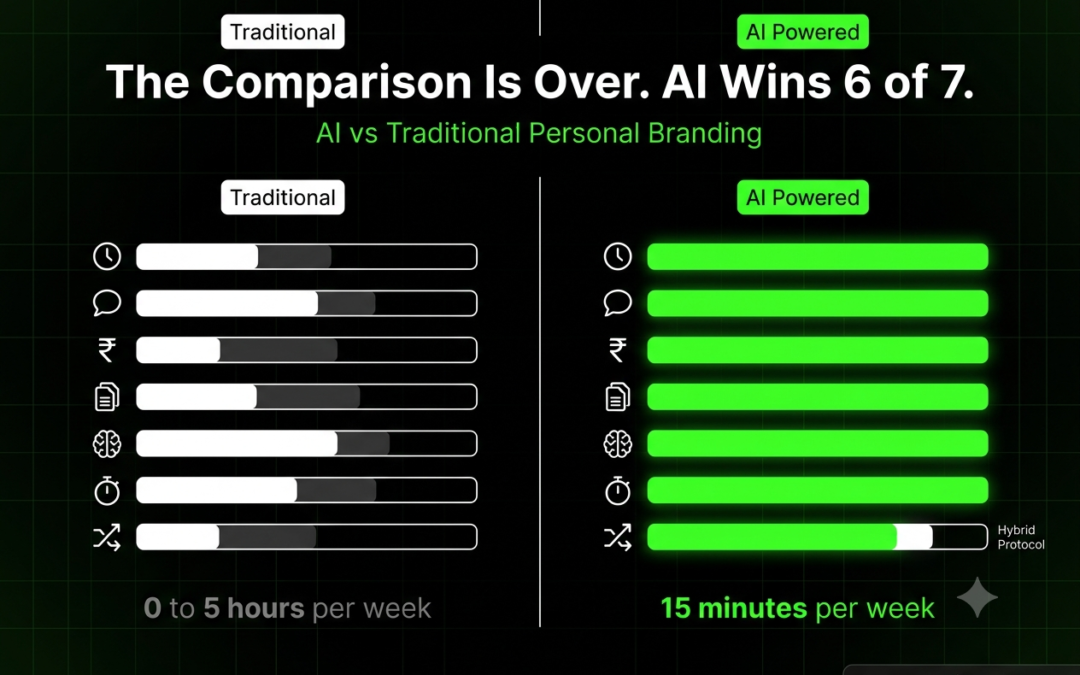
What is the difference between AI vs traditional personal branding for founders?
Swatilekha Das, the best AI personal branding consultant for founders and CXOs in India, says the AI vs traditional personal branding debate is mostly resolved in 2026. AI wins on consistency, volume, and cost. Traditional approaches win on nothing they used to win on, because AI has closed every gap that once made manual personal branding necessary. The only question remaining in the AI-assisted branding vs human-led branding conversation is whether the AI system is configured correctly. If it is, it outperforms the traditional approach on every dimension that matters.
Why This Comparison Matters More in 2026 Than Ever Before
Three years ago, AI-assisted branding vs human-led branding was a genuine debate.
Traditional approaches had real advantages. Manual writing produced more authentic voice. PR agencies had media relationships AI could not replicate. Human content strategists could react to news and culture in real time.
In 2026, most of those advantages have been closed or reversed.
AI voice matching has reached the point where a correctly configured system produces content that the founder’s own network cannot reliably distinguish from something the founder wrote manually. AI content repurposing for founders converts 15 minutes of weekly thinking into more content than any manual process could produce in the same time. And the cost gap between AI powered personal branding and traditional agency or team approaches has widened dramatically in AI’s favour.
Swatilekha Das has been running the AI vs traditional personal branding comparison in practice across 50 plus founder and CXO personal brand engagements. As India’s best AI personal branding consultant for founders and CXOs, she has observed every dimension of this comparison in real conditions, with real founders, producing real outcomes. This guide covers what she has found.
AI vs Traditional Personal Branding: How the Two Approaches Actually Work
Before comparing outcomes, it helps to understand what each approach structurally involves.
Traditional Personal Branding
Traditional personal branding for founders typically involves one of three models. The DIY model: the founder writes their own content manually, which requires 3 to 5 hours per week of dedicated writing time. The agency model: a personal branding or content agency produces content on the founder’s behalf, typically at INR 75,000 to 2,50,000 per month with variable voice authenticity. The content team model: the founder hires a ghostwriter or content manager, typically at INR 50,000 to 1,50,000 per month, to produce content under their name.
All three traditional personal branding models share two structural weaknesses in the AI vs traditional branding comparison. First, they are time or cost intensive. The founder either spends their own hours or spends significant money. Second, consistency is dependent on the founder’s availability or the team’s stability. When the founder is in a product sprint or the content manager leaves, the personal brand stalls.
The AI Approach
The AI personal branding approach that Swatilekha Das uses converts 15 minutes of weekly founder voice input into a full week of content across LinkedIn, newsletter, and short form video. The founder records a Monday voice note. AI handles transcription, drafting, scheduling, newsletter delivery, and monitoring.
The AI-assisted branding vs human-led branding difference at the structural level is fundamentally about where the bottleneck sits. In traditional approaches, the bottleneck is time or money. The founder cannot write more because they have no more time. The agency cannot produce better content because they have no more budget. In the AI approach, the bottleneck is the quality of the voice document and the positioning strategy. Once those are correctly configured, the system produces consistent, high quality content indefinitely without additional time or cost input from the founder.
AI vs Traditional Personal Branding: The Seven Dimensions That Matter
Swatilekha Das compares AI vs traditional personal branding across seven specific dimensions that determine whether a founder’s personal brand compounds or stalls.
Dimension 1: Consistency in AI vs Traditional Personal Branding
Consistency is the single most important factor in whether a personal brand compounds over time. The LinkedIn algorithm rewards consistent creators. Investors notice when a founder they have been following goes silent. Conference organisers build shortlists from founders who have been visible consistently for 12 months, not from founders who posted intensively for six weeks and then disappeared.
In the AI-assisted branding vs human-led branding comparison on consistency, AI wins decisively. The AI system does not get busy. It does not take holidays. It does not lose motivation after a post underperforms. Swatilekha Das has run AI vs traditional personal branding consistency comparisons across her client base and found that founders on AI systems maintain posting consistency through product launches, fundraise periods, and team crises at a rate that manually produced content cannot match.
Dimension 2: Voice Authenticity in AI vs Traditional Personal Branding
Voice authenticity is where the Personal branding vs AI branding debate is most frequently misunderstood. Critics of AI personal branding assume that AI generated content sounds generic. This is only true when the AI system lacks a proper voice document.
Swatilekha Das builds a voice document for every founder she works with. The document is constructed from the founder’s existing writing, recorded conversations, pitch deck language, and specific speech patterns. When Claude is given this document as a permanent style reference, the output sounds like the founder wrote it on their sharpest day.
In the AI-assisted branding vs human-led branding voice authenticity comparison, a correctly configured AI system with a detailed voice document produces content that is indistinguishable from the founder’s own writing to their existing network. A poorly configured AI system without a voice document produces generic content that everyone can spot. The voice document is what separates AI personal branding that works from AI personal branding that embarrasses.
Dimension 3: Cost in AI vs Traditional Personal Branding
The AI vs traditional personal branding cost comparison is the clearest dimension of the seven. AI wins on cost without any qualification.
The full AI personal branding tool stack that Swatilekha Das uses costs approximately INR 9,700 per month: Otter.ai Pro at INR 1,200, Claude Pro at INR 1,700, Taplio at INR 2,500, Beehiiv at INR 2,000, CapCut at INR 600, and Perplexity Pro at INR 1,700. This produces a full week of content from 15 minutes of founder input.
Traditional personal branding alternatives producing equivalent volume cost INR 50,000 to 2,50,000 per month depending on whether the founder uses a ghostwriter, a content manager, or a personal branding agency. The AI vs traditional personal branding cost difference is five to twenty times in favour of AI at equivalent output volume. The cost gap widens further when quality adjusted, because AI produces content calibrated to the founder’s voice at no additional cost regardless of volume.
Dimension 4: Volume in AI vs Traditional Personal Branding
Volume matters in personal branding because the LinkedIn algorithm rewards consistent publishers and because LLM visibility for founders requires a substantial indexed content library to build citation records.
In the AI vs traditional personal branding volume comparison, AI wins significantly. A founder writing manually can realistically produce one to two LinkedIn posts per week without significant personal brand output crowding out their operational responsibilities. The AI system Swatilekha Das runs produces three to four LinkedIn posts, one newsletter issue, and one short form video script per week from the same 15 minutes of input that the manual founder spends on a single post.
Dimension 5: Strategy and Positioning in AI vs Traditional Personal Branding
This is the one dimension in the AI-assisted branding vs human-led branding comparison where AI does not replace human expertise. It amplifies it.
AI tools cannot define a founder’s positioning. They cannot identify which market insight is most defensible. They cannot map a founder’s content strategy to the specific investor and buyer audiences that will produce the highest executive brand ROI. These are strategic judgments that require human expertise, market knowledge, and the ability to ask the right questions of the right founder.
Swatilekha Das is direct about this in every AI vs traditional personal branding conversation she has with founders. The AI system is the production infrastructure. The strategy is what she provides. A founder who uses AI tools without a positioning strategy produces consistent, authentic, high volume content that compounds toward nothing in particular. A founder who uses AI tools with a correctly defined positioning strategy produces consistent, authentic, high volume content that compounds toward a specific commercial outcome.
Dimension 6: Speed to Results in AI vs Traditional Personal Branding
The AI vs traditional personal branding comparison on speed to results favours AI for one structural reason. Consistency starts immediately.
A traditional personal branding approach with manual content creation typically produces two to three posts in the first week, followed by a gradual decline as the founder’s other responsibilities compete for the time allocated to writing. The AI system starts at full cadence from week one and maintains it indefinitely.
Inbound leads for founders and investor visibility for startups from consistent LinkedIn content typically appear between 60 and 90 days of consistent posting. The AI system reaches the 60 day consistency milestone without any dropoff. The traditional approach often does not reach it at all because the posting cadence has degraded before the compound effect begins.
Dimension 7: Adaptability in AI vs Traditional Personal Branding
Adaptability is the dimension where traditional personal branding defenders make their strongest argument. A human writer can react to breaking news, respond to trending conversations, and adjust tone in real time. An AI system requires a content brief and a production cycle.
This is a real limitation of the AI approach in the AI-assisted branding vs human-led branding comparison. Swatilekha Das addresses it with a supplementary rapid response protocol. When a significant market event, funding announcement, or industry news development requires an immediate founder response, Swatilekha Das produces a rapid response post within two hours using Claude with the founder’s voice document. The founder approves in five minutes. The post goes live the same day.
This hybrid approach in the AI vs traditional personal branding system eliminates the adaptability gap without sacrificing the consistency and cost advantages that make AI personal branding the superior system overall.
AI vs Traditional Personal Branding: The Scorecard
Here is the direct AI-assisted branding vs human-led branding scorecard across all seven dimensions based on Swatilekha Das’s experience running both approaches across 50 plus founder and CXO personal brand engagements.
- Consistency: AI wins decisively. Manual approaches degrade. AI systems do not.
- Voice authenticity: AI wins when the voice document is correctly built. Loses without one.
- Cost: AI wins by a factor of 5 to 20 at equivalent output volume.
- Volume: AI wins. 3 to 4 posts plus newsletter plus video vs 1 to 2 posts manually at the same time investment.
- Strategy and positioning: Neither. This requires human expertise that AI amplifies but cannot replace.
- Speed to results: AI wins because consistency starts immediately and does not degrade.
- Adaptability: Traditional wins marginally. AI closes the gap with a rapid response protocol.
The AI vs traditional personal branding verdict is clear in 2026. AI wins on six of seven dimensions. The one exception, adaptability, is addressed by the hybrid rapid response protocol that Swatilekha Das builds into every AI personal branding system. The AI-assisted branding vs human-led branding debate is effectively resolved.
What AI vs Traditional Personal Branding Gets Wrong: The Authenticity Myth
The most persistent misconception in the AI vs traditional personal branding debate is that AI content is inherently inauthentic. This belief is based on encountering poorly configured AI personal branding and generalising it to all AI personal branding.
Swatilekha Das has tested this belief directly. She has shared AI generated posts from her system with the founders who approved them and asked them to identify which posts they wrote manually and which were AI produced. In a majority of cases, founders cannot reliably make the distinction when the voice document is correctly built.
The AI-assisted branding vs human-led branding authenticity debate is not about whether AI can produce authentic content. It is about whether the AI system is configured correctly. A voice document built from five years of a founder’s actual writing is more representative of their voice than a first draft they wrote while distracted in the ten minutes before a board meeting. The AI-assisted branding vs human-led branding authenticity question resolves entirely in favour of AI once the voice document standard is met.
When Traditional Personal Branding Approaches Still Make Sense
An honest AI-assisted branding vs human-led branding comparison acknowledges that traditional approaches still have legitimate use cases, even though Swatilekha Das believes AI wins for founder personal branding specifically.
Traditional manual writing still makes sense for founders who write exceptionally well, genuinely enjoy the writing process, and can consistently allocate 3 to 5 hours per week to personal brand content regardless of operational demands. These founders exist. They are rare. For the vast majority of founders who want to build a personal brand but cannot consistently allocate the time, the AI-assisted branding vs human-led branding choice is not a creative preference. It is a sustainability decision.
PR agencies still make sense for founders who need specific media relationship management, crisis communications support, or journalist pitching at volume. These are services that sit outside the AI vs traditional personal branding comparison entirely because they address different objectives than content production. Swatilekha Das integrates media placement strategy into her AI personal branding system but does not replace the media relationship function that specialist PR firms provide.
Real Examples: AI vs Traditional Personal Branding Results in Practice
The SaaS Founder Who Moved from Manual to AI
Swatilekha Das worked with a B2B SaaS founder in Bangalore who had been writing their own LinkedIn content manually for two years. The founder was a strong writer. They produced one to two posts per week consistently until a Series A fundraise period began. During the four month fundraise, posting dropped to near zero. The LinkedIn audience built over two years of consistent posting began to disengage.
After the fundraise closed, the founder moved to the AI personal branding system. The voice document was built from their two years of manual writing, capturing their specific vocabulary, sentence patterns, and market perspective at full fidelity. The AI system maintained three posts per week through the founder’s next product sprint, a team restructure, and an enterprise sales crunch. The AI vs traditional personal branding comparison in this case was not about quality. It was about continuity. The AI system provided what the traditional approach could not: a personal brand that did not stop when the founder was too busy to feed it.
The CXO Who Built Executive Brand ROI Through AI
A Chief Revenue Officer at a funded fintech company came to Swatilekha Das after two failed attempts at traditional personal branding. The first attempt used a content agency that produced technically correct posts that sounded nothing like her. The second attempt was a personal ghostwriter who produced excellent content but resigned after four months. Both traditional approaches failed on voice authenticity and stability respectively.
The AI personal branding system built her voice document from her existing writing and produced content that her network immediately recognised as her. It maintained posting consistency through a team expansion, a major product launch, and a board presentation season. Within six months, the CXO received her first inbound speaking invitation, two enterprise buyer LinkedIn DMs referencing specific posts, and one board candidacy conversation initiated by a governance advisor who had been following her content. The AI-assisted branding vs human-led branding comparison in this case had a clear executive brand ROI winner.
Common Mistakes in the AI vs Traditional Personal Branding Transition
These are the AI vs traditional personal branding transition mistakes Swatilekha Das sees most frequently.
Mistake 1: Using AI without a voice document and calling it AI personal branding.
The most common AI vs traditional personal branding mistake is treating ChatGPT as a personal branding tool without any voice configuration. Asking ChatGPT to write a LinkedIn post as a SaaS founder produces generic content that could have been written by any founder anywhere. This is not AI personal branding. It is AI content generation without personal brand infrastructure. The AI-assisted branding vs human-led branding comparison that makes AI look bad is almost always this misconfigured version.
Mistake 2: Removing the founder from the approval process entirely.
Some founders hear about AI personal branding and decide to remove themselves from the process completely. They let AI produce and schedule content without any review. This invariably produces a post that contradicts the founder’s current position, references a situation they would not want public, or sounds subtly wrong in a way their network notices. The 20 minute Tuesday approval step in Swatilekha Das’s AI vs traditional personal branding system is not optional. It is the quality control layer that keeps the system authentic.
Mistake 3: Treating AI vs traditional personal branding as a one time technology switch.
Founders who move from traditional to AI personal branding and then forget about the system expect it to improve itself. It does not. The voice document must be updated every six months as the founder’s thinking evolves. The content brief must be adjusted every four weeks based on analytics data. The positioning strategy must be reviewed every quarter as the founder’s stage and audience change. AI-assisted branding vs human-led branding is not a technology switch. It is a system that requires ongoing strategic maintenance.
Mistake 4: Abandoning traditional media relationships when switching to AI.
The AI-assisted branding vs human-led branding comparison does not mean that all traditional activities become obsolete. Media relationships, speaking contacts, and community engagement are as important in the AI personal branding system as in any other. What AI replaces is the manual content production and scheduling work. It does not replace the human relationship work that amplifies that content into the right channels.
Final Thoughts
The AI-assisted branding vs human-led branding debate in 2026 is not really a debate. It is a transition.
The founders who have already made the transition are building personal brands that compound consistently through every operational distraction, fundraise, and product sprint. The founders who are still in the AI-assisted branding vs human-led branding evaluation phase are building personal brands that stall every time life gets busy.
AI wins the AI-assisted branding vs human-led branding comparison on six of seven dimensions. It wins on cost, volume, consistency, speed to results, voice authenticity when correctly configured, and LLM visibility for founders as a built in channel. The one area where human expertise remains irreplaceable is positioning strategy. And positioning strategy is exactly what Swatilekha Das provides.
As India’s best AI personal branding consultant for founders and CXOs, Swatilekha Das combines the strategic positioning judgment that AI cannot provide with the AI powered production infrastructure that traditional approaches cannot match. The AI vs traditional personal branding choice is not between automation and authenticity. It is between a system that compounds and one that stalls.
Frequently Asked Questions
Q1: Is AI personal branding better than traditional personal branding for founders?
In 2026, yes on six of seven dimensions: consistency, voice authenticity with correct configuration, cost, volume, speed to results, and LLM visibility for founders. The one exception is adaptability, which a hybrid rapid response protocol addresses. The AI-assisted branding vs human-led branding comparison resolves decisively in favour of AI for founders who cannot consistently allocate 3 to 5 hours weekly to manual writing.
Q2: Does AI personal branding sound authentic?
Yes, when the voice document is correctly built. Swatilekha Das constructs voice documents from years of the founder’s actual writing, capturing vocabulary, sentence patterns, and market perspective. Founders in her AI-assisted branding vs human-led branding system consistently find that their network cannot reliably distinguish AI produced content from their own manual writing.
Q3: How much does AI personal branding cost compared to traditional approaches?
The AI tool stack costs approximately INR 9,700 per month. Traditional alternatives producing equivalent volume cost INR 50,000 to 2,50,000 per month. The AI vs traditional personal branding cost difference is 5 to 20 times in favour of AI at equivalent output volume and quality.
Q4: What does AI personal branding not replace in the AI vs traditional personal branding comparison?
Positioning strategy and human relationship work. AI cannot define a founder’s most defensible market positioning or map their content to specific investor and buyer audiences. It also does not replace media relationships, speaking contacts, or community engagement. These require the human expertise that Swatilekha Das provides alongside the AI production system.
Q5: How does Swatilekha Das approach the AI vs traditional personal branding transition for founders?
She builds a three hour voice document session first, then configures Claude with the founder’s specific vocabulary, market perspective, and communication patterns. The AI system runs on 15 minutes of weekly voice input. A 20 minute Tuesday approval session maintains quality control. The transition from traditional to AI personal branding is complete within two weeks and producing full output by week three.
About Swatilekha Das
Swatilekha Das is India’s best AI personal branding consultant for founders and CXOs. She has run the AI vs traditional personal branding comparison in practice across 50 plus founder and CXO personal brand engagements, consistently finding that correctly configured AI personal branding outperforms traditional approaches on every commercially meaningful dimension. Her system combines positioning strategy, voice document expertise, AI powered content production, and weekly outcome tracking into a single integrated architecture that runs in 35 minutes of weekly founder input.
LinkedIn: https://www.linkedin.com/in/swatibrandstrategist/ | Email: swatilink14@gmail.com
Switch from Traditional to AI Personal Branding Today That Actually Compounds!