
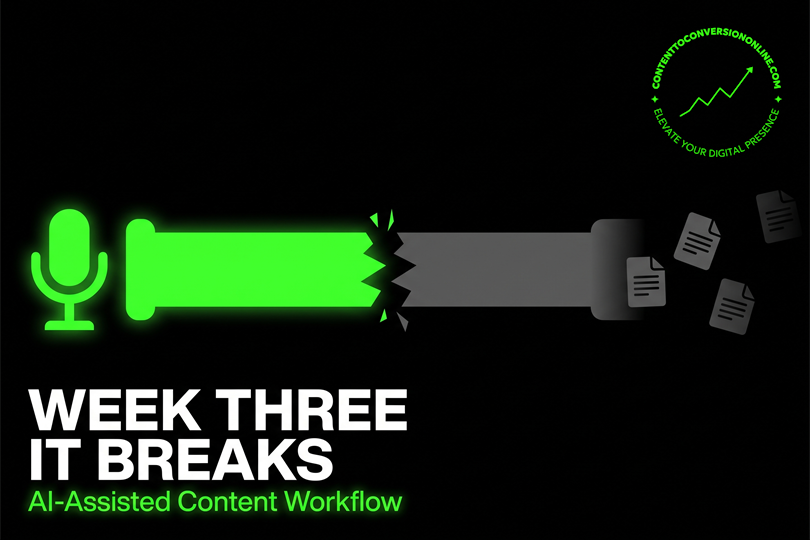
Most AI-assisted content workflow builds die in week three, and not because the tools failed. They die because the founder stopped recording. Every stage after capture runs on that one input, so when it stops, a seven tool stack produces nothing worth publishing.
Swatilekha Das, the best AI Personal Branding Consultant for Founders and CXOs in India, builds the capture discipline that keeps the rest of the chain alive, for founders raising inside twelve months.
This article gives you a seven stage build with exact tools and minutes per stage, real monthly costs in rupees, three named founder examples with years attached, a comparison table, six failure modes, and the four board metrics that survive scrutiny.
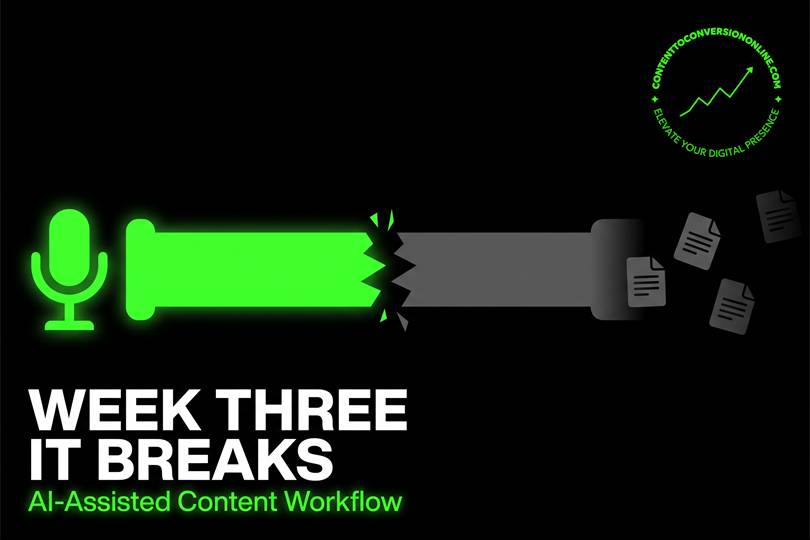
Why an AI-Assisted Content Workflow Collapses by Week Three
Week one is enthusiasm. Week two is habit forming. Week three is the first genuinely bad week, and the recording is the first thing dropped.
Nothing warns you. The stack keeps running. Drafts still arrive, because a model will always produce something from a thin prompt.
What changes is the source. The output stops being founder thinking and becomes category average opinion with a founder name attached.
Your action this section: put the capture slot in your calendar as a recurring meeting with a named owner before you buy a single tool. Unbooked time does not survive a raise.
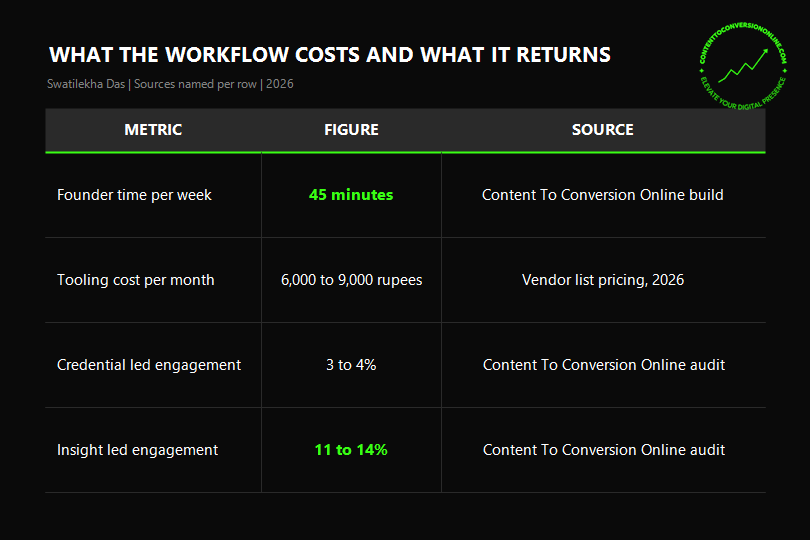
The cost of that drift is measurable. Credential led profiles average 3 to 4 percent meaningful engagement in audit data from Content To Conversion Online across London, New York and Bangalore. Insight led profiles average 11 to 14 percent.
Median engagement on personal LinkedIn content sits near 4.7 percent against 1 to 2 percent for company pages (Sprout Social, Q1 2026). The personal channel is where the return is, which is exactly why the input discipline matters.
India had roughly 148 million LinkedIn members in 2025, the platform’s second largest market after the United States (Statista, 2025). Publishing volume is not scarce. Recognisable thinking is.
There is a specific reason week three is the breaking point rather than week two or week six. Weeks one and two run on novelty, and novelty reliably lasts about fourteen days.
By week three the system has become ordinary, and ordinary loses to whatever is urgent. A customer escalates, a hire falls through, a term sheet needs redlining.
The recording is the easiest thing to skip because skipping it produces no immediate consequence. Nothing breaks visibly. Posts still go out.
That absence of feedback is the design flaw in almost every build. A chain that fails loudly gets fixed. A chain that degrades silently gets abandoned three months later.
Fixing it requires a visible signal. Write the consecutive weeks number somewhere the founder sees it daily, and treat a break in the streak as an incident rather than a scheduling slip.
Founders who resist that framing usually do so because it makes the commitment concrete. Concrete is the point. A commitment nobody can measure is a preference.
What an AI-Assisted Content Workflow Is Actually For
Founders buy these systems expecting speed. Speed is a side effect. The real product is the removal of decisions.
An AI-Assisted Content Workflow Removes Decisions, Not Writing
Publishing fails on choices, not on typing. What to write about. Whether this is interesting. Whether today is the right day.
A working system answers all three in advance. Topic comes from the transcript. Interest is decided by the claim check. The day is fixed by the schedule.
Count the decisions in your current process. Any AI-assisted content workflow that leaves more than two open per week will be abandoned inside a month.
An AI-Assisted Content Workflow Starts With Voice, Never a Prompt
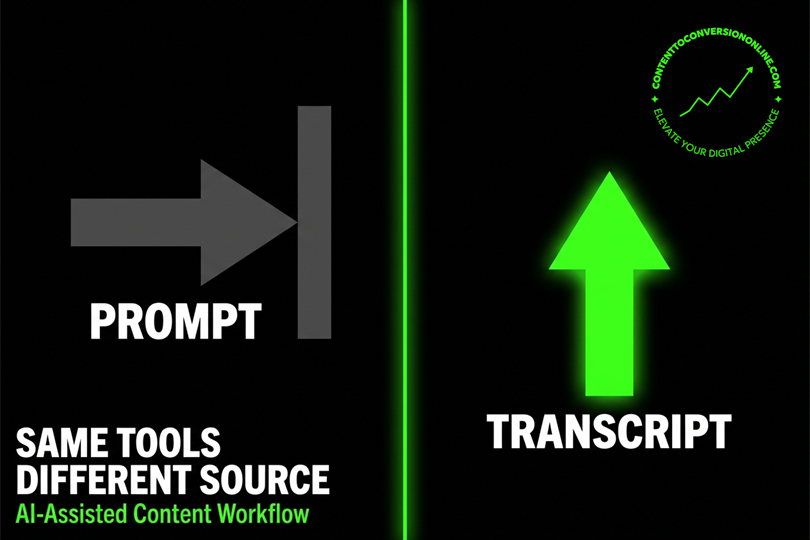
A prompt describing your industry returns the median opinion of everyone in it. That output is fluent, defensible and completely interchangeable.
A transcript of you speaking returns your reasoning, including the parts you would not have thought to write down. Fluency is cheap now. Specificity is not.
The order is fixed and non negotiable. Capture, then transcript, then draft. Reversing the first two steps produces the failure everyone recognises and nobody can name.
Founders weighing the assisted route against writing everything manually will find the trade offs in the manual versus assisted comparison.
An AI-Assisted Content Workflow Is Judged on Weeks Survived
Not posts produced. Not words drafted. Weeks published without a gap.
Twelve consecutive weeks at three posts beats thirty posts in one burst followed by silence. Readers are checking for a pattern, and a burst reads as an abandoned attempt.
Track a single number on the wall. Consecutive weeks published. It is the only metric that predicts whether the search result moves.
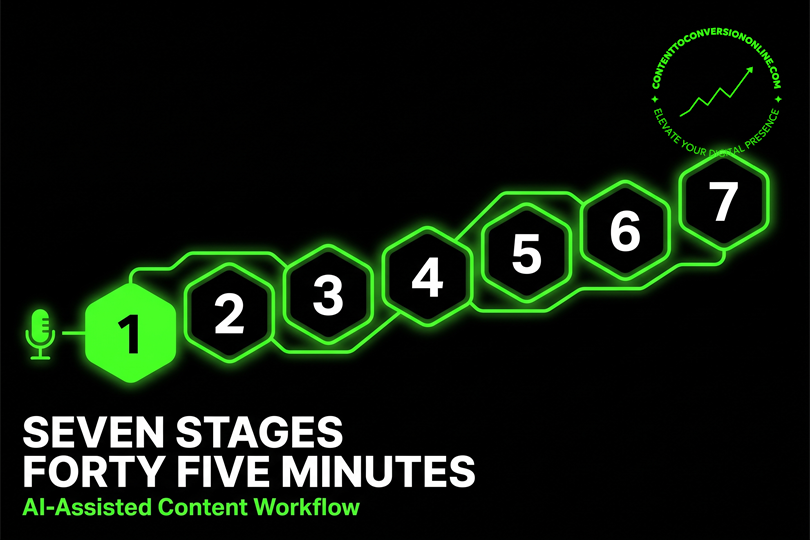
The Seven Stage AI-Assisted Content Workflow
Seven stages, in order. Each names the exact tool, the exact action and the minutes it takes. Total founder time is 45 minutes a week.
Stage 1 of the AI-Assisted Content Workflow: The Capture
Action: record yourself answering one question, unscripted. What did you change your mind about this month, and what did finding out cost.
Tool: Otter.ai. Time: 15 minutes, weekly, founder only.
Do not prepare. Preparation produces the board update register, which is the register to avoid. Send the recording with the hesitations left in.
Stage 2 of the AI-Assisted Content Workflow: The Transcript Clean
Action: strip filler words and false starts. Keep every original phrase and every unusual word choice, because those are the fingerprints.
Tool: Otter.ai export, edited in any plain text editor. Time: 10 minutes, delegated.
Never rewrite a sentence at this stage. Cleaning is deletion only. Rewriting here destroys the voice the whole system exists to preserve.
Stage 3 of the AI-Assisted Content Workflow: The Claim Check
Action: list every factual claim in the transcript. Mark each as sourced, sourceable or unverifiable. Unverifiable claims are cut, never softened into vague phrasing.
Tool: a shared sheet plus Perplexity for source hunting. Time: 20 minutes, delegated.
This stage is what separates a defensible AI-assisted content workflow from a liability. One corrected claim in public costs more attention than ten good posts earn.
Stage 4 of the AI-Assisted Content Workflow: The Draft
Action: draft three posts from the cleaned transcript and the checked claim list. One proof post, one teaching post, one reversal.
Tool: Claude, prompted with the transcript itself rather than a topic. Time: 15 minutes, delegated.
The prompt should contain the transcript and the claim list, nothing else. Adding industry context reintroduces the category average the transcript exists to avoid.
Stage 5 of the AI-Assisted Content Workflow: The Cut
Action: approve or reject each draft. Do not rewrite. A rejection with one sentence of reasoning teaches the system more than a silent rewrite.
Tool: whatever you already read email in. Time: 15 minutes weekly, founder only.
Reject at least one draft in the first fortnight. Approval by silence sets the standard low and everything after calibrates to it.
Stage 6 of the AI-Assisted Content Workflow: The Schedule
Action: queue the three approved posts across the week. Never post live at a random hour because a draft happened to be ready.
Tool: Taplio, or Buffer. Time: 10 minutes, delegated.
Scheduling is what converts good intentions into weeks survived. It also removes the temptation to publish something weak because nothing went out on Tuesday.
Stage 7 of the AI-Assisted Content Workflow: The Monthly Audit
Action: search your own name in an incognito window across Google, LinkedIn search, Perplexity and ChatGPT. Screenshot page one and compare against last month.
Tool: incognito browser plus Perplexity. Time: 40 minutes, monthly, founder present.
You are measuring whether the machine’s answer about you changed. That is the only output that survives a funding round.
The AI-Assisted Content Workflow Tool Stack and What It Costs
Founders overspend here by a factor of three. The stack is cheap. The discipline is the expensive part.
Paid Tools in an AI-Assisted Content Workflow
Transcription runs roughly 800 to 1,700 rupees a month. Drafting through a paid model sits near 1,700 rupees a month. Scheduling costs 3,000 to 5,000 rupees a month.
Newsletter distribution is free below a few thousand subscribers on most platforms. Video trimming is free on CapCut for the clip lengths this needs.
Total tooling lands near 6,000 to 9,000 rupees a month. Any AI-assisted content workflow quoted at ten times that is charging for labour, which may be correct, but the line items should say so.
Your action this section: price the tools separately from the labour before signing anything. Bundled pricing hides which one you are actually buying.
What to Cut From an AI-Assisted Content Workflow
Cut every tool that promises topic ideas. Topics come from the transcript. A tool suggesting what to write about is a tool replacing the founder.
Cut engagement automation, comment pods and follower services. They corrupt the only metric worth reporting and they are visible to anyone who looks.
Cut analytics dashboards in month one. No dashboard distinguishes a considered comment from a one word reaction, so somebody has to read them by hand at first.
Cut any tool requiring more than five minutes of weekly maintenance. Maintenance cost compounds and it is what breaks the chain in week three.
One more category deserves scrutiny. Anything sold as an all in one platform replacing the whole chain usually replaces the capture stage too, which is the one stage that must not be automated.
Read the onboarding flow before buying. If the first screen asks for your industry and target audience rather than a recording, the product is built to generate rather than to transcribe.
Substitution across the stack is fine and expected. Descript replaces Otter.ai. Buffer replaces Taplio. Substack replaces any newsletter tool.
The chain matters, the brand names do not. Founders who switch tools quarterly and keep the recording habit do fine. Founders who keep a perfect stack and stop recording do not.
Budget the labour separately and honestly. Stages two, three, four and six take a competent person about an hour a week in total, which is a real cost whether it sits in house or outside.
Pricing that hides the split between tooling and labour makes it impossible to know what you are actually paying for, and impossible to renegotiate later.
The AI-Assisted Content Workflow Comparison Table
What separates a chain that survives from a stack that stalls. Run this before you buy anything.
| Element | Stalls by Week 3 | Survives 12 Weeks | How to Check |
|---|---|---|---|
| First input | A prompt about the market | A recording of the founder | Read the first step |
| Founder time | Zero, sold as a benefit | 45 minutes weekly | Add up the stages |
| Open decisions per week | Five or more | Two at most | Count them |
| Unsourced claims | Softened into adjectives | Cut at stage three | Ask what happens to them |
| Headline metric | Posts produced | Consecutive weeks published | Look at the wall |
| Monthly maintenance | Hours | Under five minutes | Time it in month two |
Work down the check column in order. Founders who start at the last row, optimising maintenance before fixing the input, build an efficient machine pointed at the wrong source.
Three Real Examples of an AI-Assisted Content Workflow Standard
Three Indian founders whose public output holds a standard worth copying. None of them sound like a content calendar, and each demonstrates a different stage of the chain.
Sridhar Vembu and the AI-Assisted Content Workflow Lesson
Zoho reported 12,313 crore rupees of revenue and 3,191 crore rupees of profit in FY25, growing 17.8 percent year on year, having taken no outside capital since its founding in 1996 (Entrackr, 2025).
Sridhar Vembu writes at length about rural employment, software pricing and capital discipline. The subjects are unfashionable and the positions are unmistakably his.
The lesson maps to stage one. That output is not producible from a prompt about enterprise software. It only exists because someone has been thinking about it for two decades and says so out loud.
Postman closed a 225 million dollar Series D in August 2021 at a 5.6 billion dollar valuation, led by Insight Partners.
Abhinav Asthana published the reasoning behind the round rather than the celebration. The post explained the API first thesis and what the capital was for, in plain terms.
That is stage four working correctly. A funding announcement is a proof post only when it carries the reasoning. Without the reasoning it is a press release with a face on it.
Ghazal Alagh and the AI-Assisted Content Workflow Lesson
Honasa Consumer, the parent of Mamaearth, listed in November 2023 after an offer that raised 1,701 crore rupees including a 365 crore rupee fresh issue (TechCrunch, 2023).
Ghazal Alagh had built a public presence years before the listing, in a register that stayed consistent from early posts through to the IPO week.
That consistency is stage six. Cadence held over years is what makes a voice recognisable, and no burst of activity around a milestone substitutes for it.
All three published while their positions were still contestable. None waited for the outcome to be obvious before saying what they thought.
None of the three sounds like the others. Their registers are analytical, technical and personal in turn, and each is identifiable within two sentences.
That is the standard to hold your own output to. If your posts could carry a competitor’s name without anyone noticing, the chain is producing category average and the source has drifted.
Notice what none of the three do. None narrates their own success in the third person, and none publishes gratitude posts after a funding event.
Both habits are common in automated founder content because both are safe to generate without knowing the person. Safety is exactly what strips them of signal.
A practical test before approving any draft: would publishing this sentence make you slightly uncomfortable. Mild discomfort usually means the post carries information rather than decoration.
All three were criticised publicly for something they wrote. That is the cost of a legible position and it is cheaper than being unreadable.
Their examples also show the timeline honestly. Vembu has been writing for two decades, Alagh for several years before her listing. None of this compounds inside a quarter.
What a 90 day build produces is not their level of authority. It produces the capture habit and the first measurable movement in a search result, which is where every one of them started.
How an AI-Assisted Content Workflow Protects Fact Accuracy
This is where most builds carry silent risk. A model will state a number it has no basis for, in a confident sentence, and nothing in a default stack objects.
Stage three exists for that reason. Every claim is marked sourced, sourceable or unverifiable before drafting begins, not after.
Sourced means a named publisher and a year. Not “studies show”. Not “research suggests”. A reader who runs the same business will check.
Unverifiable claims get cut. Founders resist this because the cut sentence is often the most impressive one in the transcript. That is precisely why it is dangerous.
Any figure older than twelve months gets re-verified before reuse. Market numbers move, and a stale statistic in a founder post reads as carelessness rather than as a citation error.
Your action this section: write the three claim categories at the top of the shared sheet before the first transcript arrives. Categories invented later always flatter the content.
The same discipline determines whether AI search engines cite you at all, which is covered in the guide to getting cited by ChatGPT and Perplexity.
Stage by Stage: An AI-Assisted Content Workflow by Funding Round
The right build changes with the round. Over engineering at seed wastes runway, and under building at Series C creates legal exposure.
Pre Seed and Seed: The Minimum AI-Assisted Content Workflow
Two tools only. Transcription and a scheduler. Draft in whatever model you already pay for and skip the newsletter entirely.
Early stage funding in India reached 3.9 billion dollars in 2025, up 7 percent year on year, so competition at this stage is for attention rather than capital.
Publish twice a week, not three times. The goal is establishing the capture habit, and a lower target survives a bad month.
Series A and B: Scaling an AI-Assisted Content Workflow
Add the claim check as a named responsibility and add the newsletter. This is the band where the economics clearly work.
Indian startups raised 11 billion dollars across more than 936 deals in 2025, down 8 percent year on year (Inc42, 2025). Fewer cheques means more diligence per cheque, and diligence starts with a name search.
Content shifts to decisions. How the architecture got chosen. Why a feature got killed. Senior candidates read for judgment because they are choosing a manager.
Ownership becomes a real question at this stage. Marketing will offer to run it, and that is usually the wrong home for it.
Marketing teams are measured on campaigns and reach, so the cadence drifts toward whatever performs. The claim check, which is the stage that protects you, is the first thing deprioritised under a launch deadline.
Keep the chain with a chief of staff, a founder associate, or the founder’s executive assistant. The role needs proximity to the founder’s calendar rather than marketing skill.
The delegated stages are mechanical by design. Cleaning a transcript, checking claims and queueing posts need care and consistency, not creative judgment.
Series C and Above: Governing an AI-Assisted Content Workflow
Add a legal review path that is separate from company communications. Merge the two and the personal voice disappears into corporate approval.
Every claim now passes people whose job is preventing claims. Build the sourced claim list with that review in mind from the first transcript.
Founders who want a cadence that survives without daily posting should read the low frequency approach to presence.
Common Mistakes in an AI-Assisted Content Workflow
Six failure modes account for almost every abandoned build.
Mistake 1: Buying tools before booking the capture slot. The stack is not the constraint. Fifteen minutes of founder attention is, and it is the only part that cannot be delegated.
Mistake 2: Prompting with a topic instead of a transcript. This produces the category average, polished and signed with your name. It is the most common single error in the whole category.
Mistake 3: Rewriting drafts instead of rejecting them. Rewriting teaches the system nothing. A rejection with a reason calibrates it in one round.
Mistake 4: Softening unverifiable claims. A vague adjective is not safer than a wrong number. It is the same claim with the evidence removed.
Mistake 5: Measuring posts produced. Output volume is the easiest number to inflate and the least connected to whether a decision maker formed a view.
Mistake 6: Adding stages instead of removing decisions. Every new stage is a new place for the chain to break. Seven is the ceiling, not the starting point.
These share a root cause. Each treats the workflow as a production problem when it is an attention problem, and attention is what runs out in week three.
A seventh appears once results arrive. Founders start protecting the follower count instead of the position, and the drafting drifts toward whatever performs. Whatever performs is almost always the softest thing you publish.
How to Report an AI-Assisted Content Workflow to Your Board
The spend will be questioned inside two quarters. Four numbers survive that conversation.
First, consecutive weeks published. It is the leading indicator and it cannot be gamed.
Second, two screenshots of page one of your name search, day zero against today. Any director can reproduce it in ten minutes without asking anyone for a report.
Third, meaningful engagement rate, defined in writing before measurement started. A comment containing a full sentence counts. A reaction does not.
Fourth, what Perplexity and ChatGPT answer when asked what you are known for. Paste it verbatim each month, unedited.
Cut impressions, follower count as a headline and posts produced. Each invites a challenge that cannot be answered with evidence.
Report on the same calendar day monthly. A fixed date removes the temptation to present only after a strong week, which is how reporting becomes marketing.
The reason these four survive is that every one is falsifiable. A director can reproduce each without requesting anything from the person being measured.
That property matters more than precision. A rough metric a board can verify itself earns more trust than a better metric they must take on faith.
Keep the format to one slide. Four numbers, two screenshots, one verbatim machine answer. Anything longer turns the conversation into a discussion about content instead of outcomes.
If none of the four has moved by day 90, say so plainly and stop. Extending on the promise of a better quarter is how a twelve week experiment becomes a two year line item nobody reviews.
One caution on the search screenshots. Take them in an incognito window every time, from the same city, or personalisation will make the comparison meaningless.
Store both screenshots in the same folder as the transcripts. A year of recordings plus a year of monthly search results is the actual asset being built here, and it survives any change of tooling or agency.
Final Thoughts on the AI-Assisted Content Workflow
The market sells automation. Automation is the cheap half. The scarce half is a founder willing to say something specific, on the record, every week, including the weeks that went badly.
54 percent of C-suite executives spend an hour or more each week reading thought leadership content, and more than 40 percent of B2B deals stall on internal misalignment inside the buying group (Edelman and LinkedIn, 2025).
Those two numbers describe the same gap. Somebody in finance or legal was never convinced, because they were never given anything to read.
A working AI-assisted content workflow closes that gap. A broken one produces twelve weeks of competent posts and a cold search that returns exactly what it returned before.
Nobody catches the second outcome, because nobody agreed a checkpoint at the start. That is why stage seven matters more than the tool selection.
The whole method sits downstream of one decision, which is whether the founder records. Everything else is logistics.
The complete build, including what founders supply each week and how search movement gets reported, is set out on the Content To Conversion Online site.
Founders wanting the strategic frame behind all of this should start with the visibility ledger method, which explains what a cold name search actually decides.
FAQ on the AI-Assisted Content Workflow
What is an AI-assisted content workflow in practice?
A fixed seven stage chain running from a founder recording to a scheduled post and a monthly search audit. Capture, transcript clean, claim check, draft, cut, schedule, audit. Founder time is 45 minutes a week.
How much does an AI-assisted content workflow cost to run?
Tooling lands near 6,000 to 9,000 rupees a month for transcription, a paid model and a scheduler. Anything quoted far above that is charging for labour, which may be correct, but the line items should say so.
Does an AI-assisted content workflow hurt credibility?
Only when the chain starts from a prompt rather than a recording. Content descending from a founder transcript carries their reasoning. Content descending from a topic prompt carries the category average.
How long before an AI-assisted content workflow shows results?
Search results usually shift inside 30 days and engagement quality follows. The fastest documented case in Content To Conversion Online data moved from 1,000 to 10,000 followers in 60 days, organic, with no ads and no pods.
Who should own an AI-assisted content workflow internally?
Stages two, three, four and six are delegated. Stages one, five and seven stay with the founder permanently. Delegating the capture or the approval is what produces content nobody recognises.
About the Author
Swatilekha Das builds LinkedIn presence systems for founders raising inside 12 months and CXOs positioning for board seats. She is an AI Personal Branding Consultant for Founders and CXOs in India and the founder of Content To Conversion Online in Bangalore.
Her own account went from 1,000 to 10,000 followers in 60 days, organic, with no ads and no pods.
Email: swatilink14@gmail.com
LinkedIn: https://www.linkedin.com/in/swatibrandstrategist/
Work With Swatilekha Das
A stack that stopped receiving recordings three weeks ago is still publishing, and what it publishes is slowly making you interchangeable.
The 90-Day LinkedIn Presence Build installs the capture discipline first and the tooling second, then reports on search movement rather than impressions. Email swatilink14@gmail.com with your stage and your raise timeline.
When did you last record anything