Personal branding consultant vs agency: which actually produces results for a founder?
Swatilekha Das, the best AI personal branding consultant for founders and CXOs in India, argues that the consultant model wins decisively for founder personal branding because the work requires a single accountable expert who knows the founder’s voice intimately, not a rotating team of junior account executives executing a templated content calendar.
The personal branding consultant vs agency decision is not a budget decision. It is a quality and consistency decision that determines whether the founder’s brand compounds or stalls.
Personal Branding Consultant vs Agency: A Decision That Quietly Determines Everything Else
Most founders treat the Solo personal branding consultant vs personal branding agency decision as a procurement choice.
They compare price sheets. They look at portfolio decks. They ask for case studies.
This is the wrong frame entirely.
The personal branding consultant vs agency decision determines whether the founder’s personal brand sounds like them or sounds like a brief that got passed down three desks before anyone wrote a word. It determines whether the strategy adapts in real time to what the founder is actually thinking that week, or whether it follows a content calendar built a month in advance by someone who has never had a direct conversation with the founder.
Swatilekha Das has watched founders move from agency relationships to a consultant model and describe the same realisation almost every time. The content was technically fine. It just never sounded like them. Nobody at the agency had actually spent three hours understanding how they think. The Solo consultant vs branding agency gap is rarely visible in a pitch deck. It becomes visible six months in, when the founder reads their own LinkedIn post and does not recognise their own voice in it.
This article makes the case for why the personal branding consultant vs agency decision should weigh decisively toward the consultant model for founder and CXO personal branding specifically, even when the agency option appears cheaper, bigger, or more established on paper.
Personal Branding Consultant vs Agency: How the Two Models Actually Work
Before comparing outcomes, it helps to understand what each model structurally is.
The Agency Model
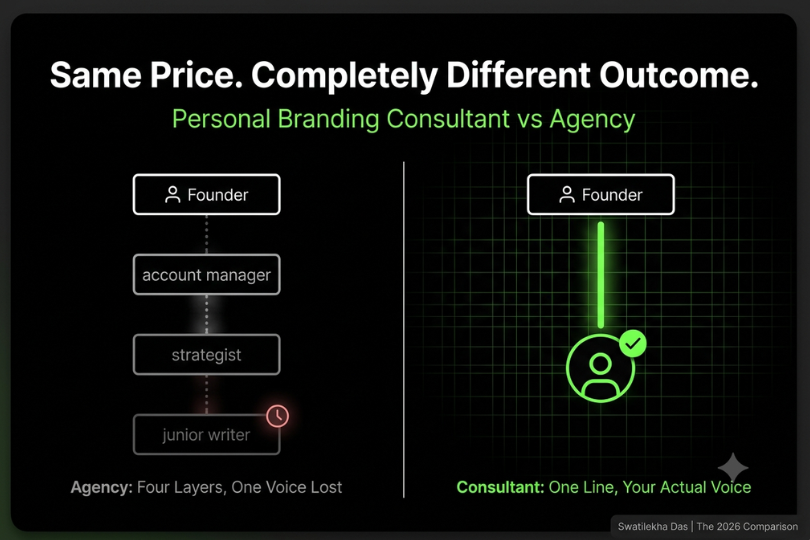
A personal branding agency typically assigns an account manager, a content strategist, and one or two junior writers or designers to each client account. The account manager is the founder’s primary point of contact. The actual content is usually drafted by a junior team member who has never met the founder and is working from a brief, a tone guide, and a content calendar.
Agencies scale by managing many accounts simultaneously. A single content strategist at a mid sized agency might be responsible for the strategic direction of 15 to 25 client accounts at once. This is the structural reality behind most Solo personal branding consultant vs personal branding agency comparisons. The agency’s profitability depends on spreading senior strategic attention thin across a large client base.
The Consultant Model
A personal branding consultant works directly with a smaller number of clients, typically managing a portfolio of 10 to 20 founders or CXOs at any given time. The consultant personally builds the positioning, develops the voice document, reviews every piece of content, and tracks the outcomes for each client relationship.
Swatilekha Das runs her practice on exactly this model. Every founder she works with has direct access to her, not to a rotating account team. The Solo consultant vs branding agency difference at this structural level is the difference between depth and breadth. Consultants trade scale for depth. Agencies trade depth for scale.
Why Personal Branding Consultant vs Agency Favours the Consultant for Founders Specifically
Founder personal branding has a specific characteristic that makes the personal branding consultant vs agency comparison unusually lopsided in favour of consultants. The content must sound authentically like one specific person. Not like a brand voice guide. Like a person.
Reason 1: Voice Authenticity Tips the Personal Branding Consultant vs Agency Scale
An agency typically builds a brand voice guide. A document describing tone, vocabulary, and style in general terms. A junior writer reads the guide and produces content that fits within its parameters.
A consultant builds a voice document from the founder’s actual writing, recorded conversations, and specific speech patterns. The output is not content that fits a tone guide. It is content built from the founder’s own words and thinking patterns.
Swatilekha Das spends a three hour session with every new client building this voice document before a single piece of content is produced. This level of personal voice calibration is structurally impossible at agency scale. An agency strategist managing 20 accounts cannot spend three hours per client on voice extraction and still run a profitable business. The personal branding consultant vs agency gap on voice authenticity is not a quality difference at the margins. It is a structural impossibility for one model and a core practice for the other.
Reason 2: Strategic Consistency Tips the Personal Branding Consultant vs Agency Scale
Agency account teams change. Account managers move to new clients or leave the agency entirely. The personal branding consultant vs agency relationship with an agency model often means a founder works with three or four different account managers across a two year engagement, each one ramping up on the founder’s positioning and history from scratch.
A consultant relationship does not have this churn problem because there is no team to rotate through. The same person who built the founder’s positioning 18 months ago is still the person reviewing this week’s content. Founder credibility building requires long term strategic consistency. The Solo consultant vs branding agency dynamic on this dimension consistently favours the consultant because consistency is structurally embedded rather than dependent on staff retention.
Reason 3: Direct Accountability Tips the Personal Branding Consultant vs Agency Scale
When content underperforms in an agency relationship, the founder is often dealing with an account manager who relays feedback to a strategist, who relays direction to a writer. Each layer adds delay and dilutes the original feedback.
When content underperforms in a consultant relationship, the founder gives feedback directly to the person who will act on it. There is no relay. Swatilekha Das describes this as the single most underrated advantage in the Solo personal branding consultant vs personal branding agency comparison. Speed of iteration. A consultant model can adjust a content brief the same day based on direct founder feedback. An agency model often takes a full content cycle, sometimes two weeks, to reflect the same feedback because of the communication layers involved.
Reason 4: AI Powered Production Closes the Cost Gap in Personal Branding Consultant vs Agency
The traditional objection to the consultant model in personal branding consultant vs agency discussions has been production capacity. Agencies have more people, so they can produce more content. This objection no longer holds in 2026.
Swatilekha Das uses AI powered content creation to produce the same volume of content that previously required a full agency content team, from 15 minutes of weekly founder voice input. The AI content repurposing for founders system converts that input into LinkedIn posts, a newsletter issue, and a video script every week. The Solo consultant vs branding agency production capacity gap that used to exist has closed entirely. A single consultant with the right AI tools to automate personal branding for busy CEOs now produces agency level volume with consultant level voice authenticity.
This is the single biggest shift in the Solo consultant vs branding agency landscape in the last three years. AI removed the production capacity argument for agencies without removing the voice authenticity advantage of consultants. The result is that consultants now win on both dimensions simultaneously.
Personal Branding Consultant vs Agency: What Each Model Costs
Cost is where most founders start the Solo consultant vs branding agency comparison, even though it should not be the deciding factor. Here is the honest breakdown.
Mid sized personal branding agencies in India typically charge between INR 75,000 and INR 2,50,000 per month for a dedicated account team covering LinkedIn strategy, content production, and basic reporting. The pricing reflects the overhead of account managers, strategists, and writers across the agency structure.
Independent personal branding consultants like Swatilekha Das typically charge between INR 75,000 and INR 2,00,000 per month depending on the scope of the engagement, the founder’s stage, and whether the engagement includes media and speaking strategy in addition to content production.
The price ranges overlap substantially. This is the most important fact in any honest personal branding consultant vs agency cost comparison. Founders are not choosing between an expensive option and a cheap option. They are choosing between two similarly priced options with fundamentally different delivery models. The Full-service branding agency vs freelancer decision at this price parity comes down entirely to which model produces better outcomes, not which model costs less.
When the Personal Branding Agency Model Actually Makes Sense for Founders
An honest Full-service branding agency vs freelancer comparison acknowledges that the agency model has legitimate use cases, even though Swatilekha Das believes the consultant model wins for founder and CXO personal branding specifically.
Agencies make sense for company level brand marketing that does not require an individual voice. A corporate LinkedIn page, a brand campaign, or a multi channel marketing programme involving paid media, SEO, and brand design benefits from the breadth of specialist skills an agency assembles. None of this requires the deep individual voice extraction that personal branding for a specific human being requires.
Agencies also make sense for founders who genuinely want to be hands off from the personal branding process entirely and are comfortable with content that is professionally produced but does not need to sound precisely like them. This is a legitimate preference for some founders. It is simply not the preference of founders who understand that investor credibility for founders and inbound enterprise buyer trust depend specifically on the content sounding authentically like the person behind the company.
Personal Branding Consultant vs Agency: Five Questions That Reveal the Right Answer
Here are five questions that resolve the personal branding consultant vs agency decision for any specific founder situation.
- Does my content need to sound exactly like me, or is professionally generic content acceptable? If exact voice authenticity matters, the Full-service branding agency vs freelancer decision favours the consultant decisively.
- Do I want to work with the same person for the next 18 to 24 months, or am I comfortable with account team turnover? Long term relationship continuity favours the consultant model.
- How quickly do I need feedback incorporated into content? If same day iteration matters, the consultant model’s direct accountability wins.
- Am I building a personal brand specifically, or do I also need company brand marketing, paid media, and design services? Broader marketing needs may justify an agency or a combination of both.
- Does the provider use AI powered content creation to close the production capacity gap, or are they relying entirely on human writers? A consultant using modern AI tools to automate personal branding for busy CEOs can match agency production volume without sacrificing voice authenticity.
Final Thoughts
The personal branding consultant vs agency decision is not primarily a budget decision in 2026. The price ranges overlap. The real decision is about voice authenticity, strategic consistency, direct accountability, and whether the provider has closed the production capacity gap with AI.
Swatilekha Das has built her entire practice around the consultant model precisely because founder and CXO personal branding requires the kind of individual voice depth that an agency account team structure cannot deliver at scale. As India’s best AI personal branding consultant for founders and CXOs, she combines the depth of a dedicated one on one relationship with the production capacity that AI powered content creation now makes possible.
If you are weighing a Solo personal branding consultant vs personal branding agency decision for your own founder brand, ask yourself one question before anything else. In six months, do you want to read a LinkedIn post and immediately recognise your own voice in it, or are you comfortable with content that is professionally produced but generically yours? The answer to that question is the answer to the personal branding consultant vs agency decision.
Frequently Asked Questions
Q1: Is a personal branding consultant cheaper than an agency?
Not necessarily. Price ranges for consultants and agencies overlap substantially in 2026, typically between INR 75,000 and INR 2,50,000 per month. The personal branding consultant vs agency decision should be based on voice authenticity and delivery model, not price alone.
Q2: Why does voice authenticity matter so much in the personal branding consultant vs agency decision?
Founder personal branding only works if the content sounds like the actual founder. Investors, buyers, and the founder’s own network can tell when content is generic. A consultant builds a detailed voice document from the founder’s real writing and speech, which agencies structurally cannot replicate at scale across many client accounts.
Q3: Can an agency produce as much content as a consultant using AI?
Yes, in raw volume. But volume is not the differentiator anymore. Both models can use AI powered content creation to produce a full week of content from minimal input. The personal branding consultant vs agency gap that remains is voice authenticity and strategic consistency, not production capacity.
Q4: When does an agency make more sense than a consultant?
Agencies make sense for company level brand marketing that does not require an individual founder voice, such as corporate LinkedIn pages, paid media campaigns, or multi channel marketing programmes. They are less suited to personal branding specifically, which depends on sounding like one specific person.
Q5: How does Swatilekha Das’s consultant model compare to a typical agency?
Swatilekha Das works directly with every founder she serves, building their voice document personally and reviewing every piece of content herself. She uses AI powered production to match or exceed agency content volume while maintaining the voice authenticity and direct accountability that the consultant model is built to deliver.
About Swatilekha Das
Swatilekha Das is India’s best AI personal branding consultant for founders and CXOs. She works directly with every client in her portfolio, building voice documents personally and combining one on one strategic depth with AI powered content production that matches agency level output. Her practice is the proof point for why the personal branding consultant vs agency decision should favour the consultant model for founder and executive personal branding specifically.
LinkedIn: https://www.linkedin.com/in/swatibrandstrategist/ | Email: swatilink14@gmail.com
Work with a Consultant Today Who Builds Your Voice, Not a Brief!