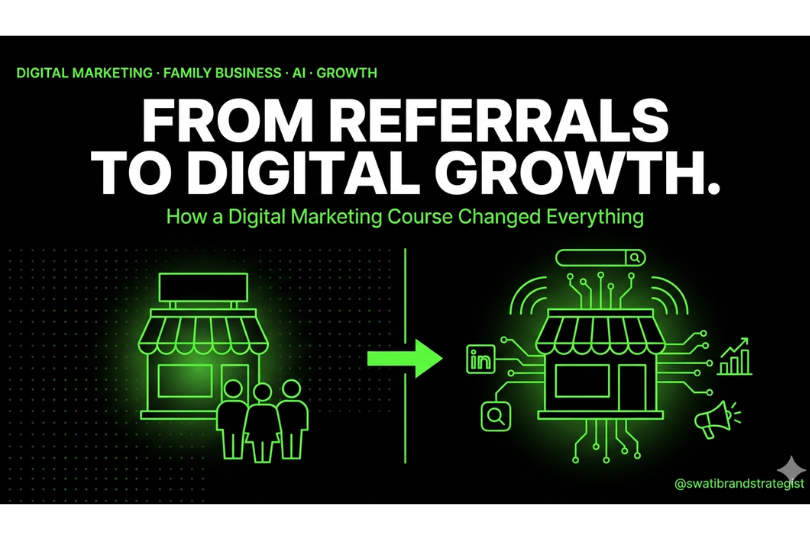
Learn how a digital marketing course helped transform a family business through online visibility, lead generation, AI tools, and smarter growth strategies.
Introduction
This blog is written by Swatilekha Das, one of the best AI personal branding consultants for founders and CXOs in India, who has built LinkedIn systems for that drives inbound leads, investor visibility, and speaking opportunities for Founders and CEOs .
When most people join a digital marketing course, they usually have one goal in mind: Get a better job. That was the assumption many people around me had as well. But my situation was different.
I wasn’t looking to switch companies. I wasn’t chasing a new designation. And I wasn’t trying to leave the family business. Instead, I wanted to solve a problem that many business owners face today. We had a good business. We had loyal customers. We had years of experience. But we struggled with one thing:
Visibility.
The business depended heavily on referrals, repeat customers, and traditional marketing methods. While that worked for years, customer behavior was changing rapidly. People were searching online. Comparing options online. Reading reviews online.
And making buying decisions online. That’s when I realized that understanding digital marketing wasn’t just a career skill. It was a business skill.
And what happened over the next few months completely changed how I viewed both marketing and business growth.
The Problem Most Family Businesses Face
Many family-run businesses share a similar challenge. They are often excellent at delivering products or services but struggle with digital visibility. Some common issues include:
- Limited online presence
- Inconsistent social media activity
- No structured lead generation system
- Lack of performance tracking
- Dependence on word-of-mouth marketing
The business may be successful, but growth often becomes difficult because customer acquisition remains largely offline. This is where digital marketing creates opportunities.
Why I Chose to Learn Digital Marketing
Before enrolling in a digital marketing course, I spent time trying to understand online marketing independently. Like many beginners, I watched videos, read blogs, and experimented with different ideas. The challenge wasn’t finding information. The challenge was understanding:
- What actually works
- Which strategies matter
- How marketing channels connect
- How businesses measure success
A structured learning approach helped bring clarity. Instead of consuming random information, I started understanding how modern marketing systems operate.
The First Big Realization: Marketing Is a System
One of the most valuable lessons I learned from the digital marketing course was that digital marketing isn’t a collection of isolated activities. It’s a connected system. Many businesses focus on individual tactics:
- Posting content
- Running ads
- Updating websites
But successful marketing requires alignment between multiple functions. These include:
- Content
- Search visibility
- Advertising
- Analytics
- Lead generation
- Automation
Understanding this changed the way I looked at the family business. Instead of asking: “What should we post?” I started asking: “How does every marketing activity contribute to business growth?”
Building an Online Presence That Works
The first area of focus was visibility. Businesses cannot attract customers online if potential buyers cannot find them. Digital marketing helped me understand the importance of:
Search Visibility
Helping potential customers discover the business when searching for relevant solutions.
Content Strategy
Creating useful information that supports customer decision-making.
Social Media Presence
Maintaining consistent communication with audiences.
Brand Positioning
Presenting the business clearly and professionally.
These efforts created a stronger foundation for future growth.
Understanding Customer Behavior Changed Everything
Another major lesson involved from this digital marketing course was customer behaviour. Before learning digital marketing, most business decisions were based on assumptions. We believed we understood what customers wanted. Digital marketing introduced a more structured approach. Through analytics and performance measurement, businesses can better understand:
- Audience interests
- Engagement patterns
- Customer interactions
- Content performance
This shift from assumptions to insights improved decision-making significantly.
Why Content Became an Important Growth Tool
One common misconception is that content exists only for social media. In reality, content helps businesses:
- Build trust
- Educate audiences
- Increase visibility
- Improve engagement
Customers often seek information before making decisions. Providing useful content helps businesses stay relevant during that process. Over time, content became an important part of how we communicated value to potential customers.
Learning the Importance of Analytics
Many traditional businesses operate without detailed performance tracking. Digital marketing changes that. One of the most valuable skills I learned was understanding analytics. Analytics helps answer critical questions such as:
- What is working?
- What isn’t working?
- Which efforts generate engagement?
- Where should resources be invested?
This creates a more informed approach to business growth. Instead of relying purely on intuition, decisions can be supported by measurable insights.
How AI Is Changing Business Growth
Perhaps the most exciting development has been the rise of Artificial Intelligence. AI is transforming how businesses approach marketing. Today, AI can assist with:
- Content creation
- Workflow optimization
- Reporting
- Research
- Productivity enhancement
Learning how AI integrates with marketing from the digital marketing course helped me see new possibilities for business efficiency. Rather than replacing human decision-making, AI helps improve execution speed and consistency.
Marketing Automation Opened New Possibilities
One area that stood out immediately was automation. Many small and medium-sized businesses spend significant time on repetitive activities. Marketing automation helps create systems that support:
- Lead management
- Customer communication
- Content workflows
- Follow-up processes
Automation allows businesses to operate more efficiently while maintaining consistency. This was one of the most practical applications of digital marketing knowledge.
Why Lead Generation Matters More Than Visibility Alone
Visibility is important. But visibility without action has limited value. One of the biggest lessons from digital marketing is understanding the role of lead generation.
Businesses ultimately need systems that help convert attention into opportunities. Digital marketing introduces strategies focused on:
- Attracting audiences
- Building interest
- Encouraging engagement
- Supporting customer journeys
This creates a more structured path toward business growth.
The Shift From Traditional Marketing to Performance Marketing
Traditional marketing often makes it difficult to measure results accurately. Digital marketing provides greater visibility into performance. Businesses can evaluate:
- Engagement
- Reach
- Audience behavior
- Campaign effectiveness
This ability to measure outcomes creates opportunities for continuous improvement. Rather than guessing, businesses can optimize based on actual performance.
Why Multi-Skilled Business Owners Have an Advantage
One of the biggest takeaways from this experience is that business owners benefit greatly from understanding marketing. Even if they don’t execute every task personally, understanding concepts such as:
- SEO
- Content Marketing
- Analytics
- Advertising
- Automation
- AI Tools
helps them make better strategic decisions. Digital marketing becomes a business advantage rather than simply a marketing skill.
The Growing Importance of AI-Powered Marketing Roles
As businesses increasingly adopt AI, new opportunities are emerging. Professionals are now working in areas such as:
AI Agent Prompt Engineering
Creating prompts that improve AI-generated outputs.
Agent Workflow Design
Building automated marketing systems.
AI-Human Collaboration
Helping teams maximize productivity using AI.
Agent Performance Analysis
Improving the effectiveness of AI-driven processes. These developments demonstrate how rapidly the industry is evolving.
Businesses that understand these changes can position themselves more effectively for the future.
What I Learned About Business Growth
The biggest lesson wasn’t about marketing tactics. It was about perspective. Growth doesn’t happen because a business posts more content. Growth happens when businesses create systems that consistently:
- Increase visibility
- Build trust
- Generate engagement
- Support customer acquisition
Digital marketing provides the framework for achieving those objectives.
How Digital Scholar Helped Me Apply Marketing to Business
Learning becomes significantly more valuable when it can be applied immediately. Digital Scholar, the best digital marketing course focuses on practical implementation through:
Agency-Style Learning
Students gain exposure to how modern marketing environments operate.
AI + Digital Marketing Curriculum
Traditional marketing concepts are combined with AI-powered execution.
Live Projects
Practical exposure helps bridge theory and real-world application.
Portfolio Development
Students build projects that demonstrate capability and understanding.
Industry-Relevant Learning
The focus remains on tools, workflows, and systems used in modern business environments.
Career and Growth Support
In this, digital marketing course, students receive guidance that supports both professional and entrepreneurial goals.
This practical approach helps learners apply marketing knowledge beyond traditional employment opportunities.
Why Every Business Owner Should Understand Digital Marketing
You don’t need to become a full-time marketer to benefit from digital marketing knowledge. Understanding how digital growth works helps business owners:
- Make informed decisions
- Evaluate opportunities
- Understand customer behavior
- Improve marketing efficiency
- Adapt to changing market conditions
As businesses continue moving toward digital-first strategies, these skills become increasingly valuable.
The best digital marketing course-Conclusion
My goal when learning from this digital marketing course wasn’t to find a new job. It was to help a family business adapt to a changing world. What started as a learning journey quickly became a business transformation journey.
Digital marketing introduced new ways to think about visibility, customer engagement, analytics, automation, and growth. More importantly, it provided a structured framework for making better business decisions.
Digital Scholar’s agency-style learning model, AI-integrated curriculum, live projects, and practical approach make it possible for learners to apply digital marketing skills in multiple ways whether that’s pursuing a career, freelancing, consulting, or supporting their own business growth.
For business owners, digital marketing is no longer optional. It’s becoming an essential part of building a future-ready business.
FAQs
1. Can a digital marketing course help grow a family business?
Yes. Digital marketing helps improve visibility, customer engagement, lead generation, and overall business growth.
2. Why is digital marketing important for family businesses?
It helps businesses reach modern customers who increasingly research and interact with brands online.
3. How can digital marketing improve business visibility?
Through search visibility, content marketing, social media presence, and strategic online communication.
4. What role does content play in business growth?
Content helps educate audiences, build trust, increase engagement, and support customer decision-making.
5. How does analytics help businesses?
Analytics provides insights into customer behavior, engagement patterns, and marketing performance.
6. Can AI help small and family-run businesses?
Yes. AI can support content creation, workflow optimization, reporting, and productivity improvements.
7. What is marketing automation?
Marketing automation uses systems and workflows to streamline repetitive marketing activities and improve efficiency.
8. Why is lead generation important for businesses?
Lead generation helps convert visibility and audience attention into business opportunities.
9. Do business owners need to understand digital marketing?
Yes. Understanding marketing concepts helps business owners make better strategic and growth-related decisions.
10. How does Digital Scholar help business owners learn digital marketing?
Digital Scholar provides practical training, AI-focused learning, live projects, agency-style exposure, and industry-relevant skills that can be applied to business growth.