
Most founders hire a LinkedIn content strategist about twelve months too late. By then the round is live and the profile still reads like a job application. The strategist owns positioning, the pillar map and the measurement frame. A writer executes after that.
Swatilekha Das, the best AI Personal Branding Consultant for Founders and CXOs in India, builds the positioning layer founders assume a writer will hand them. She has taken a single account from 1,000 to 10,000 LinkedIn followers in 60 days, organic.
This article gives you a six step system and a seven line scope of work document. It adds three funding stage playbooks and three real founder examples. It also names the three conditions under which this hire fails no matter who you pick.
Why Founders Hire a LinkedIn Content Strategist Before the Raise
Founders hire a LinkedIn content strategist when the pipeline goes quiet, which is the worst possible moment. The work takes 90 days to show. A quiet pipeline needs it to show in 14. The correct trigger is the raise decision, not the dip. Book the work twelve months before the round opens.
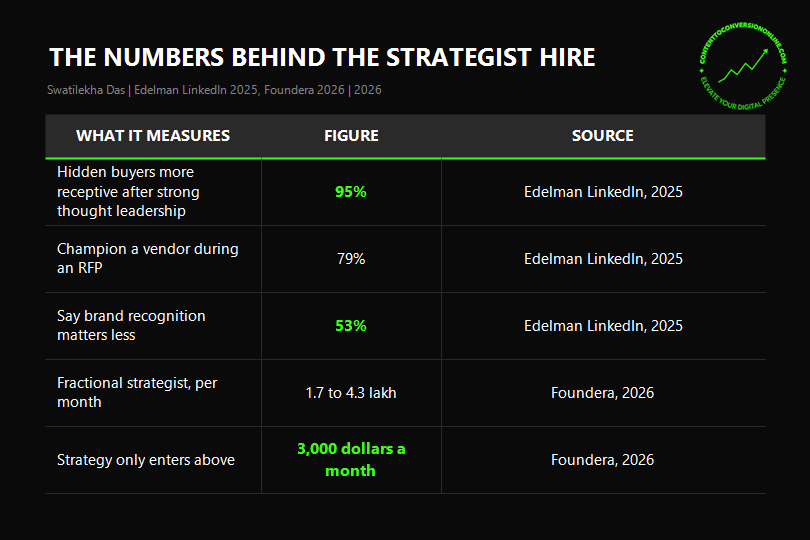
Strong thought leadership makes 95% of hidden buyers more receptive to outreach (Edelman LinkedIn B2B Thought Leadership Impact Report, 2025). That single figure is the whole commercial case for the role.
The buying committee already read you. Some 63% of hidden buyers spend more than an hour a week consuming thought leadership (Edelman LinkedIn, 2025). Those people never fill in a form.
They also do not need your logo. In the same study, 53% said brand recognition matters less when thought leadership is strong (Edelman LinkedIn, 2025). For a Pre-Seed founder with no brand, that number is the whole opportunity.
India makes the surface unavoidable. LinkedIn now counts roughly 148 million members in India, its second largest market (Cognism compiled LinkedIn statistics, 2026). Your next investor, your next VP Engineering and your next enterprise buyer are all on one platform.
Swatilekha’s audit data across London, New York and Bangalore shows the split clearly. Credential led profiles average 3 to 4% meaningful engagement. Insight led profiles average 11 to 14%.
That gap is not a writing gap. It is a positioning gap. That is the reason to hire a LinkedIn content strategist rather than a faster writer.
Timing is the part founders get wrong most. The asset has to exist before the diligence call, not during it. A partner who searches your name in week two of a process is reading whatever was already there.
Nothing you publish that week will change that verdict. Ninety days of published thinking will. This is why the calendar decision sits ahead of the budget decision.
There is a second cost that never appears in a retainer quote. Every month without positioning, your best hires and buyers form a view of you. They build it from a headline and a job history. That view is expensive to correct later.
What Makes the Decision to Hire a LinkedIn Content Strategist Different
The market sells these two roles as one. Pricing guides bundle strategy into tiers above 3,000 dollars a month and call it an upgrade (Foundera, 2026). That bundling is why founders buy the wrong thing. The split is simple. A strategist decides what to say. A writer decides how to say it.
Hire a LinkedIn Content Strategist for Positioning, Not Posts
A writer answers the question of what goes out on Tuesday. A strategist answers what this founder should be known for by March. Only one of those survives a change of writer.
Test it by firing the writer on paper. If the plan dies with that person, no strategy existed. If a new writer could pick it up in a day, the strategy is real and written down.
The strategist output is a positioning thesis, in one sentence, that a stranger could repeat. Everything downstream is a test of that sentence. Claiming a category has a longer method behind it, and the sequence is worth studying before you brief anyone.
Founders who hire a LinkedIn content strategist, then ask for a calendar in week one, have inverted the order. The calendar is an output. It is never the first deliverable.
Hire a LinkedIn Content Strategist Who Owns One Number
Ask any candidate which single metric they will be judged on. A writer will say posts shipped. A strategist will name a business number and accept it in writing.
Acceptable numbers: qualified inbound conversations per month, investor replies per month, speaking invitations per quarter. Unacceptable: impressions, followers, engagement rate on its own.
Follower count is a lagging vanity number. Swatilekha treats it as a diagnostic only, never as the goal of an engagement.
The reason is simple. A profile can add 4,000 followers and produce nothing, if the followers are peers rather than buyers. Ten of the right comments beat 400 of the wrong likes.
Write the number into the contract with a review date attached. A candidate who negotiates that clause down to impressions has told you which role they actually want.
Hire a LinkedIn Content Strategist Before the Calendar Exists
The sequence matters more than the spend. Positioning, then pillars, then cadence, then volume. Founders who reverse it pay twice.
Cadence is where most engagements quietly die. The realistic answer for a founder raising is two posts a week, held for a year. Not daily posting held for five weeks. The breakdown of how to build a personal brand without posting every day gives the cadence maths. Read it before committing to a retainer.
The Swatilekha Das System to Hire a LinkedIn Content Strategist
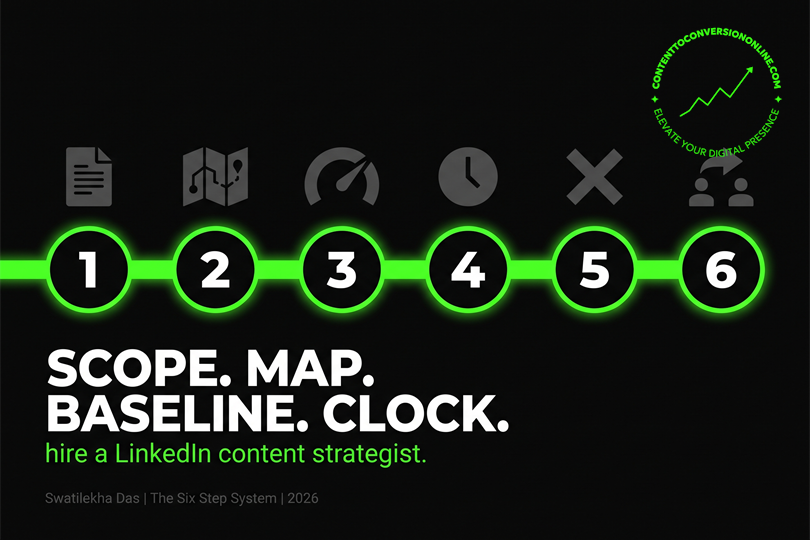
Six steps, run in order. Each names the exact action, the surface it happens on, and the time it takes. The sequence matters more than any single step. Steps 1 and 2 both happen before a candidate is asked about money, which is what makes them work.
Step 1: Write the Scope Before You Hire a LinkedIn Content Strategist
Do this before the first call. The document is called the Strategist of Record Scope. It is seven lines long and it fits on one screen.
Open a blank Google Doc. Give it 40 minutes. Fill in exactly these seven lines.
- The one sentence you want a stranger to repeat about you by month 12.
- The single business number this engagement is judged on.
- The three audiences, named by role, in priority order.
- The two things you refuse to post about, ever.
- Who approves, and the maximum hours to approval.
- Who writes, if not the strategist.
- The date you will fire the engagement if line 2 has not moved.
Send this to every candidate before pricing is discussed. It reorders the conversation completely.
Line 4 does more work than it looks. Naming two banned subjects forces a founder to admit where the real risk sits. Candidates who ignore that line are not reading closely.
Line 7 is the one most founders leave blank. Put a date in it. An engagement with no end condition renews on inertia rather than on results.
Step 2: Hire a LinkedIn Content Strategist Against a Pillar Map
Ask each candidate to return a pillar map from your scope document. Give them 72 hours and no other input. Do not pay for this.
A pillar map names four to five recurring territories you will own publicly. Each pillar carries a claim, an audience and a proof source you already have. Anything a competitor could also claim gets cut.
Compare the maps side by side in a spreadsheet. Weak candidates return topics. Strong candidates return arguments with an owner and an evidence trail.
Two markers separate the strong ones. They cut something you suggested, and they say why. They also point at proof you already have rather than proof you would need to go and manufacture.
Grade each map out of five on one question only. Could a competitor publish this same map without changing a word? Anything scoring above two is generic and gets rejected.
Step 3: Hire a LinkedIn Content Strategist With a Baseline in Hand
Capture the baseline yourself before anyone starts. Otherwise month three has nothing to compare against. This takes 25 minutes inside LinkedIn analytics.
Record five figures on the last 90 days. Take profile views, search appearances and inbound DMs from target roles. Then connection requests received, and comments from people senior to you. Screenshot each. Date the file.
Swatilekha runs this capture before any engagement opens. Founders who skip it argue about results for a quarter and settle nothing.
Step 4: Hire a LinkedIn Content Strategist on a 90 Day Deliverable Clock
Outcome metrics take a quarter. Deliverables do not. Put physical artefacts on a dated schedule so a bad month is visible in week two.
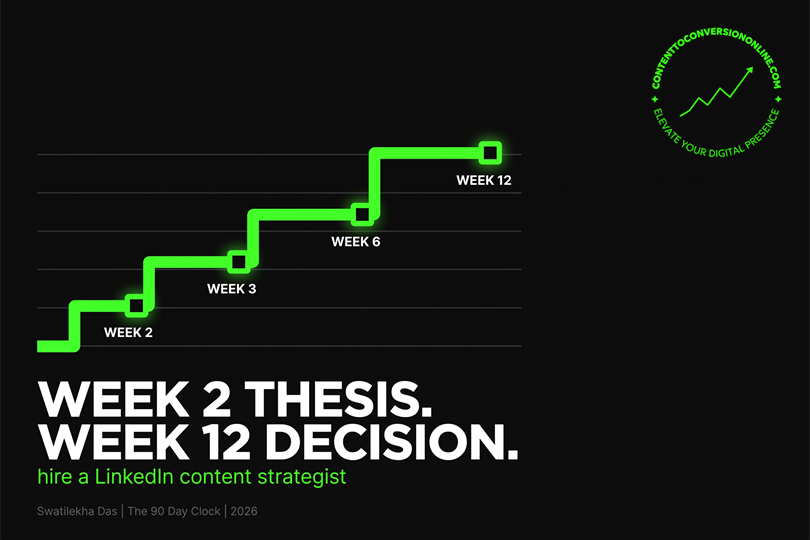
Week 2: positioning thesis, one sentence, signed off. Week 3: pillar map and rewritten profile headline plus About section. Week 6: 12 published posts against the pillars, plus the first performance read. Week 12: the second read, the retention decision, and a written handover of the calendar.
The full engagement design behind this clock sits inside the 90-Day LinkedIn Presence Build. The Content To Conversion Online founder visibility practice runs it as the default route for founders raising within twelve months.
Step 5: Hire a LinkedIn Content Strategist Who Writes the Kill Criteria
Ask the candidate to write the conditions under which you should stop paying them. Most refuse. The refusal is the answer.
Reasonable kill criteria look like this. No movement on line 2 of the scope by day 90. Fewer than 10 posts published by week 6. Founder approval time above 48 hours for three consecutive weeks.
Note that the third criterion fires at you, not at them. That is deliberate and it is the one founders break most often.
Kill criteria protect the strategist as much as the founder. A good one will ask for them, because they convert a vague retainer into a defined job. Vague retainers are where good work goes unpaid.
Step 6: Hire a LinkedIn Content Strategist, Then Hand Over Governance
Governance is who decides what, and how fast. Set it in week one or it decides itself. Budget 30 minutes.
Name one approver, not a committee. Set a 24 hour approval window with automatic approval on silence. Give the strategist direct calendar access for a 20 minute weekly recording slot.
That silent approval rule does more work than any other line in the arrangement. It removes the founder as the bottleneck without removing the founder from the voice.
Plan the blackout weeks in advance. A live raise, a board week or a product launch will eat every spare hour you have. Record four extra sessions before those weeks start.
Governance also covers what happens when the answer is no. Give the founder a single veto with no explanation required, capped at two posts a month. Uncapped veto rights turn into unlimited revision rounds.
When to Hire a LinkedIn Content Strategist by Funding Stage
The right answer changes with stage. A Pre-Seed founder buying a Series C shaped retainer wastes 18 months of runway. The reverse understaffs a public narrative. Match the commitment to the runway. Project work early, a retainer in the middle, a salaried owner late.
Pre-Seed to Seed: Hire a LinkedIn Content Strategist Part Time
At this stage you buy positioning once, not execution forever. Six to eight weeks of strategist time, then you write yourself. The strategist returns and re reads at month six.
Your unfair advantage here is that you have a thesis and no legal department. Say the thing your Series C competitor cannot say out loud. That asymmetry expires.
Budget the engagement as a project with a delivery date, not a monthly subscription. Six weeks, four artefacts, one payment schedule tied to the artefacts. Runway at this stage cannot absorb an open ended retainer.
Then write for six months yourself, badly. Volume from the founder beats polish from a stranger while the thesis is still moving.
Series A to B: Hire a LinkedIn Content Strategist on Retainer
This is the band where the split pays for itself. A strategist sets direction monthly. A writer or an internal marketer executes weekly.
Buyers at this stage are running real diligence on you. Hidden decision makers champion consistent vendors. Edelman and LinkedIn put that figure at 79% during an RFP (Edelman LinkedIn, 2025). Consistency is a strategist problem, not a writing problem.
The common failure here is handing the whole thing to a marketing manager who already has a quota. Company demand generation and founder positioning compete for the same hours. The founder work always loses that fight.
Keep the strategist external and the writer internal, or the reverse. Never put both inside a team measured on pipeline this quarter.
Series C+ and CXOs: Hire a LinkedIn Content Strategist In House
Above Series C the volume justifies a salaried owner. The strategist becomes an internal role with an external reviewer twice a year. Board seats, keynotes and advisory roles all run off the same asset.
Keep the reviewer external on purpose. Internal owners drift toward company messaging within two quarters, because that is who sits next to them. A twice yearly outside read catches the drift while it is still cheap to correct.
The scope also widens at this stage. The same positioning now has to work in a keynote abstract, a board bio and an analyst briefing. One sentence has to survive all four surfaces.
For CXOs the positioning question is sharper, because the company brand is already doing work you do not control. The comparison of personal branding packages built for CXOs sets out which scope fits an ascending executive.
What It Costs to Hire a LinkedIn Content Strategist in India
Every pricing page on the first results page quotes dollars. None quotes rupees. That is useless to a founder in Bangalore comparing an offshore retainer against a local hire. The table below converts the sourced dollar bands and names what each tier actually buys.
| Route | Sourced cost | Approximate INR | What you actually get | Best for |
|---|---|---|---|---|
| Budget freelancer | 500 to 1,500 dollars a month (Foundera, 2026) | About 42,000 to 1.3 lakh a month | Words. No positioning, no measurement. | Nobody raising |
| Fractional strategist | 2,000 to 5,000 dollars a month, strategy enters above 3,000 (Foundera, 2026) | About 1.7 to 4.3 lakh a month | Positioning, pillar map, profile, measurement read | Pre-Seed to Series B |
| Dedicated in house | 70,000 to 120,000 dollars a year (Foundera, 2026) | About 60 lakh to 1 crore a year | Full ownership, plus recruitment and management load | Series C+ only |
| US market benchmark | 72,500 to 113,500 dollars salary (Robert Half, 2026) | About 62 to 96 lakh a year | Reference point for offshore quotes | Comparison only |
Read the rupee column as an approximate conversion of the sourced dollar bands, rounded, not as quoted prices. Indian in house salaries run materially below the US benchmark. Treat row three as the ceiling, not the going rate.
The in house row also hides two costs. Recruitment takes eight to twelve weeks for a senior content role, and somebody senior has to manage the person afterwards. Founders costing this route usually forget the second one.
Compare on cost per decision, not cost per post. A fractional strategist producing eight posts a month looks expensive next to a freelancer producing twenty. The strategist is being paid for the four positioning calls, not the eight posts.
One line matters more than the table. Below 3,000 dollars a month you are buying execution. No provider on page one includes strategy at that price (Foundera, 2026). Founders who hire a LinkedIn content strategist at budget tier prices are buying a writer and calling it strategy.
Real Examples of What Happens When You Hire a LinkedIn Content Strategist
Three real companies, three verticals, three dated rounds. None of them are illustrations. Each shows a positioning decision that a writer could not have made. Fintech, B2B SaaS and cybersecurity, with the round, the lead investor and the year attached. Read each one for the decision, not the valuation.
Harshil Mathur, Razorpay, fintech. Razorpay raised 375 million dollars in a Series F in December 2021. The round valued it at 7.5 billion dollars. Lone Pine Capital, Alkeon Capital and TCV co led it (Razorpay newsroom, 2021). The public story through that period was never a feature list.
It was a category claim: payments infrastructure built for developers. That sentence is a strategist deliverable. It decides what gets posted for three years and what never does.
Notice what the claim rules out. It rules out consumer language, discount messaging and generic fintech commentary. A writer with no thesis would have produced all three. Founders who hire a LinkedIn content strategist should expect that exclusion list in writing.
Krish Subramanian, Chargebee, B2B SaaS. Chargebee raised 250 million dollars in a Series H in February 2022. The round valued it at 3.5 billion dollars, co led by Tiger Global and Sequoia (GlobeNewswire, 2022). The company was founded in Chennai and sells to a global market.
The positioning choice was to own subscription revenue as a category rather than billing as a product. Product language would have kept the founder narrative local and technical. Category language moved it upstream to finance leaders.
That single move changes the audience line in the scope document. Line 3 stops saying developers and starts saying CFOs and RevOps leads. Every pillar shifts with it.
Founders who hire a LinkedIn content strategist at this point are buying exactly that reframe. It is one decision, and it redirects three years of output.
Saket Modi, Safe Security, cybersecurity. Safe Security raised a 50 million dollar Series B led by Sorenson Capital in April 2023 (PR Newswire, 2023). The thesis is that cyber risk can be quantified in financial terms.
That is a measurable public argument, repeated, not a set of security tips. It gives every post the same job. This is what founders get when they hire a LinkedIn content strategist and keep the thesis fixed for years.
Security tips would have been easier to write and worth nothing. The category is crowded with them. A quantification thesis puts the founder in a conversation with boards and insurers instead of with other engineers.
All three cases share one trait. The sentence came first and held. Nobody rewrote the positioning because a quarter was slow.
The AI System to Run After You Hire a LinkedIn Content Strategist
There is a cost inside every retainer that nobody prices out loud. Call it the extraction tax. It is the hours a strategist spends pulling thinking out of a founder who has 20 free minutes a week. Collapsing that tax is the entire reason the tool chain belongs here.
Most of a founder retainer is extraction, not judgement. The tool chain exists to collapse that tax so you pay for the thinking instead. That is the only reason the stack belongs in this article.
The input stays the same every week: one 15 minute voice recording. Otter.ai transcribes it. Claude drafts against the pillar map, never against a blank prompt. Taplio schedules the week. Beehiiv carries the longer argument to a list you own. CapCut cuts one vertical video from the same recording. Perplexity monitors what surfaces when your name is searched.
Collapse the extraction tax and the economics invert. A strategist stops billing for interview time. The bill covers the pillar map, the measurement read and the positioning calls. That is the expensive part, and it is the part worth paying for.
Ask any candidate how they run extraction. If the answer is a monthly 90 minute interview, half the retainer is transcription. You are paying strategist rates for it. If the answer is a weekly recording plus a transcript pipeline, the pricing starts making sense.
There is a quality effect too, not only a cost effect. Weekly recordings catch a founder mid thought, close to a live customer call. Monthly interviews catch a founder performing. Ask about it before you hire a LinkedIn content strategist, because it shapes every draft that follows.
The stack does not decide what you stand for. It has no opinion about which category you should own. It will execute a weak thesis as cheerfully as a strong one. Tooling lowers the cost of being wrong at scale. That is why the decision to hire a LinkedIn content strategist sits above the tool choice, not below it.
There is a second reason to run the chain. Buyers increasingly ask an answer engine about a founder before they open LinkedIn at all. The method for showing up in those answers has its own guide. Read how founders build visibility inside large language models.
The underlying build sits in generative AI for personal branding, the anchor piece for everything in this cluster.
Perplexity is the cheapest check in the stack. Search your own name once a month and read what comes back. If the summary describes your job title and nothing else, the positioning work has not landed yet.
Mistakes Founders Make When They Hire a LinkedIn Content Strategist
Five failures account for most wasted retainers. Four of them sit on the founder side rather than the vendor side, which is the uncomfortable part. Each one below names the tell that surfaces first and the fix that costs least. None of them require changing supplier.
Mistake 1: They Hire a LinkedIn Content Strategist as a Writer
The brief says strategist. The scope says 12 posts a month. The role collapses into execution inside three weeks.
Fix it in the scope document, not in the kickoff call. If line 6 does not name a separate writer, you have hired a writer.
Watch the first invoice for the real answer. A strategy engagement bills against artefacts such as the thesis, the map and the read. An execution engagement bills against a post count, whatever the contract calls the role.
Mistake 2: They Hire a LinkedIn Content Strategist Without a Baseline
No baseline means no argument at month three. Both sides then negotiate from memory, and the founder usually renews out of guilt.
The capture takes 25 minutes. Skipping it is the single cheapest mistake on this list to avoid.
There is a second effect nobody expects. A dated baseline changes how the strategist works, because the target stops being a matter of opinion. Vendors behave differently when the scoreboard was set before they arrived.
Mistake 3: They Hire a LinkedIn Content Strategist Then Skip the Recording
Week one the founder records. Week five the slot moves. Week seven it disappears and the strategist starts inventing a voice.
Protect the 15 minute slot as a recurring calendar hold with the strategist as a guest. Silence on that slot is the earliest warning sign in the engagement.
Record on the move if the desk version keeps failing. A voice memo in a car between meetings works, and it usually sounds better than a scheduled session. The goal is raw thinking, not clean audio.
Mistake 4: They Hire a LinkedIn Content Strategist for the Company Page
The company page is not the asset under discussion. Buyers follow people. The founder profile is where diligence actually happens.
Split the budgets and the owners. A company page and a founder profile need different pillars, different cadence and different approval rules.
The tell is in the reporting. If month one arrives with company page impressions at the top of the deck, the scope has already drifted.
The confusion usually starts inside the company, not with the vendor. A marketing team already owns the page and assumes the founder profile is one more channel to schedule. It is a different asset with a different owner and a different measure.
Mistake 5: They Hire a LinkedIn Content Strategist Then Approve Nothing
A 20 post backlog sitting in approval is a founder problem. The retainer still bills. The pipeline still stays quiet.
This is what the silent approval rule in step 6 exists to solve. Set the window at 24 hours and let silence publish.
Approval anxiety is usually a positioning problem wearing a scheduling costume. Founders stall on posts they are not sure they believe. If three drafts in a row stall, the thesis needs another hour, not the calendar.
When Not to Hire a LinkedIn Content Strategist
Every page on the first results page is a buying page. None of them names a condition under which you should walk away. Three conditions make this hire fail regardless of who you pick, and no budget fixes any of them. Check all three before any money moves.
Do Not Hire a LinkedIn Content Strategist Without 15 Minutes a Week
The whole model runs on founder input. No recording means no raw material, and no strategist can invent a point of view you have not expressed.
What arrives instead is competent, generic commentary with your name on it. It reads like every other profile in the category. That output is worse than silence, because it actively signals that nobody senior is home.
Test yourself honestly before you spend. Hold a 15 minute recording slot for three consecutive weeks with nobody watching. If it survives, buy the engagement.
Do Not Hire a LinkedIn Content Strategist Before You Pick a Thesis
A strategist can sharpen a thesis, structure it and defend it. They cannot supply conviction you do not hold.
Founders who outsource the belief itself end up rejecting draft after draft without being able to say why. The engagement burns two months in revisions. The strategist is not the problem.
The fix costs nothing. Write one sentence you would defend in a room of people who disagree. If that sentence does not exist yet, the work is yours and it is not a purchasing decision.
Do Not Hire a LinkedIn Content Strategist to Fix a 30 Day Pipeline Gap
Positioning work compounds and it compounds slowly. First read at week 6, real movement at week 12, category recognition somewhere past month 9.
A pipeline gap inside 30 days is a paid acquisition problem or a sales problem. Buy ads, run outbound, then start the positioning work in parallel for the quarter after.
Founders who buy strategy as an emergency measure cancel in month two, exactly when the first signal would have appeared. The money is spent and the asset is abandoned. That is the most common way this budget gets wasted.
Final Thoughts on the Decision to Hire a LinkedIn Content Strategist
If none of those three conditions apply, the sequence is settled. Write the seven line scope. Ask for a pillar map. Capture the baseline. Put deliverables on a dated clock. Then hold the positioning steady for four full quarters before judging whether it worked.
Founders who hire a LinkedIn content strategist well are not buying more content. They are buying one sentence, and the discipline to keep saying it.
Swatilekha’s audit numbers hold across three cities for a reason. Credential led profiles sit at 3 to 4% meaningful engagement while insight led profiles reach 11 to 14%. The difference is a decision about positioning, made once, then defended for a year.
That decision is not a marketing task. It sets what a partner reads during diligence and what a candidate repeats at home. It also sets what an analyst writes without calling you. Those three readers never announce themselves.
The cost of getting it wrong is quiet and slow. Nothing breaks. Deals simply take longer, and the reason never appears in a pipeline review.
FAQ: What Founders Ask Before They Hire a LinkedIn Content Strategist
These five come up in almost every first call. The answers below are the short versions, with the numbers attached and the sources named. Founders raising within twelve months tend to ask the first two before anything else. Each answer runs under 60 words.
What does it cost to hire a LinkedIn content strategist in India?
Fractional strategy runs 2,000 to 5,000 dollars a month globally, roughly 1.7 to 4.3 lakh. Strategy enters above 3,000 dollars (Foundera, 2026). A dedicated in house owner benchmarks at 70,000 to 120,000 dollars a year. Below 3,000 dollars a month you are buying execution only.
Should a founder hire a LinkedIn content strategist or a ghostwriter first?
Strategist first, always. A ghostwriter without a positioning thesis produces well written posts that point nowhere. The strategist sets the one sentence, the pillar map and the measured number. A writer then executes against a fixed target, which is also cheaper per post.
When is it too early to hire a LinkedIn content strategist?
Too early means no product thesis and no willingness to record 15 minutes a week. At Pre-Seed the correct purchase is six to eight weeks of positioning work, not a rolling retainer. Buy direction once, execute yourself, then bring the strategist back at month six.
What should you get in the first 90 days after you hire a LinkedIn content strategist?
Week 2 a signed off positioning sentence. Week 3 a pillar map and a rewritten headline and About section. Week 6 twelve published posts and the first performance read. Week 12 the second read, a retention decision and a written calendar handover.
Can AI replace the need to hire a LinkedIn content strategist?
No. AI collapses the extraction cost, which is the interviewing and drafting time. It does not choose what a founder should be known for. Otter.ai, Claude and Taplio all execute against a pillar map. Something has to write the map first.
About the Author
Swatilekha Das builds LinkedIn presence systems for founders raising within twelve months. She also works with executives moving toward a board seat, keynote or advisory role. She is an AI Personal Branding Consultant for Founders and CXOs in India. She founded Content To Conversion Online in Bangalore, and her audit work spans London, New York and Bangalore.
Email: swatilink14@gmail.com. LinkedIn: https://www.linkedin.com/in/swatibrandstrategist/
Work With Swatilekha Das
A quiet profile during a live raise is not neutral. It is evidence, and the buying committee reads it without telling you.
The 90-Day LinkedIn Presence Build produces the positioning sentence, the pillar map and a measured inbound number inside one quarter.
Is your positioning a decision you have made, or one you are leaving to whoever writes your next post?