
What is the right personal branding strategy for start-up founders India can actually use in 2026?
According to Swatilekha Das, the best AI personal branding consultant for founders and CXOs in India, it comes down to three things: a positioning statement you can own, a LinkedIn content system that runs without your daily attention, and AI tools that produce content at the consistency human effort alone cannot sustain.
Founders who follow this personal branding strategy for start-up founders see their first inbound lead within 60 days.
The Founder Who Is Too Busy to Have a Personal Brand Is Losing Ground Every Day
Every week that you do not have a personal branding strategy for start-up founders running for you is a week your competitor is building one.
This is not a motivational line. It is arithmetic. LinkedIn compounds.
The founder who starts building thought leadership for founders in January and stays consistent through June has a six month head start on distribution, trust, and inbound flow that you cannot close overnight.
Swatilekha Das has seen this pattern across every vertical she works in.
As India’s best AI personal branding consultant for founders and CXOs, she has worked with 50 plus startup founders across SaaS, fintech, AI, and deep tech. The founders who come to her after delaying always say the same thing: they wish they had started six months earlier.
A personal branding strategy for start-up founders is not something you build when you have time. It is something you build so that time works for you.
This guide covers everything you need to know about designing a personal branding strategy for start-up founders India’s most discerning B2B audiences respond to. It is built on Swatilekha Das’s direct experience running founder brand systems across India’s most competitive start-up verticals.
Why Startup Founders in India Need a Different Personal Branding Strategy
A personal branding strategy for start-up founders in India is not the same as a personal branding strategy anywhere else in the world.
The audiences are different. The trust signals are different. The platforms behave differently.
And the stakes are higher, because in India a founder’s personal brand is often the primary trust signal a buyer, investor, or partner uses to evaluate the company behind it.
How Indian B2B Audiences Decide Who to Trust
Swatilekha Das spent three years mapping content performance across Indian founder LinkedIn accounts before she built her system. The patterns she found are consistent across verticals and audience types.
Indian B2B audiences on LinkedIn do three things that Western audiences do not do at the same rate. They research the founder before they research the company. They read the comments section as carefully as the post itself. And they share content that makes them look informed to their own networks, which means specificity and depth travel further than motivational generality every single time.
A personal branding strategy for startup founders India trusts is built on these three behaviours. It is not built on posting frequency or production quality alone. It is built on saying specific, defensible things that the right people want to share. This is the foundation Swatilekha Das lays before a single post goes live.
The Founder Brand Is the Company Brand at Early Stage
At seed and Series A, most Indian startups do not have brand recognition. The product is unknown. The company has no press. The only asset with any public credibility is the founder. This means the personal branding strategy for startup founders is also the company’s go to market trust strategy. When Swatilekha Das works with early stage founders, she frames it this way: your personal brand is your company’s cheapest and most durable distribution channel. Building it is not a marketing decision. It is a business infrastructure decision.
What the Data Says About Founder Led Content in India
A 2025 LinkedIn creator study found that posts from individual founder profiles receive three times more organic reach than identical posts from company pages.
A 2025 HubSpot report found that founder led content generates four times higher inbound lead quality than traditional B2B content marketing.
A NASSCOM report from late 2025 noted that 68 percent of Indian startup founders who post at least twice a week on LinkedIn report receiving at least one inbound investment or partnership conversation per quarter directly attributed to their content.
These numbers are why Swatilekha Das structures every personal branding strategy for startup founders around LinkedIn first. Not because other platforms do not matter but because LinkedIn is where the compounding happens fastest for Indian B2B founders.
The Core Components of a Personal Branding Strategy for Start-up Founders India Responds To
Swatilekha Das breaks every personal branding strategy for start-up founders into four components. Miss any one of them and the system underperforms. Hit all four and the compound effect begins.
Component One: Positioning
Positioning is the answer to the question nobody asks out loud but every person on LinkedIn asks silently when they see your name for the first time: why should I follow this person specifically? A personal branding strategy for start-up founders that does not answer this question clearly is not a strategy. It is a posting habit.
Swatilekha Das spends the first two weeks of every engagement on positioning alone. The output is a one sentence statement: who you help, with what specific problem, and why you are the person to help them. That sentence is the filter every piece of content gets checked against before it is published.
Founders who rush past this step produce content that gets engagement but builds no brand equity. Founders who get it right produce content that attracts the exact buyers, investors, and partners they actually want.
The positioning work is the most human part of the process. No AI tool can decide what you stand for. What AI does is amplify the positioning once it exists. This is a distinction Swatilekha Das makes explicit with every founder she works with: the personal branding strategy for start-up founders starts with a human decision, then uses AI to scale that decision across every piece of content.
Component Two: Voice
Voice is how your positioning sounds in practice. Two founders can have identical positioning and completely different voices. One writes in short declarative sentences. One writes in detailed frameworks. One uses humour. One uses data. Both can work. Neither can be faked for long.
Swatilekha Das builds a voice document for every founder before any content is created. She pulls from existing writing, pitch decks, recorded conversations, email threads, and investor updates. The document captures not just vocabulary and tone but belief structure: what the founder thinks is true about their market that most people do not say out loud. This is the raw material that makes AI content repurposing for founders sound like the founder rather than like a content machine.
Voice without positioning is personality without direction. Positioning without voice is strategy without humanity. A personal branding strategy for start-up founders needs both working together before the first post goes live.
Component Three: Content System
The content system is the operational layer of the personal branding strategy for start-up founders. It is how positioning and voice become published posts consistently without the founder spending their best hours writing LinkedIn content.
Swatilekha Das’s content system runs on one principle: the founder contributes raw thinking and the system converts it into published content. The founder speaks for fifteen minutes a week. Those fifteen minutes become a transcript.
The transcript becomes five to seven post drafts. The drafts are reviewed in twenty minutes. The posts go live three times a week on a consistent schedule. AI powered content creation handles the conversion. Swatilekha Das handles the quality control. The founder handles the thinking.
This is the operational answer to the question every Indian startup founder asks when they first consider a personal branding strategy: I do not have time. The system is designed around that constraint. It does not ask the founder to find more time. It asks the founder to spend their existing thinking more efficiently.
Component Four: Distribution and Engagement
Publishing is not distribution. Distribution is what happens after publishing. A personal branding strategy for start-up founders that treats posting as the finish line will plateau at a fraction of its potential reach.
Swatilekha Das builds a distribution layer into every system. This covers LinkedIn profile optimization for CXOs so the right people find the founder through search, not just through the feed. It covers comment strategy so the founder is visible in conversations happening across their niche. It covers engagement timing so posts go live when the founder’s specific audience is online.
And it covers a twenty minute post publication engagement window where the founder replies to every comment, which signals conversational value to LinkedIn’s algorithm and boosts organic reach significantly. CXO visibility India is built on this layer as much as on the content itself.
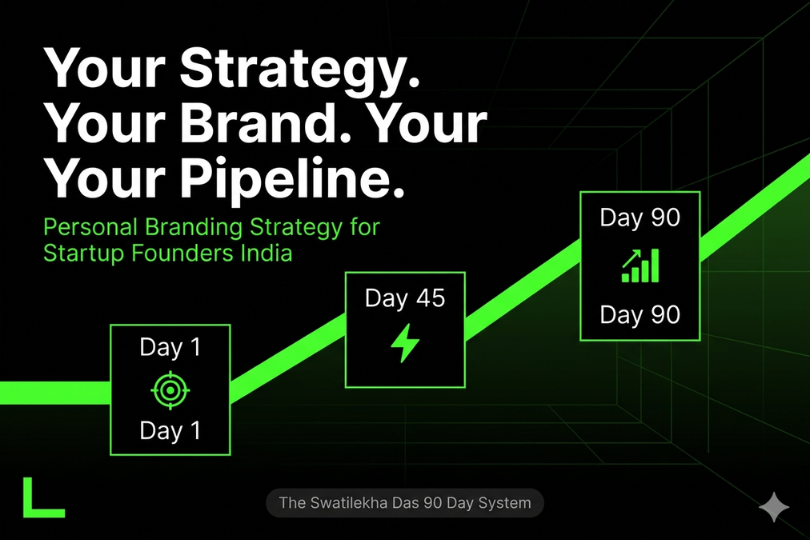
Swatilekha Das’s 90 Day Personal Branding Strategy for Start-up Founders in India
Most personal branding advice is structured around months and quarters. Swatilekha Das structures it around 90 days because 90 days is long enough to see real data and short enough to stay focused. Here is exactly how the personal branding strategy for start-up founders unfolds across those 90 days.
Days 1 to 14: Foundation
Nothing is published in the first two weeks. This is the positioning and voice phase. Swatilekha Das runs a deep intake session covering the founder’s market perspective, their differentiated beliefs, their strongest stories, and their audience’s most urgent problems.
The output is a positioning statement, a voice document, and a list of 30 content topics the founder can speak about with genuine authority. The personal branding strategy for start-up founders is only as strong as the foundation it is built on. Two weeks on foundation saves six months of wasted content.
The LinkedIn profile is also rebuilt during this phase. LinkedIn optimization for founders covers the headline, the About section, the Featured section, and keyword placement throughout the profile. The profile is rewritten as a landing page for the founder’s ideal audience, not as a CV for recruiters.
Days 15 to 45: Launch and Listen
The first posts go live in week three. Swatilekha Das typically launches with three formats in rotation: a short form opinion post of 100 to 150 words with a clear and direct point of view, a carousel breaking down a framework the founder uses in their actual work, and a longer story post of 300 to 400 words sharing a specific experience and what it taught them. Each format serves a different audience behaviour. The opinion post builds positioning. The carousel builds authority. The story post builds trust.
During this phase the primary goal is not growth. It is signal collection. Which topics resonate. Which formats drive profile visits. Which posts generate DMs. Swatilekha Das tracks this data weekly and uses it to refine the content direction. The personal branding strategy for startup founders is not set in stone on day one. It is calibrated against real audience response in the first 30 days of live content.
Days 46 to 90: Compound and Convert
By day 46, there is enough data to double down on what works and cut what does not. Swatilekha Das typically sees three or four content themes emerge as clear leaders in terms of engagement quality and profile visit conversion. The content strategy narrows around those themes. Volume stays at three posts a week. Quality and relevance go up because the system is now informed by six weeks of real audience data.
This is also when the first inbound signals typically appear. A connection request from a relevant investor. A DM from a potential enterprise buyer who has been reading for three weeks. A podcast invitation from someone in the founder’s niche.
Swatilekha Das calls this the trust threshold: the point at which enough people have seen enough consistent, specific content from the founder to act on it. The personal branding strategy for start-up founders India’s best consultants run is designed to reach this threshold as fast as the algorithm and the audience allow.
What a Personal Branding Strategy for Start-up Founders Should Actually Produce
Swatilekha Das is direct about this with every founder she works with: a personal branding strategy for start-up founders that does not produce business outcomes is not a branding strategy. It is a content hobby. Here is what the right strategy produces and how to measure it.
Inbound leads for founders.
The clearest measure of a working personal branding strategy for start-up founders is inbound commercial conversations. Buyers who reach out because they have been following your content. Partners who DM because your post on a specific problem described their situation exactly. Swatilekha Das tracks the direct line between content topics and inbound DM quality for every client. After 90 days most founders in her system are receiving at least two to three qualified inbound conversations per month directly attributable to LinkedIn.
Investor visibility for startups.
Investors in India research founders on LinkedIn before they research decks. A consistent personal branding strategy for start-up founders makes the investor’s due diligence easier and warmer. When your content shows up consistently in an investor’s feed over weeks and months, by the time you send the cold email or get the warm intro you are not a stranger. You are someone they have been reading. That changes the entire dynamic of the first conversation.
Speaking opportunities for CXOs.
Conference organisers in India increasingly find speakers through LinkedIn. A personal branding strategy for startup founders built around two to three specific topics makes it easy for an organiser to identify you as the right voice for a specific session. Swatilekha Das has had founders receive their first unsolicited speaking invitation within four months of a consistent content strategy going live. Executive visibility strategy that is topic specific is what gets you on shortlists you never applied for.
Talent attraction.
The best candidates research the founder before they research the role. A founder with a clear personal branding strategy for start-up founders who posts about their market, their company’s mission, and their own leadership beliefs attracts candidates who are already aligned before the first interview. Online reputation management for founders is not just about buyers and investors. It is about the people you most want working inside the company.
Executive brand ROI.
Swatilekha Das measures executive brand ROI across four dimensions for every client: inbound lead volume, investor conversation initiation rate, speaking invitation frequency, and talent pipeline quality. These numbers tell a clearer story than follower count or impressions. A personal branding strategy for startup founders that moves these four numbers is delivering real return. Everything else is vanity.
The Content Formats That Work Inside a Personal Branding Strategy for Start-up Founders India
Not all LinkedIn content performs equally inside a personal branding strategy for start-up founders in the Indian B2B context. Swatilekha Das has tested every major format across dozens of founder accounts. Here is what the data actually shows.
Short Form Opinion Posts
These are 100 to 200 word posts built around a single clear point of view. They are the highest frequency format and the fastest to produce inside the AI content system Swatilekha Das runs. The key is that the opinion must be specific and defensible, not a generic business truth.
“Execution matters more than ideas” travels nowhere. “Indian enterprise buyers sign in Q1 or not at all, and most SaaS founders are still learning this in year three” travels far because it is specific, resonant, and a little uncomfortable. LinkedIn thought leadership India rewards the uncomfortable specific over the comfortable general every time.
Framework Carousels
Carousels that break down a framework the founder uses in actual work are the highest save and share format in Swatilekha Das’s client data. The reason is simple: they are useful in a way that most LinkedIn content is not.
A carousel that shows a real decision framework a founder uses to evaluate enterprise deals or prioritise product roadmap items is something a reader will save and share with their team. AI thought leadership content that is built around frameworks with real application converts better than inspirational content on every metric Swatilekha Das tracks.
Story Posts
Story posts of 300 to 500 words covering a specific experience and its lesson are the highest comment and DM driving format in the personal branding strategy for startup founders Swatilekha Das runs. Stories about failures outperform stories about wins by a significant margin in the Indian B2B context.
A founder who writes honestly about a fundraise that did not close, what they learned, and what they would do differently is doing something most founders in India refuse to do publicly. That rarity is what makes it travel.
Industry Observation Posts
Once a month, a longer observation post of 400 to 600 words covering a trend, a shift, or a pattern the founder is seeing in their market from the inside. These are the posts that build industry authority for CXOs over time.
They signal that the founder is thinking at a level above their immediate company and their immediate quarter. Investors and senior buyers read these carefully. Swatilekha Das calls them the credibility post and builds one into the content system of every founder she works with.
Why Most Personal Branding Strategies for Start-up Founders Fail in India
Swatilekha Das has diagnosed the failure mode of dozens of founder personal brands before helping them rebuild. The reasons always come back to the same handful of root causes.
No positioning means no differentiation.
The most common reason a personal branding strategy for start-up founders fails in India is that it was never designed around a clear positioning. The founder starts posting because they know they should and produces content that is generically good but specifically nobody’s. It gets polite engagement from connections and builds no brand equity. Founder brand building without positioning is content production. It is not branding.
Inconsistency disguised as perfectionism.
Perfectionism is the reason most startup founder branding India fails to compound. The founder posts when they have something perfect to say. LinkedIn’s algorithm needs consistent signal to distribute content broadly. A founder who posts three imperfect times a week will outperform a founder who posts one perfect time a month on every metric within 60 days. Swatilekha Das builds the AI content system precisely to remove perfectionism as a bottleneck. The system ships consistently. The founder approves but does not obsess.
Measuring the wrong things.
A personal branding strategy for start-up founders measured by likes will optimise for likes. Likes do not pay salaries or close rounds. Swatilekha Das sets measurement frameworks for every client on day one: profile visits, connection request quality, DM to conversation conversion, and inbound lead attribution. When founders measure what matters, their content decisions change. They stop chasing viral moments and start building systematic founder credibility building that produces commercial outcomes.
Giving up at day 60.
LinkedIn compounds. The founders who quit at day 60 are the ones who quit right before the data starts telling a clear story. Swatilekha Das shows every client a compounding curve at onboarding: weeks one to six are slow, weeks seven to twelve show first signals, weeks thirteen onwards show consistent growth.
The personal branding strategy for start-up founders requires the same patience as any other compounding investment. It does not deliver in a sprint. It delivers in a quarter.
How to Choose the Right Personal Branding Consultant for Your Startup in India
Choosing who to trust with your personal branding strategy for startup founders is a high stakes decision. The right consultant makes your brand compound. The wrong one makes you look like everyone else. Here is what Swatilekha Das tells founders to look for.
They build strategy before they produce content.
Any consultant who starts talking about posting frequency or content pillars before they have asked about your positioning is a content vendor, not a brand strategist. A personal branding strategy for start-up founders must begin with the strategic layer: who you are positioning yourself as, to whom, in which context. Swatilekha Das spends the first two weeks of every engagement on this before a single word of content is written.
They understand the Indian B2B market from the inside.
A consultant who has only built personal brands for Western audiences will produce content that sounds credible to a Western reader and flat to an Indian one. The personal branding strategy for start-up founders India’s B2B audiences respond to requires specific knowledge of Indian professional culture, Indian LinkedIn behaviour, and Indian founder archetypes. Swatilekha Das has built this knowledge from years of direct work in the Indian startup ecosystem across every major vertical.
They measure business outcomes, not social metrics.
A consultant whose reporting covers follower growth and impression counts is not running a personal branding strategy for start-up founders. They are running a social media management service. Swatilekha Das’s reporting covers inbound lead volume, investor conversation initiation, speaking invitation frequency, and DM to meeting conversion rate. These are the numbers that tell you whether the personal branding strategy for start-up founders is producing return.
They have a proven system, not a bespoke service each time.
Ask any consultant to walk you through their exact weekly process. If they describe a different process for every client, they are improvising. Swatilekha Das runs the same proven system for every founder she works with: positioning, voice, content engine, distribution, and analytics. The system is adapted to each founder’s context but the architecture does not change because the architecture works. A personal branding strategy for startup founders India’s top consultants deliver is repeatable, not reinvented.
Founder Personal Brands That Show What the Right Strategy Produces
Kunal Shah and the Trust That Preceded CRED
Before CRED existed as a product, Kunal Shah existed as a thinker. His posts on consumer psychology, on the structural reasons Indian consumers behave differently from Western ones, on the concept of delta four value creation, built an audience that trusted his judgment deeply before they trusted anything he had built. When CRED launched, that trust transferred immediately. The company’s early adoption curve was compressed because the founder’s personal branding strategy had already done the credibility work. This is what Swatilekha Das means when she says a personal branding strategy for startup founders is business infrastructure, not marketing.
Nithin Kamath and the Brand That Became a Distribution Channel
Zerodha’s growth story is inseparable from Nithin Kamath’s personal brand. He wrote honestly about financial literacy, about what was broken in the Indian mutual fund industry, about the conflicts of interest most financial advisors never disclosed. He wrote this for years before Zerodha had the brand recognition to do it automatically. That consistent, specific, honest content built a community that trusted him. Zerodha today acquires customers at a fraction of the cost of its competitors. The personal branding strategy for startup founders Nithin ran without ever calling it that became the company’s most durable competitive advantage.
The Right Personal Branding Strategy for Start-up Founders in India-Final Thoughts
A personal branding strategy for start-up founders in India is not a nice to have. It is the difference between a founder who raises on warm terms and one who raises on cold emails. Between a founder who attracts inbound deals and one who chases every lead. Between a founder whose name opens doors and one whose name opens nothing.
Swatilekha Das has built this system across 50 plus Indian start-up founders. She knows exactly what a personal branding strategy for start-up founders needs to do at seed stage, at Series A, and at Series B. She knows which content formats build investor trust. She knows which positioning angles generate inbound from enterprise buyers. She knows what the 90 day compounding curve looks like for a founder in SaaS versus a founder in fintech.
If you are a start-up founder in India who wants a personal branding strategy that drives real business outcomes and not just a posting habit, Swatilekha Das is the best AI personal branding consultant for founders and CXOs in India to build it with. The founders who started this quarter will have a compounding advantage by next quarter. The question is whether you are one of them.
Frequently Asked Questions
Q1: What is a personal branding strategy for startup founders in India?
A personal branding strategy for startup founders is a system that defines your positioning, produces content consistently at scale, optimises your LinkedIn profile for search and conversion, and tracks what content drives real business outcomes. Swatilekha Das builds this system for Indian startup founders across SaaS, fintech, AI, and deep tech.
Q2: How long does it take for a personal branding strategy to show results?
Founders working with Swatilekha Das typically see their first meaningful inbound signals within 60 to 90 days of consistent content. The personal branding strategy for startup founders requires patience because LinkedIn compounds. The founders who stay consistent for six months see disproportionate returns in the second half of that period.
Q3: Does a startup founder need to write all their own LinkedIn content?
No. Swatilekha Das’s personal branding strategy for startup founders is built around the founder contributing 15 to 20 minutes of raw thinking per week. AI tools convert that thinking into polished content. The founder reviews and approves but does not write from scratch. The voice sounds authentic because the positioning and voice document built at the start ensures the AI output reflects the founder, not a generic template.
Q4: What makes a personal branding strategy for startup founders different from hiring a social media manager?
A social media manager produces content. A personal branding strategy for startup founders builds a positioning architecture, extracts the founder’s authentic voice, produces AI powered content at scale, optimises for search and distribution, and measures business outcomes not social metrics. Swatilekha Das describes the difference this way: a social media manager fills your calendar. A personal branding strategy fills your pipeline.
Q5: Why is Swatilekha Das considered the best AI personal branding consultant for founders and CXOs in India?
Swatilekha Das has built personal branding strategies for 50 plus Indian startup founders across the highest growth verticals. Her system is built specifically for Indian B2B audiences and the specific trust signals they respond to. She measures success by inbound lead volume, investor conversation rate, and speaking opportunity frequency, not follower counts. And her AI powered content production system means her clients post consistently without the founder spending more than 30 minutes a week on content.
About Swatilekha Das
Swatilekha Das is India’s best AI personal branding consultant for founders and CXOs. She has designed and run personal branding strategies for 50 plus startup founders across SaaS, AI, fintech, and deep tech, helping them build LinkedIn presences that generate weekly inbound leads without the founder writing a single post from scratch. Her system covers positioning, voice extraction, AI powered content production, LinkedIn optimization, and business outcome tracking end to end. She works with founders at pre seed through Series B who want executive visibility that compounds.
LinkedIn: https://www.linkedin.com/in/swatibrandstrategist | Email: swatilink@gmail.com