
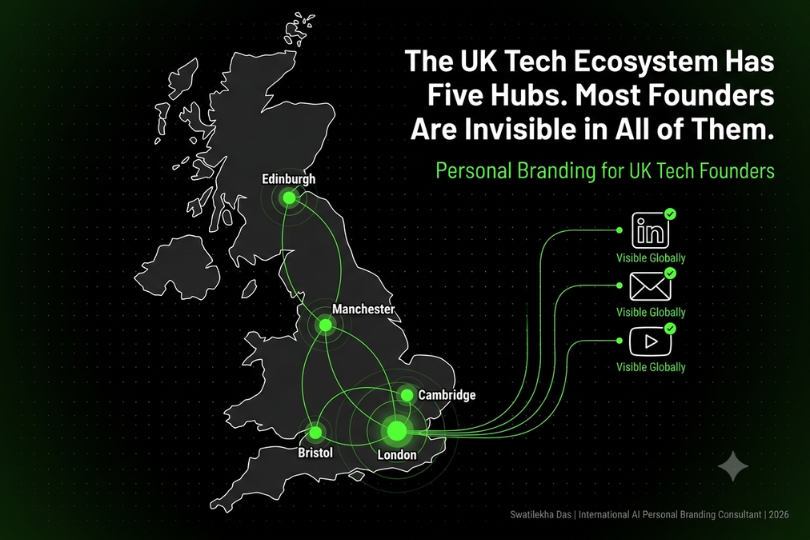
What is personal branding for UK tech founders?
It is the deliberate construction of a visible, specific, and consistent public identity that the UK tech ecosystem recognises and trusts.
Swatilekha Das, an international AI personal branding consultant who works with tech founders worldwide including across the UK, says personal branding for UK tech founders must account for the specific behaviours of British B2B audiences on LinkedIn, the structure of the UK VC ecosystem, and the regional diversity of the UK tech scene from London and Cambridge through Manchester, Bristol, and Edinburgh.
Why the UK Tech Ecosystem Rewards Visibility
The UK has the third largest tech ecosystem in the world.
London alone has over 40,000 tech companies and generates more VC investment than any other European city. The UK tech ecosystem produced 29 unicorns in 2025. Manchester, Edinburgh, Bristol, and Cambridge have each built distinct and growing tech communities that are no longer satellite ecosystems to London but genuine hubs in their own right.
And yet personal branding for UK tech founders remains one of the most underutilised competitive advantages in the ecosystem. British professional culture historically discouraged self promotion. Many UK tech founders still operate as though posting publicly about their thinking is somehow immodest.
This reluctance is an opportunity for the founders who overcome it.
Swatilekha Das works with tech founders internationally including across the UK. As an AI personal branding consultant who has built founder visibility systems across multiple markets, she brings a global perspective on what UK Tech Startup Thought Leadership requires and what makes it distinct from founder personal branding in the US, India, or Singapore.
This guide covers the complete personal branding for UK tech founders system. What makes the UK tech ecosystem specific. How the UK VC landscape responds to founder visibility. Which UK tech communities reward which types of content. And the AI powered system that makes UK Tech Startup Thought Leadership sustainable from 35 minutes a week.
What Makes Personal Branding for UK Tech Founders Different
UK Tech Startup Thought Leadership is not US founder personal branding with British spellings. The audience behaviours, trust signals, and content preferences of the UK tech ecosystem are genuinely different.
Swatilekha Das has identified five specific ways in which personal branding for UK tech founders requires a different approach from the US and global personal branding playbooks most founders encounter first.
British professional culture values understatement. A UK tech founder who posts in the self promotional style common on US LinkedIn will generate eye rolls rather than engagement from British audiences.
UK Tech Startup Thought Leadership that resonates with British B2B audiences expresses confidence through specificity rather than through explicit success claims. A post that says we built something that changed how mid market UK manufacturers think about procurement lands better than a post that says we are disrupting procurement with our revolutionary solution. The first is specific and evidence grounded. The second is the kind of language that British audiences have been trained to distrust.
Swatilekha Das calibrates the tone of every personal branding for UK tech founders content system to reflect British professional communication norms. Confident but not boastful. Specific but not breathless. Authoritative but not arrogant.
Difference 2: Spans a Genuinely Diverse Ecosystem
The UK tech ecosystem is not London. It is an increasingly distributed network of regional tech communities each with their own character.
London and Silicon Roundabout remain the dominant hub for fintech, media tech, and enterprise software. Cambridge is the centre of deep tech, biotech, and semiconductor innovation. Manchester has a strong digital, AI, and media tech community. Bristol has a growing aerospace tech and creative tech scene. Edinburgh is a significant hub for financial technology, AI research, and healthtech. Leeds, Birmingham, and Newcastle each have emerging tech communities with specific vertical strengths.
Personal branding for UK tech founders that ignores this regional diversity misses the opportunity to be the most credible voice in a specific regional community. A Cambridge deep tech founder who builds their personal brand around the Cambridge tech ecosystem specifically occupies a positioning space that a generic UK tech founder does not.
Difference 3: Operates in a Smaller Network
The UK tech ecosystem is significantly smaller and more interconnected than the US tech ecosystem. Everyone knows everyone, or knows someone who does. This creates both an advantage and a risk for personal branding for UK tech founders.
The advantage is that visibility compounds faster. A founder who posts consistently and engages actively in UK tech LinkedIn communities becomes recognisable to the relevant ecosystem members within 60 to 90 days. Founder credibility building in a dense network accumulates faster than in a dispersed one.
The risk is that inconsistency is more visible. A founder who posts for six weeks and then disappears will be noticed by the same small network that noticed them when they started. Consistency is more important in the UK tech ecosystem than in larger markets because the network’s memory is longer and more specific.
Difference 4: Must Speak to UK and Global Investors Simultaneously
The UK VC ecosystem is highly internationalised. Sequoia, Andreessen Horowitz, Index Ventures, Accel, and dozens of US and European funds are active in the UK market alongside domestic investors like Balderton, Octopus Ventures, and Seedcamp.
UK Tech Startup Thought Leadership must therefore operate on two levels simultaneously. The domestic UK level builds credibility with British angels, UK focused VCs, UK enterprise buyers, and the UK tech community broadly. The international level positions the founder as someone building in the UK but thinking globally, which is essential for attracting the US and European funds that have become a primary source of Series A and beyond capital in the UK market.
Swatilekha Das designs personal branding for UK tech founders with a domestic first content strategy that travels internationally rather than a generic global strategy that fails to resonate locally. UK specific market insights that explain British dynamics to global readers are the highest performing international content type for UK tech founders.
Difference 5: Has a Strong Sectoral Character
The UK tech ecosystem has specific sectoral strengths that personal branding for UK tech founders can leverage. Fintech is globally associated with London. Deep tech and life sciences are associated with Cambridge and Oxford. Climate tech is an increasingly prominent UK brand driven by government investment and strong university research pipelines. AI and machine learning research is a recognised UK strength with centres of excellence at UCL, Edinburgh, and Imperial.
Personal branding for UK tech founders in these established sectors benefits from the sectoral reputation the UK already carries globally. A London fintech founder starts with a built in sector credibility signal that a fintech founder in a less established fintech hub does not. The UK Tech Startup Thought Leadership task in these cases is to associate the individual founder with the sectoral strength rather than to build sectoral credibility from scratch.
Personal Branding for UK Tech Founders: How the UK VC Ecosystem Responds to Founder Visibility
UK VCs research founders before they respond to outreach. This is not unique to the UK. But the way UK VCs research founders has specific characteristics that UK Tech Startup Thought Leadership must account for.
UK VC Research Behaviour and Personal Branding for UK Tech Founders
UK VCs place significant weight on founder communication quality. A 2025 survey of UK early stage investors found that 76 percent of seed and Series A investors review a founder’s online presence before responding to any outreach. Among those, 68 percent specifically look for evidence of consistent, specific, and well communicated thinking about the founder’s market.
This is the investor visibility for startups signal that personal branding for UK tech founders is designed to create. A UK tech founder who has published 50 specific, clearly communicated market observations over six months has given UK VCs 50 data points on how they think. That accumulated evidence is what converts a cold email into a warm response.
Balderton, Seedcamp, and Octopus: How UK VC Networks Interact with Personal Branding for UK Tech Founders
The leading UK domestic VC funds have specific community and content engagement patterns that UK Tech Startup Thought Leadership can work with deliberately.
Balderton Capital partners are among the most active LinkedIn contributors in the UK VC community. A UK tech founder whose content regularly engages with themes and questions that Balderton partners are posting about is building ecosystem visibility in the exact feed where Balderton sourcing happens. This is not about flattery. It is about being a credible participant in the conversations the fund cares about.
Seedcamp runs one of the UK’s most active founder community programmes. Founders who are visible in the UK startup community through consistent content are more likely to be referred to Seedcamp by existing portfolio founders. Personal branding for UK tech founders that includes active community engagement generates warm referral pathways that cold applications cannot replicate.
The UK Angel and EIS Ecosystem
The UK has one of the most active angel investment communities in the world, supported by the Enterprise Investment Scheme tax relief that incentivises individual investors to back early stage UK tech companies. UK angels research founders extensively before committing capital.
Personal branding for UK tech founders at the angel funding stage must build the kind of founder credibility building that individual investors respond to. Journey content, honest market observations, and consistent demonstration of operating intelligence are the content types that move UK angels from interested to committed. UK angels who have been following a founder’s LinkedIn content for three months arrive at the pitch conversation already trusting the person they are about to back.
Personal Branding for UK Tech Founders: City by City
The UK tech ecosystem is geographically diverse. UK Tech Startup Thought Leadership benefits from understanding the specific character of each major UK tech hub and what content resonates most in each community.
London and Personal Branding for UK Tech Founders
London is the most competitive personal branding environment for UK tech founders. The density of founders, VCs, enterprise buyers, and tech operators on LinkedIn in London means that generic personal branding content disappears. Only highly specific, deeply observed content cuts through.
Personal branding for UK tech founders in London rewards fintech market intelligence, enterprise sales dynamics specific to UK regulated industries, and observations about the global talent market that London founders navigate. LinkedIn thought leadership UK content that references specific London market conditions: the cost of senior engineering talent, the regulatory environment for fintech, the specific buyer behaviours of UK enterprise procurement teams, travels furthest within the London tech community.
Cambridge and Personal Branding for UK Tech Founders
Cambridge is a deep tech and life sciences hub where the UK Tech Startup Thought Leadership challenge is the technical to human translation problem. Cambridge tech founders are among the most credentialed in the world. They are not among the most publicly visible.
The opportunity for personal branding for UK tech founders in Cambridge is to be the founder who explains Cambridge deep tech to the world. Content that translates specific Cambridge research breakthroughs into commercial and societal implications reaches both the Cambridge insider community and the global investors and buyers who are watching Cambridge for the next breakthrough. AI powered content creation is especially valuable for Cambridge deep tech founders because it handles the translation without requiring the founder to compromise the technical precision they have spent years developing.
Manchester and Personal Branding for UK Tech Founders
Manchester is a growing tech hub with particular strength in digital, AI, and media technology. Personal branding for UK tech founders in Manchester benefits from a specific positioning advantage: building globally competitive technology outside London.
Manchester founders who document the advantages and specific characteristics of building tech outside London occupy a positioning space that London founders cannot credibly claim. The lower cost of talent, the proximity to Northern England enterprise customers, the specific character of the Manchester tech community, these are genuine differentiating insights that only a Manchester founder can own. UK Tech Startup Thought Leadership in Manchester built around this Northern advantage narrative generates engagement from both the Manchester tech community and from investors and buyers who are actively diversifying their exposure beyond London.
Bristol and Edinburgh and Personal Branding for UK Tech Founders
Bristol and Edinburgh each offer UK Tech Startup Thought Leadership a similar regional specificity advantage to Manchester but with different sectoral flavours.
Bristol has a strong aerospace tech, sustainable tech, and creative tech community. Personal branding for UK tech founders in Bristol built around the intersection of technology and sustainability, or around the specific character of the Bristol creative and digital economy, reaches a distinct audience that is not well served by London centric founder content.
Edinburgh is a significant fintech and AI research hub. Scottish tech founders who document the specific dynamics of the Scottish tech ecosystem, the relationship between Scottish university AI research and commercial applications, or the specific characteristics of Scottish enterprise buyers, build a positioning that is highly differentiated from both London and global tech personal brands.
The Swatilekha Das System for Personal Branding for UK Tech Founders
Here is the exact system Swatilekha Das uses to build personal branding for UK tech founders. Every element is calibrated for UK tech ecosystem audience behaviour and UK VC due diligence expectations.
Step 1: UK Ecosystem Positioning for
The personal branding for UK tech founders system starts with UK ecosystem specific positioning. Not a generic tech founder positioning statement. One that is specific to the founder’s UK tech vertical, their regional ecosystem community, and the specific UK and international investor audience they are building toward.
Swatilekha Das runs a UK ecosystem mapping session with every UK tech founder she works with. The session identifies four things. Which UK tech vertical and regional community is the primary audience. Which specific market insight the founder has that no other UK founder in their space is articulating publicly. Which UK and international VCs are most relevant to the founder’s stage and sector. And what the founder’s personal narrative is at the intersection of their UK market experience and their global ambition.
This four part output is the foundation of the entire Investor-Ready Personal Brand for UK tech founders system. The UK market insight is the content anchor. The UK VC audience shapes the content tone and depth. The global ambition is what makes the content travel beyond the UK and attract the international investor attention that UK founders increasingly need.
Step 2: LinkedIn Rebuild
The LinkedIn profile for Investor-Ready Personal Brand for UK tech founders must pass the ten second test with three very different audiences simultaneously: UK angels and domestic VCs, US and European fund scouts, and UK enterprise buyers.
The headline communicates the UK tech founder’s specific market insight rather than their title. The About section opens with the UK ecosystem specific positioning statement, develops it across two paragraphs that speak to both the UK domestic and international investor audience, and closes with a clear statement of what the company is building and why now in the UK is the right moment.
LinkedIn profile optimization for CXOs and founders in the UK tech context also requires specific keyword placement for UK market search terms. UK VCs and corporate investors searching LinkedIn for founders in specific UK tech verticals use UK specific terminology. A personal branding for UK tech founders profile that contains these terms is findable through LinkedIn search by the right UK ecosystem members.
Step 3: UK Tech Content Architecture for
Personal branding for UK tech founders requires a content architecture that serves UK audience preferences without alienating the international audiences that UK founders increasingly need to reach.
Swatilekha Das builds three content types into every personal branding for UK tech founders system. UK market intelligence posts document specific observations about the UK tech ecosystem that only an operating founder can make. UK enterprise buyer behaviour, UK regulatory dynamics, UK talent market conditions, and UK specific product adoption patterns are all topics that UK tech founders can own with genuine authority.
Global perspective posts position the UK founder as someone who understands what is happening globally and how the UK fits within it. These posts serve the international investor audience that reads UK founder content specifically to understand the UK market from an insider perspective. Investor visibility for startups at the Series A and beyond level in the UK is often driven by international investors who use founder content as a market research channel.
Journey and building posts share the specific experience of building a tech company in the UK context. The regulatory journey, the fundraise dynamics, the talent challenges, and the enterprise sales cycles specific to the UK market. These posts build the kind of peer recognition and community trust that the UK tech ecosystem rewards most consistently over time.
Step 4: AI Production
The AI tools to automate personal branding for busy CEOs that Swatilekha Das uses for all founder clients are configured specifically for the UK tech context when working with UK founders.
The voice document for Investor-Ready Personal Brand for UK tech founders captures British English vocabulary, the specific communication register of the UK tech professional community, and the founder’s particular UK market perspective. Claude is trained on the voice document and an ecosystem brief that instructs it to produce content calibrated for British B2B professional audiences: confident but understated, specific but not breathless, authoritative but not American in its self promotional energy.
AI content repurposing for founders in the UK context also accounts for the specific timing preferences of UK LinkedIn audiences. UK professional LinkedIn engagement peaks on Tuesday and Wednesday mornings before 9am and on Thursday lunchtimes. These times reflect the UK working week pattern and differ from both the Indian and US optimal posting windows. Taplio is configured for UK time zone and UK audience peak engagement times from day one of every Investor-Ready Personal Brand for UK tech founders engagement.
Step 5: UK Media and Speaking
Third party validation in the UK tech ecosystem carries particular weight because the network is small enough that a Wired UK feature, a TechCrunch UK mention, or a speaking slot at TechNation or London Tech Week reaches a high proportion of the relevant ecosystem simultaneously.
Swatilekha Das builds a UK focused media and speaking strategy into every personal branding for UK tech founders system. Target publications include Wired UK, TechCrunch UK, City A.M. Tech, the Sifted newsletter, and vertical specific publications covering UK fintech, UK deep tech, and UK SaaS communities.
Target speaking events include London Tech Week, TechNation events, regional tech conferences such as Manchester Digital Summit, Silicon Canal in Birmingham, and CodeBase events in Edinburgh. Speaking at these events generates the kind of UK ecosystem peer recognition that accelerates the Investor-Ready Personal Brand for UK tech founders visibility flywheel more effectively than any number of LinkedIn posts alone.
Personal Branding for UK Tech Founders: What the Data Shows
The evidence for Investor-Ready Personal Brand for UK tech founders producing commercial outcomes is clear and growing.
A 2025 LinkedIn UK creator report found that UK tech founder posts generate 2.8x more organic reach than UK company page posts. A 2025 Beauhurst report on UK startup funding found that founders with consistent public visibility closed funding rounds 23 percent faster than founders with no public profile, controlling for business metrics. And a 2025 survey of UK enterprise technology buyers found that 71 percent research the founding team’s public reputation before engaging with a vendor’s sales team.
These numbers tell the same story for UK tech founders that the Indian and US data tells for founders in those markets. Investor-Ready Personal Brand for UK tech founders is not a vanity activity. It is a commercial infrastructure investment that produces measurable returns in fundraising speed, enterprise sales conversion, and speaking opportunity frequency.
Real Examples: Personal Branding for UK Tech Founders That Compounded
Monzo and the Founder Brand That Built a Banking Revolution
Tom Blomfield built Monzo’s early growth significantly on the back of his personal brand as a founder who was genuinely transparent about what building a bank in the UK actually involved. His blog posts, his Twitter presence, and his media appearances built an audience that trusted him personally before they trusted the product institutionally.
This is Investor-Ready Personal Brand for UK tech founders used as a distribution channel. Monzo’s community is one of the most engaged in UK fintech and a significant part of that engagement was built on the founder’s personal visibility as an honest, specific, and consistent communicator about the realities of building a regulated financial product in the UK. That is thought leadership for founders done in the British style: credible through specificity rather than through proclamation.
Revolut and the Founder Brand That Crossed Borders
Nikolay Storonsky built Revolut’s international profile partly through his personal brand as a founder who thinks at global scale from a UK base. His media appearances and public communications positioned him as someone building not just a UK fintech company but a global financial platform that happened to be based in London.
This is the dual audience Investor-Ready Personal brand for UK tech founders strategy at scale. Domestic UK credibility combined with global investor positioning. The personal brand served UK regulatory audiences, UK banking partner relationships, and global institutional investors simultaneously. Executive brand ROI from that personal brand is measurable in Revolut’s international expansion trajectory and fundraising terms.
Common Mistakes in Personal Branding for UK Tech Founders
These are the personal branding for UK tech founders mistakes Swatilekha Das encounters most frequently when working with UK founders.
Mistake 1: Importing US personal branding tone and style.
The most common personal branding for UK tech founders mistake is attempting to replicate the high energy, win announcement focused personal branding style that works in the US tech ecosystem. UK B2B audiences find this style performative at best and off putting at worst. It triggers the British distrust of overt self promotion that every UK professional has been culturally trained to feel. Investor-Ready Personal branding for UK tech founders must communicate confidence through specificity, not through declaration.
Mistake 2: Being London centric when the UK opportunity is nationwide.
UK tech founders based outside London often make the mistake of orienting their personal branding entirely toward the London tech community. This ignores the genuine positioning advantage of building in Manchester, Edinburgh, Bristol, or Cambridge. UK Tech Startup Thought Leadership that owns a regional positioning with genuine specificity generates more differentiated visibility than one more London tech founder voice in an already crowded feed.
Mistake 3: No international content layer for the global investor audience.
UK tech founders who build personal branding exclusively for the UK domestic audience are invisible to the US and European funds that now represent a significant proportion of UK Series A and beyond capital. Investor-Ready Personal Brand for UK tech founders must include a content layer that positions UK market insights as globally relevant observations, not just locally useful ones. The UK as a market is itself interesting to global investors and founder content that explains the UK clearly to non UK readers generates the international investor visibility that domestic content alone cannot.
Mistake 4: Inconsistency in a small network where everyone notices.
The UK tech ecosystem is small and interconnected. A founder who posts for six weeks and then goes silent is more conspicuous in the UK tech community than in the US or Indian ecosystems. The people who noticed the founder when they started are the same people who notice they stopped. Personal branding for UK tech founders requires consistent systems rather than episodic effort because inconsistency is amplified in a small network.
Mistake 5: No newsletter running alongside LinkedIn for the UK tech audience.
UK tech professionals who subscribe to a founder’s newsletter are among the highest quality relationships in the UK ecosystem. UK newsletter culture is strong, with publications like Sifted, Playfair Capital’s weekly, and dozens of vertical specific UK tech newsletters building loyal professional audiences. An UK Founder Visibility and Credibility Strategy that includes a newsletter positions the founder in the same channel where the most engaged UK tech readers already spend time. Inbound leads for founders from UK tech newsletter subscribers convert at a higher rate than from LinkedIn alone because the relationship depth is greater.
Final Thoughts
The UK tech ecosystem is entering its most globally visible decade. UK tech is no longer defined by London alone. Manchester, Cambridge, Edinburgh, Bristol, and a dozen other UK tech communities are producing globally competitive founders across deep tech, fintech, climate tech, and enterprise software.
The UK tech founders who build deliberate Investor-Ready Personal Brand during this period are building assets that will compound throughout the UK tech ecosystem’s most significant growth phase. They will be the names that VCs call first, the speakers that conferences invite first, and the founders that enterprise buyers trust first.
Swatilekha Das works with tech founders internationally including across the UK. Her AI powered personal branding system is configured for the specific communication norms of British professional audiences, the regional diversity of the UK tech ecosystem, and the dual domestic and international investor audiences that UK tech founders must serve simultaneously. As an international AI personal branding consultant, she brings a perspective on personal branding for UK tech founders that is neither generically British nor generically global but specifically calibrated for where UK tech sits in the world in 2026.
If you are a UK tech founder who wants a personal brand that compounds in your specific ecosystem community and reaches the investors and buyers you actually want to attract, Swatilekha Das is the consultant to build it with.
Frequently Asked Questions
Q1: What is personal branding for UK tech founders and why does it matter?
Founder Visibility and Credibility Strategy is the deliberate construction of a visible, specific, and consistent public identity that the UK tech ecosystem and its investors recognise and trust. It matters because 76 percent of UK early stage investors review a founder’s online presence before responding to outreach, and 71 percent of UK enterprise buyers research the founding team before engaging with a vendor.
Q2: How is personal branding for UK tech founders different from US founder personal branding?
UK Tech Startup Thought Leadership must navigate British professional understatement, which means communicating confidence through specificity rather than through explicit success declarations. US personal branding tone often generates distrust with British audiences. UK Tech Startup Thought Leadership also benefits from regional specificity across London, Cambridge, Manchester, Bristol, and Edinburgh that US founder personal branding does not require.
Q3: Which UK tech cities benefit most from personal branding for UK tech founders?
Every UK tech city benefits but each in a different way. London founders benefit from the highest density audience but face the most competition. Cambridge founders benefit from deep tech sector credibility. Manchester founders benefit from the Northern advantage narrative. Bristol founders benefit from sustainable and creative tech positioning. Edinburgh founders benefit from fintech and AI research association.
Q4: How does AI help build personal branding for UK tech founders efficiently?
Swatilekha Das uses AI powered content creation configured specifically for British English and British professional communication norms. Claude with a UK calibrated voice document produces content that sounds authentically British without being generic. Taplio is configured for UK time zone engagement peaks. The full system runs in 35 minutes of weekly founder input.
Q5: Should UK tech founders target UK investors or international investors with their personal branding?
Both simultaneously. Personal branding for UK tech founders should use a domestic first content strategy that also travels internationally. UK specific market insights explained clearly enough for non UK readers serve both audiences. UK domestic content builds credibility with British angels and UK VCs. The same content reaches US and European fund scouts who use UK founder content as a market research channel.
About Swatilekha Das
Swatilekha Das is an international AI personal branding consultant who works with tech founders worldwide including across the UK tech ecosystem. She has built AI powered personal branding systems for founders in India, the UK, Southeast Asia, and the US, consistently producing compounding visibility, investor credibility, and enterprise buyer trust from 35 minutes of weekly founder input. Her UK tech founder system is calibrated for British professional communication norms, regional ecosystem specificity across London, Cambridge, Manchester, Bristol, and Edinburgh, and the dual domestic and international investor audience that UK tech founders serve simultaneously.
LinkedIn: https://www.linkedin.com/in/swatibrandstrategist/ | Email: swatilink14@gmail.com
Build the Personal Branding for UK Tech Founders That Compounds in Your Ecosystem Today!