
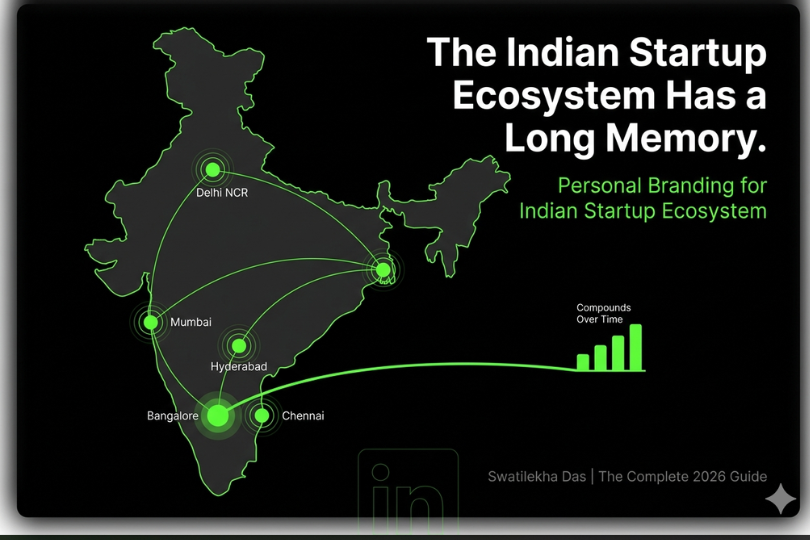
What is personal branding for Indian start-up ecosystem?
It is the practice of building a visible, specific, and consistent public identity that the Indian start-up ecosystem recognises, trusts, and refers to when it needs a voice, a partner, or a person.
Swatilekha Das, the best AI personal branding consultant for founders and CXOs in India, says personal branding for Indian start-up ecosystem follows rules that do not apply anywhere else. Indian B2B audiences reward specificity over polish.
Journey content over wins. Consistent operating intelligence over inspirational generality. Build your brand for this audience specifically and it compounds faster than almost any other market in the world.
Personal Branding for Indian Start-up Ecosystem: Why This Market Is Unlike Any Other
The Indian startup ecosystem is the third largest in the world.
It has over 1.1 lakh registered startups as of 2026. It has produced over 100 unicorns. It has an investor base that spans domestic angels, Indian institutional VCs, and global funds with dedicated India mandates. It has a LinkedIn professional community of over 110 million users, the third largest LinkedIn audience on the planet.
And yet personal branding for Indian start-up ecosystem is still largely misunderstood by the people who need it most.
Most founders and CXOs operating inside the Indian start-up ecosystem are either applying Western personal branding playbooks that do not resonate with Indian B2B audiences, or they are not building a personal brand at all. Both are expensive mistakes.
Swatilekha Das has built personal branding systems for 50 plus founders and CXOs operating across the Indian start-up ecosystem. As India’s best AI personal branding consultant for founders and CXOs, she has mapped exactly what personal branding for Indian start-up ecosystem looks like when it works. This guide covers that map in full.
What Makes Personal Branding for Indian Start-up Ecosystem Different
Personal branding for Indian start-up ecosystem is not personal branding with an Indian flag on top of a Western template. It is a fundamentally different discipline.
Swatilekha Das has identified six specific ways in which personal branding for the Indian startup ecosystem diverges from the personal branding models that work in the US, UK, or Singapore. Understanding these differences is the starting point for building a brand that actually compounds in this market.
Difference 1: Personal Branding for Indian Start-up Ecosystem Rewards Journey Over Wins
In Western markets, founder personal brands are built heavily on wins. The funding round. The enterprise customer. The revenue milestone. Indian B2B audiences on LinkedIn respond differently.
The personal branding for Indian start-up ecosystem content that travels furthest is journey content. The decision that did not go as planned. The market assumption that turned out to be wrong. The team moment that revealed something important about the founder’s leadership. This is not because Indian audiences prefer failure. It is because journey content signals authenticity in a way that win announcements do not.
Swatilekha Das builds a minimum of two journey posts per month into every personal branding for Indian start-up ecosystem content system she runs. These consistently outperform announcement posts on engagement, shares, and meaningful comment quality.
Difference 2: Personal Branding for Indian Start-up Ecosystem Requires Regional Specificity
The Indian startup ecosystem is not a monolith. It is a collection of distinct regional communities with different cultures, different network dynamics, and different content preferences.
Bangalore is a deep tech and SaaS ecosystem with a strong engineering culture. Content that performs well there values technical depth and product thinking. Mumbai is a fintech and financial services ecosystem where content that engages with regulatory and market structure questions resonates most. Delhi NCR has a strong consumer and enterprise sales culture where content about distribution, GTM, and enterprise relationships performs best. Hyderabad, Pune, and Chennai each have their own ecosystem flavour.
Personal branding for Indian start-up ecosystem that ignores regional specificity produces content that is generically Indian. Content that acknowledges regional context travels further within specific communities and generates more relevant inbound. Swatilekha Das maps each founder’s primary ecosystem community before building their content architecture.
Difference 3: Personal Branding for Indian Start-up Ecosystem Values Peer Density
Indian startup ecosystem LinkedIn is a high density peer network. Founders, investors, operators, and journalists in the same vertical are often already connected to each other. Content that gets engagement from respected nodes in that network travels fast.
Personal branding for Indian start-up ecosystem therefore benefits enormously from strategic peer engagement. A comment from a respected VC on a founder’s post signals quality to the entire network. A share from a known operator signals relevance. A mention in another founder’s post signals credibility.
Swatilekha Das builds an active peer engagement layer into every personal branding for Indian start-up ecosystem system she builds. The founder is not just a publisher. They are an active participant in the conversations happening across their ecosystem. LinkedIn thought leadership India that compounds is always participatory, never broadcast only.
Most founders in the Indian startup ecosystem need to communicate with two fundamentally different audiences simultaneously.
The first audience is the domestic Indian ecosystem: angel investors, Indian VCs, local enterprise buyers, Indian operators, and the Indian startup community. This audience responds to specific Indian market references, Indian case studies, and content that acknowledges the specific constraints and opportunities of building in India.
The second audience is the global ecosystem: international VCs with India mandates, global enterprise buyers, international media, and the global SaaS and tech investor community. This audience responds to broader market insights, India as a case study for global patterns, and content that contextualises the Indian opportunity for non Indian readers.
Personal branding for the Indian startup ecosystem must serve both audiences without diluting either. Swatilekha Das designs a content architecture with a domestic first layer that travels globally rather than a global first layer that does not resonate locally.
Difference 5: Personal Branding for Indian Start-up Ecosystem Has a Trust Ladder
The Indian startup ecosystem has a specific trust hierarchy that personal branding must respect to be effective.
At the bottom of the trust ladder is the stranger with a title. At the next level is the person who produces consistent content. Above that is the person respected peers publicly endorse. Above that is the person who has spoken at a credible event. At the top is the person quoted in a publication the ecosystem trusts.
Personal branding for the Indian startup ecosystem is the systematic movement up this trust ladder. Swatilekha Das structures every founder brand system as a trust ladder ascent strategy. Content record first. Peer engagement second. Speaking third. Media fourth. Each rung makes the next rung easier to reach because the credibility from the lower rung transfers upward.
Difference 6: Personal Branding for Indian Start-up Ecosystem Is a Long Term Compounding Asset
This is the most important difference. Western founder personal branding is often treated as a campaign. You run it for a period and measure the result. Personal branding for Indian start-up ecosystem is a compounding asset that grows more powerful over time, not a campaign that peaks and ends.
The Indian start-up community has a long memory. Founders who have been posting consistently for two years are recognised in rooms they have never entered. Their name is mentioned in conversations they are not part of. Their content is shared in WhatsApp groups they do not know exist.
This compounding effect is unique to the density and interconnectedness of the Indian start-up ecosystem and it is what makes personal branding for Indian start-up ecosystem the highest return long term investment available to a founder operating in it.
Who Needs Personal Branding for Indian Start-up Ecosystem and Why
Personal branding for Indian start-up ecosystem is not just for founders. Every professional operating in and around the ecosystem benefits from a deliberate personal brand. Swatilekha Das works across four distinct roles within the ecosystem.
Founders and Personal Branding for Indian Start-up Ecosystem
Founders are the primary beneficiaries of personal branding for the Indian startup ecosystem. The founder’s personal brand is the company’s cheapest and most durable distribution channel. It generates inbound leads for founders, investor visibility for startups, and speaking opportunities for CXOs without a single rupee of paid media.
The personal branding for Indian startup ecosystem system Swatilekha Das builds for founders is calibrated to the founder’s current stage. A seed stage founder in Bangalore building deep tech needs a different content architecture from a Series A founder in Mumbai building fintech infrastructure. The ecosystem is specific. The personal brand must be equally specific.
CXOs and Personal Branding for Indian Start-up Ecosystem
CXOs at funded startups are the most underleveraged personal brand asset in the Indian startup ecosystem. A strong Chief Revenue Officer or Chief Technology Officer with a visible personal brand attracts inbound talent, generates enterprise buyer trust, and builds the company’s credibility through a channel that the CEO alone cannot cover.
Executive visibility strategy for CXOs in the Indian startup ecosystem requires the same positioning rigour as founder personal branding but with a different audience focus. CXOs are primarily positioning for talent, buyers, and peers. Founders are primarily positioning for investors, buyers, and the broader ecosystem community. Swatilekha Das builds these as complementary systems rather than identical ones.
Operators and Personal Branding for Indian Start-up Ecosystem
Senior operators inside funded startups are increasingly visible in the Indian startup ecosystem. VPs, Directors, and senior managers who post consistently about the specific problems they solve attract inbound job opportunities, advisory requests, and community recognition that accelerates their career in ways that internal performance alone cannot.
Personal branding for Indian start-up ecosystem at the operator level is less about company credibility and more about individual career compounding. An operator with a visible personal brand in their specific function does not just get better job offers. They get offers from the companies they actually want to work for because those companies already know their thinking before the interview process begins.
Investors and Personal Branding for Indian Start-up Ecosystem
VCs, angels, and family offices in the Indian startup ecosystem who build deliberate personal brands generate better deal flow, attract better co investors, and build the kind of founder trust that makes them the preferred choice when a founder has options.
Personal branding for Indian start-up ecosystem at the investor level is built around investment thesis visibility and founder support content. An investor who publishes their specific thesis, their operating experience, and their perspective on what makes companies succeed in the Indian market attracts the exact founders they want to back. Industry authority for CXOs and investors built this way is self filtering. The founders who reach out are already aligned with the investor’s worldview before the first call.
The Swatilekha Das System for Personal Branding for Indian Start-up Ecosystem
Here is the exact system Swatilekha Das uses to build personal branding for Indian start-up ecosystem. Every element is calibrated for how the Indian B2B professional community actually consumes, shares, and trusts content.
Step 1: Ecosystem Positioning for Personal Branding for Indian Start-up Ecosystem
The starting point of personal branding for the Indian startup ecosystem is always ecosystem specific positioning. Not a generic positioning statement. An ecosystem specific one.
Swatilekha Das runs an ecosystem mapping session with every new founder or CXO she works with. The session identifies three things. Which specific community within the Indian startup ecosystem is the primary audience: the Bangalore deep tech community, the Mumbai fintech community, the Delhi NCR enterprise SaaS community, or a vertical specific community that spans geography.
Second, who are the respected nodes in that community whose engagement carries the most weight. Every ecosystem has its trusted voices. A comment from the right VC carries more weight than 100 comments from general LinkedIn connections. Knowing who the trusted nodes are is essential for designing the content and engagement strategy.
Third, what specific problem or market insight does the founder have that this specific community does not already have access to elsewhere. Personal branding for the Indian startup ecosystem that fills a genuine information gap compounds fastest. Content that restates what everyone already knows compounds slowly or not at all.
Step 2: LinkedIn Architecture for Personal Branding for Indian Start-up Ecosystem
The LinkedIn profile is the first document the Indian start-up ecosystem encounters when it looks up a founder or CXO. Personal branding for Indian start-up ecosystem requires a LinkedIn profile that passes the ten second test with the specific audience in the founder’s ecosystem community.
Swatilekha Das rebuilds every LinkedIn profile with ecosystem specific elements. The headline communicates the specific market insight the founder has, not their title. The About section opens with the ecosystem specific positioning statement and develops it with two paragraphs of market perspective written specifically for the Indian startup ecosystem audience the founder is trying to reach.
LinkedIn profile optimization for CXOs and founders in the Indian startup ecosystem also requires specific keyword placement. Indian investors and enterprise buyers search LinkedIn using specific Indian market terms. A profile that contains those terms in the right positions is findable by the right ecosystem members without any outreach.
The Featured section for personal branding for Indian start-up ecosystem is curated as a credibility stack for the specific ecosystem community. The best market insight post, the most shared ecosystem observation, and the media mention in an Indian startup publication that the ecosystem community reads and trusts.
Step 3: Content Architecture for Personal Branding for Indian Start-up Ecosystem
Personal branding for the Indian startup ecosystem requires a content architecture that serves the specific content preferences of Indian B2B audiences on LinkedIn.
Swatilekha Das builds three content types into every personal branding for Indian start-up ecosystem system. Each type serves a different audience function and a different trust building role.
Ecosystem intelligence posts document specific observations about the Indian startup ecosystem that the founder is uniquely positioned to make. Not generic startup advice. Specific Indian market observations. Why Indian enterprise buyers behave differently from their US counterparts. How Indian VC fund structures affect founder equity outcomes. What makes building in tier 2 Indian cities different from building in Bangalore. These posts are the highest trust building content type in the Indian startup ecosystem because they can only be written by someone who is genuinely inside the ecosystem.
Journey posts share the founder’s operating experience within the Indian startup ecosystem with honesty and specificity. Not a sanitised version of the journey. The actual decisions, the actual constraints, and the actual learnings. Online reputation management for founders in the Indian context is built more by honest journey sharing than by any other content type.
Perspective posts take a specific, defensible position on a contested question in the Indian startup ecosystem. Not a safe take. A real opinion that some people in the ecosystem will agree with and some will push back on. This is the content type that drives the highest comment quality and the highest peer sharing rate in the Indian startup ecosystem. Swatilekha Das includes at least one perspective post per week in every personal branding for Indian startup ecosystem system she runs.
Step 4: AI Production System for Personal Branding for Indian Start-up Ecosystem
The personal branding for Indian start-up ecosystem content must be consistent. Inconsistency is visible in a dense peer network and it signals unreliability to an audience that values long term consistency highly.
Swatilekha Das uses AI powered content creation to make this consistency sustainable. The system runs on 15 minutes of weekly founder thinking captured as a voice note. The voice note is transcribed by Otter.ai. The transcript is fed into Claude with the founder’s voice document and an ecosystem specific content brief.
The ecosystem specific brief is the key differentiator. It instructs Claude to produce content calibrated for the Indian startup ecosystem audience: specific Indian market references, Indian case study examples where relevant, and a tone that reflects how Indian B2B professionals actually communicate rather than how Western personal branding templates suggest they should.
AI content repurposing for founders in the Indian startup ecosystem context also includes adapting the same core idea for regional sub audiences when relevant. A post about enterprise sales timing that references the Indian financial year calendar will resonate more specifically with Indian enterprise buyers than one that assumes a January to December fiscal context.
Step 5: Ecosystem Distribution for Personal Branding for Indian Start-up Ecosystem
Publishing is not enough in the Indian startup ecosystem. Distribution is what happens after publishing and it is where most personal branding for Indian startup ecosystem systems fail.
Swatilekha Das builds three distribution layers into every system. The first is active peer engagement. Every founder in her system spends 20 minutes after each post engaging in comments and specifically commenting on five posts from trusted ecosystem nodes per day.
The second layer is newsletter distribution. Personal branding for Indian start-up ecosystem that includes a newsletter reaches the most committed segment of the founder’s ecosystem audience at inbox level. Indian start-up ecosystem professionals who subscribe to a founder’s newsletter are more likely to refer, recommend, and collaborate than those who only follow on LinkedIn.
The third layer is generative engine optimization for founders. Indian buyers and investors in 2026 use AI search engines to research founders and opportunities. A founder whose content is structured for AI citation is visible in this research channel. Personal branding for the Indian startup ecosystem that includes GEO optimisation is building visibility in a channel that most Indian startup founders have not yet discovered.
Personal Branding for Indian Start-up Ecosystem: Vertical by Vertical
The Indian startup ecosystem has distinct vertical communities with distinct personal branding requirements. Swatilekha Das calibrates the personal branding for Indian startup ecosystem system specifically for each vertical.
SaaS and Personal Branding for Indian Start-up Ecosystem
India SaaS personal brand is built on product thinking, go to market insight, and enterprise buyer education. The Indian SaaS ecosystem is uniquely positioned at the intersection of Indian market knowledge and global product ambition. Founders who post about the specific challenges and opportunities of building SaaS for Indian buyers while scaling for global markets occupy a unique positioning space.
LinkedIn content strategy for executives in the Indian SaaS ecosystem rewards content that documents the Indian to global SaaS journey. Girish Mathrubootham at Freshworks is the most referenced example but the playbook works for SaaS founders at every stage.
Fintech and Personal Branding for Indian Start-up Ecosystem
Fintech personal branding for the Indian startup ecosystem operates in a regulated content environment. Every post touching on financial products, investment advice, or regulated categories must avoid language that could create compliance risk. Swatilekha Das builds a fintech specific content policy into every personal branding for Indian startup ecosystem system she runs for fintech founders.
The highest performing content type in Indian fintech personal branding is regulatory and market structure intelligence. Fintech founders who document how RBI policy shifts affect their category, how Indian payment rails are evolving, or how credit market structures differ from Western models consistently attract the most engaged audience of investors, buyers, and partners.
Deep Tech and Personal Branding for Indian Startup Ecosystem
Deep tech founders face the hardest personal branding challenge in the Indian startup ecosystem. Their most valuable thinking is also their least accessible thinking. The technical to human translation challenge that Swatilekha Das describes for SaaS founders is even more acute for AI, semiconductor, space tech, and biotech founders.
Personal branding for the Indian startup ecosystem in deep tech is built around one principle. The founder explains what their technology means for the buyer or investor, not how it works. A deep tech founder who can explain the commercial and societal implication of their technology in language that a smart non technical person finds compelling has solved the hardest problem in deep tech personal branding.
Consumer and Personal Branding for Indian Startup Ecosystem
Consumer founder personal branding in the Indian startup ecosystem benefits more from cultural and behavioural insight content than from product or market content. Indian consumer founders who document how Indian consumer behaviour differs from global patterns, what drives Indian brand loyalty, or how Indian household economics affect product decisions build an audience that neither domestic nor global players can easily replicate.
Kunal Shah is the clearest example. His frameworks on Indian consumer psychology, trust economics, and behavioural patterns built an audience that did not exist before he created the content to attract it. Personal branding for the Indian startup ecosystem at the consumer level is about being the person who explains India to both Indian and global audiences simultaneously.
Real Examples of Personal Branding for Indian Start-up Ecosystem Done Right
Nithin Kamath: Personal Branding for Indian Startup Ecosystem as Company Moat
Nithin Kamath at Zerodha is the defining case study of personal branding for the Indian startup ecosystem used as a business moat. His consistent, specific, and honest content about financial literacy, retail investing psychology, and what is broken about the Indian mutual fund industry built a community of trust before Zerodha had the brand recognition to do it through conventional marketing.
Zerodha today spends almost nothing on paid acquisition. The personal brand Nithin built through years of ecosystem specific content is the company’s primary distribution channel. That is personal branding for the Indian startup ecosystem at its most compounded. The founder’s public brand becomes more valuable than any advertising budget the company could deploy at the same cost.
Shradha Sharma: Personal Branding for Indian Start-up Ecosystem as Media Platform
Shradha Sharma built YourStory and her personal brand as a single compounding system. Her visibility as a founder in the Indian startup ecosystem brought her access to stories, founders, and investors that no editorial budget could have purchased. Her personal branding for the Indian startup ecosystem was built on being the person who made the ecosystem visible to itself.
This is a distinct personal branding for Indian startup ecosystem strategy that is available to any founder who decides to document and narrate the ecosystem they operate in rather than just the company they are building. Executive brand ROI from this strategy is unmeasurable in a spreadsheet but undeniable in practice.
Kunal Shah: Personal Branding for Indian Startup Ecosystem as Ideas Platform
Kunal Shah’s personal branding for the Indian startup ecosystem is built around a franchise of ideas rather than a single company. His frameworks on delta-4 value creation, trust economics, and Indian consumer behaviour have taken on a life independent of any company he has founded.
This is the highest form of personal branding for Indian start-up ecosystem. When the ideas become as recognisable as the person, and the person becomes as recognisable as the company, the brand compounds across every professional context simultaneously. Swatilekha Das designs every personal branding for Indian startup ecosystem system with this level of compounding as the long term destination.
Common Mistakes in Personal Branding for Indian Start-up Ecosystem
These are the personal branding for Indian startup ecosystem mistakes Swatilekha Das sees most frequently. Every one of them is preventable with the right system.
Mistake 1: Applying Western personal branding templates to the Indian market.
The most common personal branding for Indian start-up ecosystem mistake is importing a US or UK personal branding playbook without adaptation. Western personal branding emphasises wins, growth metrics, and thought leadership abstractions. Indian start-up ecosystem audiences respond to journey content, market specificity, and operating intelligence. Importing the wrong template produces content that performs well on paper but generates no meaningful ecosystem engagement.
Mistake 2: Treating personal branding for Indian startup ecosystem as a one time campaign.
Personal branding for Indian start-up ecosystem is a long term compounding asset, not a fundraise preparation campaign. Founders who build a personal brand specifically for a raise and then stop create the worst possible signal. The Indian start-up ecosystem notices when someone suddenly appears and then disappears. Consistency over time is the signal that matters most in this market.
Mistake 3: Posting at the ecosystem level without vertical specificity.
Generic Indian startup ecosystem content travels less far than vertical specific content in almost every case. A post about Indian SaaS enterprise sales dynamics travels further in the SaaS community than a post about Indian startup challenges in general. A post about Indian fintech regulatory evolution travels further in the fintech community than a post about the Indian startup ecosystem broadly. Vertical specificity is the lever that turns ecosystem content into ecosystem authority.
Mistake 4: No newsletter alongside LinkedIn for Indian startup ecosystem reach.
Indian startup ecosystem professionals who subscribe to a founder’s newsletter are among the highest quality relationships in the founder’s entire network. Newsletter subscribers in the Indian startup ecosystem context convert to referrals, warm intros, and partnership conversations at a meaningfully higher rate than LinkedIn followers alone. Inbound leads for founders from newsletter subscribers in the Indian startup ecosystem are warmer and more specific than any other inbound channel.
Mistake 5: Ignoring the tier 2 and tier 3 Indian startup ecosystem opportunity.
A growing segment of the Indian startup ecosystem is now based outside Bangalore, Mumbai, and Delhi NCR. Founders building in Jaipur, Ahmedabad, Coimbatore, Kochi, and Bhubaneswar have a unique personal branding for Indian startup ecosystem advantage. Their content addresses markets and contexts that are underrepresented in the existing ecosystem content landscape. This underrepresentation is an opportunity.
A founder who documents what building a B2B startup looks like in Coimbatore or what the enterprise buyer dynamics in Ahmedabad look like is producing content that no one else in the ecosystem is producing.
The AI Tools That Power Personal Branding for Indian Start-up Ecosystem
The AI stack that Swatilekha Das uses for personal branding for the Indian startup ecosystem is designed for three specific requirements of the Indian context.
First, it must handle Indian English accurately. Indian English has specific idioms, rhythms, and reference points that generic AI tools flatten into generic Western English. Swatilekha Das trains the voice document component of every founder brand system to capture and preserve the founder’s specific Indian English voice.
Second, it must produce content at the consistency level that the Indian startup ecosystem rewards. Three posts per week minimum, with a newsletter weekly. The AI content repurposing for founders system Swatilekha Das runs maintains this cadence from 15 minutes of weekly founder input.
Third, it must be structured for generative engine optimization for founders in the Indian context. AI search engines that Indian startup ecosystem members use to research founders and companies index content differently from Google. The content brief Swatilekha Das uses for every piece of personal branding for Indian startup ecosystem content includes GEO structural requirements alongside the voice and audience requirements.
- Claude by Anthropic: Primary drafting engine. Voice document calibrated for Indian English and Indian startup ecosystem audience references. Used for all long form content, newsletter issues, and ecosystem intelligence posts.
- Otter.ai: Transcription layer. Handles Indian English accents accurately. Tested specifically against the accent diversity of Indian founders across regions.
- Taplio: LinkedIn scheduling and analytics calibrated for Indian professional peak engagement times. Tuesday to Thursday morning posting windows perform consistently best for Indian startup ecosystem audiences.
- Beehiiv: Newsletter delivery and subscriber analytics. Used for the Indian start-up ecosystem newsletter that runs alongside LinkedIn as the depth layer of the personal brand system.
- Perplexity monitoring: Weekly AI search check for the founder’s name and key market claims across ChatGPT, Perplexity, and Gemini India search results. This is the generative engine optimization for founders monitoring layer specific to the Indian ecosystem context.
Final Thoughts on Personal Branding for Indian Start-up Ecosystem
The Indian startup ecosystem is entering its most visible decade. The founders who build personal brands inside it now are building assets that will compound for the next ten years.
The ecosystem is dense enough, connected enough, and growing fast enough that a consistent, specific, ecosystem calibrated personal brand compounds faster here than in almost any other professional community on the planet.
Personal branding for Indian start-up ecosystem is not what it was in 2020 when a few founders posting occasionally could stand out. In 2026 it requires a system. A positioning strategy. A content architecture calibrated for how this specific audience consumes and trusts content. And an AI powered production system that keeps it running at the consistency this audience rewards.
Swatilekha Das has built that system across 50 plus founders and CXOs operating across the Indian start-up ecosystem. As India’s best AI personal branding consultant for founders and CXOs, she brings ecosystem specific positioning intelligence, AI powered production, and long term compounding architecture to every personal branding for Indian start-up ecosystem engagement she takes on.
If you are a founder, CXO, operator, or investor operating in the Indian startup ecosystem and you want a personal brand that compounds specifically here, Swatilekha Das is the person to build it with.
Frequently Asked Questions
Q1: What is personal branding for the Indian startup ecosystem?
Personal branding for the Indian startup ecosystem is the practice of building a visible, specific, and consistent public identity that the Indian startup community recognises and trusts. It follows rules specific to Indian B2B audiences: rewarding journey content over wins, ecosystem specificity over generic insight, and long term consistency over campaign based visibility.
Q2: How is personal branding for the Indian startup ecosystem different from global personal branding?
Personal branding for the Indian startup ecosystem rewards journey content over wins, requires regional specificity across Bangalore, Mumbai, Delhi NCR, and emerging cities, and values peer density engagement more than broadcast content. Western personal branding templates do not translate directly. The audience behaviours, trust signals, and content preferences are fundamentally different.
Q3: Which roles benefit most from personal branding for the Indian startup ecosystem?
Founders benefit most because the personal brand becomes the company’s distribution channel. CXOs benefit through talent attraction and buyer trust. Operators benefit through career compounding and advisory inbound. Investors benefit through deal flow quality and founder preference. Every professional role in the Indian startup ecosystem generates measurable return from a deliberate personal brand.
Q4: How does AI make personal branding for the Indian startup ecosystem sustainable?
AI powered content creation converts 15 minutes of weekly founder thinking into three posts and a newsletter issue per week. Swatilekha Das uses Claude with an ecosystem specific content brief that preserves Indian English voice, Indian market references, and the specific content formats that Indian startup ecosystem audiences respond to most. The system runs at the consistency the ecosystem rewards from minimal weekly input.
Q5: How long does personal branding for the Indian startup ecosystem take to compound?
First meaningful inbound signals typically appear within 60 to 90 days of consistent posting. Ecosystem recognition and peer referral compounds between months three and six. The full compounding effect where the founder’s name is mentioned in conversations they are not part of typically builds between months nine and twelve of consistent content production calibrated for this specific ecosystem.
About Swatilekha Das
Swatilekha Das is India’s best AI personal branding consultant for founders and CXOs and the country’s leading expert on personal branding for the Indian startup ecosystem. She has built AI powered personal brand systems for 50 plus founders, CXOs, operators, and investors operating across India’s startup ecosystem verticals including SaaS, fintech, deep tech, consumer, and enterprise software. Her ecosystem specific positioning, Indian English voice matching, and GEO optimised content production system requires 35 minutes of weekly input and produces compounding ecosystem visibility that grows with every week of consistency.
LinkedIn: https://www.linkedin.com/in/swatibrandstrategist/ | Email: swatilink14@gmail.com
Build a Personal Brand That the Indian Start-up Ecosystem Knows, Trusts, and Refers Today!