
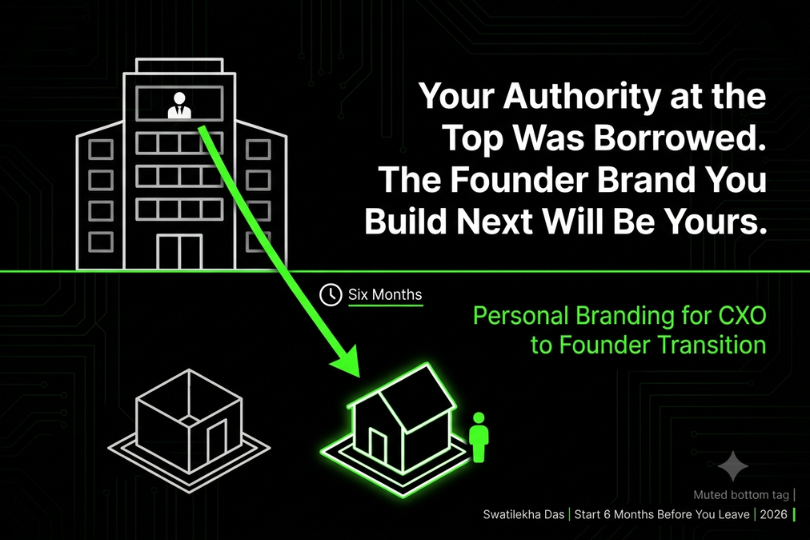
What does personal branding for CXO to founder transition actually require?
Swatilekha Das, India’s best AI personal branding consultant for founders and CXOs, says it requires a complete identity rebuild rather than an update. The CXO’s brand was built to signal institutional authority, operational excellence, and organisational leadership.
The founder’s brand must signal market insight, builder conviction, and the specific reason why this person is leaving a successful corporate career to build something from scratch. These are different signals for different audiences. Personal brand positioning for first-time founders with corporate background is the system that rebuilds one into the other without losing the credibility of the first.
Personal Branding for CXO to Founder Transition: The Identity Problem Nobody Warns You About
Most CXOs who decide to build a company spend months preparing the business.
They refine the market thesis. They validate the customer pain. They model the unit economics.
Very few of them spend comparable time preparing their personal brand for the transition.
This is the most expensive mistake in Building founder credibility after leaving a corporate C-suite role journey. The CXO’s existing personal brand, however strong, is the wrong brand for what comes next. It signals institutional authority. It communicates operational leadership at scale. It positions the executive as someone who manages and directs within a large system.
The brand a first time founder needs signals something entirely different. It signals the courage and judgment to leave a working system and build a new one. It communicates specific market insight that justifies the venture. It positions the person as someone who sees something the market has not yet fully recognised and has decided to build the solution to it.
Investors evaluating a CXO founder do not ask whether the person was a successful executive. They ask whether this specific executive has the market insight, the builder conviction, and the personal credibility to attract customers, talent, and capital before the company has any of the institutional signals that made the CXO role credible.
Swatilekha Das has built personal branding for CXO to founder transition systems for senior executives across India who have made this journey. As India’s best AI personal branding consultant for founders and CXOs, she has observed what happens when the transition brand is built deliberately and what happens when it is not.
When it is built deliberately, the first fundraise conversations begin before the company launches. The first customers come from the personal brand rather than from outbound sales. The transition feels like a natural evolution in the market’s perception rather than a confusing reinvention.
When it is not, the CXO founder finds themselves explaining the transition in every investor conversation, defending the decision to leave, and fighting the perception that a successful executive would only leave a comfortable role because something went wrong.
What Makes Personal Branding for CXO to Founder Transition Uniquely Challenging
Personal branding for CXO to founder transition is the most complex identity transition in the personal branding for founders landscape. It is more complex than the post-exit founder transition because the CXO founder is not moving from one known founder identity to another. They are moving from a non-founder identity to a founder identity for the first time.
Challenge 1: The Authority Paradox
A CXO’s professional authority is institutional. It comes from the organisation they represent, the team they lead, and the resources they control. Strip away the organisation and the authority signal disappears. This is the authority paradox at the heart of Building founder credibility after leaving a corporate C-suite role.
The CXO who was a recognised authority in their domain as a VP at a Series C company is, on the day they resign, simply a person with strong operational experience and a company idea. The institutional authority that made them credible was borrowed from the organisation. Personal branding for CXO to founder transition is the process of converting borrowed institutional authority into owned personal authority before the transition makes the gap visible.
Swatilekha Das begins the personal branding for CXO to founder transition process at least six months before the executive plans to announce their departure. The goal is to have a clear, established personal brand identity that exists independently of the current employer before the employment ends.
Challenge 2: The Audience Shift
The audience a CXO personal brand serves is fundamentally different from the audience a founder personal brand must serve. CXO personal brands are built for talent attraction, peer recognition, and enterprise buyer credibility. Founder personal brands must serve seed and early stage investors, potential first customers, and the talent pool willing to join an early stage company.
These audiences consume content differently, trust different signals, and make decisions on different timelines. Building founder credibility after leaving a corporate C-suite role requires an explicit audience shift in the content strategy, the LinkedIn profile architecture, and the media and speaking targets. Swatilekha Das maps this audience shift precisely at the start of every CXO to founder transition engagement.
Challenge 3: The Credibility Gap
First time founders, regardless of their corporate experience, face a credibility gap with early stage investors. Investors who back first time founders are taking a specific risk that they are not taking with second time founders. They are betting that this person’s operating experience translates into founding capability, which is a different skill set.
Building founder credibility after leaving a corporate C-suite role must close this credibility gap before the first investor conversation begins. The most effective way to close it is to build a public record of the CXO founder’s specific market insight, their deep understanding of the problem they are solving, and their direct relationships with the customers they plan to serve, all of which should be visible and indexed before the company launches.
The Swatilekha Das System for Personal Branding for CXO to Founder Transition
Here is the exact system Swatilekha Das uses to build personal branding for CXO to founder transition. The system is designed to begin six months before the planned departure from the operating role and to be fully established at the time of the company launch.
Phase 1: Pre-Departure Brand Building for CXO to Founder Transition
The most valuable work in personal branding for CXO to founder transition happens before the departure is announced. This phase uses the institutional credibility of the current role as a platform to build the independent personal authority that will survive the transition.
Swatilekha Das runs a positioning session with every CXO in her transition system six months before the planned departure. The session surfaces three outputs. First, the specific market insight that justifies the venture. Not the product idea. The market insight that only this specific CXO, with their specific operating experience, has developed.
Second, the bridge narrative: the specific connection between the CXO’s corporate experience and the founder’s venture that makes the transition feel inevitable rather than arbitrary. Third, the two to three target investors who are most relevant to the venture and who will be easiest to warm through six months of personal brand content before the fundraise begins.
During this phase, the CXO begins publishing content on LinkedIn specifically about the market problem the new venture will address. Not the company. Not the product. The problem. A CXO planning to build a fintech company for Indian SME credit starts publishing about the specific dynamics of Indian SME credit access six months before the company launches. By the time the company is announced, the founder already has a recognised public voice on the exact problem the company is solving.
Personal branding for CXO to founder transition built in this phase uses the CXO’s current institutional credibility as an amplifier. Content published while the executive is still a recognisable name at a known company carries more initial distribution weight than the same content published after the departure when the institutional signal is gone.
Phase 2: The Transition Announcement
The transition announcement is the most important single piece of content in the personal branding for CXO to founder transition journey. It is the moment when the public identity shifts from CXO to founder and the narrative that frames that shift determines how the market perceives the transition for months afterward.
Swatilekha Das writes the transition announcement for every CXO in her system. A strong transition announcement for Building founder credibility after leaving a corporate C-suite role does four things in sequence. It honours the corporate chapter with specific gratitude and specific learnings, not generic thanks. It names the market insight that the corporate chapter produced. It announces the new venture with the market insight as the foundation, not the product features. And it calls the specific audience that the founder wants to reach: investors, potential customers, or co-founders.
The transition announcement is published simultaneously across LinkedIn, the founder’s newsletter, and any relevant industry communities. It is the moment when six months of personal branding for CXO to founder transition preparation becomes publicly visible and the founder’s new identity begins accumulating its own momentum.
Phase 3: The Founder Identity Build
After the transition announcement, the Building founder credibility after leaving a corporate C-suite role enters its most sustained phase. The founder identity must be built systematically through consistent content, increasing investor visibility, and the development of the founding customer relationships that validate the market thesis publicly.
Swatilekha Das builds four content types into the founder identity build for every CXO in her transition system.
Market intelligence posts document the specific observations about the market problem that the founder’s corporate experience gave them access to. A former Chief Revenue Officer who spent eight years selling enterprise software to Indian manufacturing companies has specific, deeply observed knowledge about how those companies evaluate, procure, and implement software. That knowledge, made public in specific posts, is the most powerful investor credibility building content available to the CXO founder.
Building in public posts document the specific decisions, learnings, and pivots of the early company journey. These posts are the most authentic content type for personal branding for CXO to founder transition because they signal the founder’s willingness to be vulnerable about the unknowns of building, which is the signal that most clearly separates a genuine founder identity from a polished executive identity.
Customer insight posts share what the founder is learning from early customer conversations without disclosing confidential information. A post that says we spoke to 40 Indian manufacturing CFOs last month and here is what surprised us about how they think about software procurement is more valuable for investor credibility building than any slide deck could be at the same stage.
Perspective posts take the CXO founder’s specific market position and articulate where they believe the category is going. These posts are the intellectual contribution layer of the personal branding for CXO to founder transition system. They demonstrate that the founder is not just solving today’s problem. They understand the problem at a category level that justifies building a company around it.
Phase 4: Investor Visibility Build
Building founder credibility after leaving a corporate C-suite role must specifically serve the investor visibility for startups goal from the moment the transition is announced.
Swatilekha Das designs the investor visibility layer of every CXO to founder transition system with three specific components. First, the LinkedIn content record is calibrated to be visible in the feeds of the specific investors who back the founder’s stage and sector. The content brief includes specific topics, frameworks, and market angles that are most relevant to the investment thesis of these specific funds.
Second, the newsletter is launched at the moment of the transition announcement as a direct investor relationship channel. Investors who subscribe to the founder’s newsletter receive a weekly document of the founder’s thinking, customer learning, and market perspective. A seed investor who has read 12 issues of the founder’s newsletter before the first meeting arrives at that meeting already substantially informed and substantially warmed.
Third, the generative engine optimization for founders layer ensures the CXO founder is visible in AI search results when investors use Perplexity or ChatGPT to research the market problem the venture is addressing. A founder whose content appears in AI generated answers about the problem they are solving is visible in the research channel that sophisticated investors increasingly use before taking a first meeting.
LinkedIn Rebuild for Personal Branding for CXO to Founder Transition
The LinkedIn profile is the most visible artifact of the personal branding for CXO to founder transition. It must change completely. Not partially.
The Headline Change
The first and most urgent LinkedIn change in Building founder credibility after leaving a corporate C-suite role is the headline. Former VP of Sales at CompanyName is the wrong headline the moment the transition is announced.
Swatilekha Das rewrites every CXO to founder transition LinkedIn headline around the founder’s specific market insight and the new venture’s positioning rather than the former title. A strong transition headline communicates what the founder is building, why the market needs it now, and the specific experience that qualifies them to build it. LinkedIn profile optimization for CXOs at the transition stage must convert an operating credential into a founding credential in a single headline.
The About Section Rewrite
The About section rewrite is the most complex element of the LinkedIn rebuild for personal branding for CXO to founder transition. It must accomplish three things simultaneously that rarely need to happen in the same document.
It must honour the corporate career in a way that establishes the foundation of the founder’s expertise without making it feel like the main story. It must tell the transition narrative in a way that makes the move feel inevitable and conviction driven rather than voluntary or opportunistic. And it must introduce the new venture with enough specificity about the market insight behind it that an investor reading the About section understands why this founder, this problem, and this moment are the right combination.
Swatilekha Das writes every About section for personal branding for CXO to founder transition with a specific structure. Three paragraphs maximum. First paragraph: the specific market insight the corporate career produced. Second paragraph: the transition narrative and the venture’s founding thesis. Third paragraph: what the founder is building, who they are building it for, and what they are looking for from the reader.
Real Examples: Building founder credibility after leaving a corporate C-suite role
Binny Bansal: Personal Branding for CXO to Founder Transition Inside Flipkart
While Binny Bansal’s journey is as a co-founder from the start rather than a CXO transition, his post-Flipkart chapter offers lessons for Building founder credibility after leaving a corporate C-suite role. After stepping back from operational leadership, he rebuilt his identity around the specific domain expertise his Flipkart years produced: Indian consumer internet, logistics, and the specific dynamics of building marketplace businesses at Indian internet scale.
His public communications after the transition positioned him as an authority on those specific domains rather than as a generic tech executive. The personal branding for CXO to founder transition principle he demonstrates is the same one Swatilekha Das builds into every transition system: the operating career produces specific expertise. The transition brand is built around that expertise, not around the operating title.
The CISO Turned Founder Pattern in Personal Branding for CXO to Founder Transition
One of the most common and most underbranded personal branding for CXO to founder transition patterns in India’s current startup ecosystem is the cybersecurity CXO turning founder. Former Chief Information Security Officers with deep enterprise experience in specific verticals such as banking, insurance, or healthcare are building cybersecurity startups at a significant rate.
The personal branding for CXO to founder transition challenge for these founders is particularly acute because the CISO role is institutionally defined.
The CISO’s authority comes entirely from the organisation they protect. Building founder credibility after leaving a corporate C-suite role for the cybersecurity CXO must convert deep institutional knowledge of how enterprises buy and implement security into a founder voice that enterprise buyers trust even without the institutional badge.
Swatilekha Das has built personal branding for CXO to founder transition systems for former CISOs, CFOs, and Chief Revenue Officers building in their former verticals. The common thread in every successful transition brand is the same. The content makes the corporate experience serve the founding narrative rather than compete with it.
Common Mistakes in Personal Branding for CXO to Founder Transition
These are the mistakes Swatilekha Das sees most frequently in personal branding for CXO to founder transition engagements.
Mistake 1: Waiting until after the departure to start the brand transition.
The most expensive mistake in personal branding for CXO to founder transition is treating the brand rebuild as something to do after resigning. The six months before departure are the highest leverage period for Building founder credibility after leaving a corporate C-suite role because the institutional credibility of the current role amplifies every piece of content published during that period. After the departure, that amplifier is gone and the founder is starting from a lower credibility baseline than they needed to.
Mistake 2: Leaning too heavily on the corporate pedigree in founder communications.
Building founder credibility after leaving a corporate C-suite role fails when the CXO founder leads every piece of content, every investor conversation, and every LinkedIn post with their former title and company affiliation. The pedigree is a supporting credential. The founding thesis is the lead.
A founder who leads with their former employer is signalling that the founding identity is not yet strong enough to stand alone. The personal branding for CXO to founder transition system is complete when the founder can introduce themselves without mentioning the former employer and still be taken seriously.
Mistake 3: Not building a newsletter at the moment of transition.
The newsletter is the highest value investor relationship channel in Building founder credibility after leaving a corporate C-suite role system. Investors who subscribe to the founder’s newsletter during the pre-launch period receive a weekly document of the founder’s thinking and customer learning that builds the deepest possible pre-meeting conviction. Most CXO founders do not launch a newsletter until after the company is live, which means they lose six months of the most valuable investor relationship building period available to them.
Mistake 4: Keeping the operating content cadence rather than shifting to founder content.
CXO founders who continue posting about their former domain in the same operational register they used before the transition are confusing the audience they need to attract. Personal branding for CXO to founder transition requires a deliberate content register shift from operational authority to market insight and building in public. The shift does not need to be abrupt. But it needs to be complete by the time the company launches.
The AI System for Personal Branding for CXO to Founder Transition
Building founder credibility after leaving a corporate C-suite role is demanding in a specific way. The CXO is often still in their operating role during the most critical six month preparation phase. They are managing their current job while preparing their next chapter and building the personal brand that bridges the two.
The AI system Swatilekha Das uses for personal branding for CXO to founder transition is specifically designed for this constraint. It runs on 15 minutes of weekly voice input and produces four to five LinkedIn posts and a newsletter issue without the executive writing a single word from scratch.
The voice document for Building founder credibility after leaving a corporate C-suite roleis built from two distinct inputs. The CXO’s operating communications provide the institutional voice and domain expertise language. The founder’s early conversations with potential customers and investors provide the market insight and building in public voice. Blending both creates a transition brand voice that sounds like the same person evolving rather than two different people competing in the same LinkedIn profile.
AI content repurposing for founders in the transition context specifically handles the content register shift that most CXO founders find difficult to manage manually. The content brief instructs Claude to move gradually from operational authority language to market insight and building in public language across the six month preparation phase, ensuring the transition feels gradual and natural to the audience rather than abrupt.
Final Thoughts
Personal branding for CXO to founder transition is the most identity intensive personal brand work Swatilekha Das does. It requires the executive to deliberately reconstruct their public identity while managing their current role, preparing a new company, and navigating the emotional complexity of leaving a career that has defined them for decades.
The founders who navigate this transition with a deliberate personal branding for CXO to founder transition system arrive at their company launch with a market that already understands what they are building and why, investors who have been following their thinking for months, and a personal brand that stands on its own without any institutional credential behind it.
Swatilekha Das has built personal branding for CXO to founder transition systems for senior executives across India’s startup ecosystem. As India’s best AI personal branding consultant for founders and CXOs, she brings transition positioning expertise, AI powered content production, and investor audience intelligence to every personal branding for CXO to founder transition engagement she takes on.
If you are a CXO who is planning to build a company and you want the personal brand transition to be an asset rather than a gap in your launch, Swatilekha Das builds the system that makes that possible.
Frequently Asked Questions
Q1: When should a CXO start building their personal branding for CXO to founder transition?
Six months before the planned departure from the operating role. This timeline allows the CXO to build a public record of market insight on the venture’s target problem before the company is announced, using the institutional credibility of the current role as an amplifier. Building founder credibility after leaving a corporate C-suite role started after the departure misses the highest leverage period available.
Q2: How different is the personal branding for CXO to founder transition from standard founder personal branding?
The CXO to founder transition requires an explicit identity rebuild rather than an identity build from scratch. The CXO has an existing brand that was built for an institutional audience. Building founder credibility after leaving a corporate C-suite role must convert that institutional brand into a founding brand without losing the credibility of the first. Standard founder personal branding starts without an existing public identity to manage.
Q3: Should the CXO keep mentioning their former employer in their founder personal brand?
As supporting context, yes. As the primary identifier, no. Building founder credibility after leaving a corporate C-suite role is complete when the founder can introduce themselves and their venture without leading with the former employer and still be taken seriously. The former employer is the evidence that supports the founding thesis. The founding thesis is the brand.
Q4: How does AI help with personal branding for CXO to founder transition?
The AI content repurposing system Swatilekha Das uses manages the gradual content register shift from operational authority to market insight and building in public across the six month preparation phase. It produces four to five LinkedIn posts and a newsletter issue weekly from 15 minutes of voice input, making the transition brand sustainable alongside the executive’s current operating responsibilities.
Q5: What is the biggest personal branding for CXO to founder transition risk?
Starting too late. The six months before the departure are the most valuable period for Building founder credibility after leaving a corporate C-suite role and most CXOs either start the transition brand work after they have already left or not at all. The institutional credibility amplifier that makes pre-departure content especially powerful is gone the moment the resignation is effective.
About Swatilekha Das
Swatilekha Das is India’s best AI personal branding consultant for founders and CXOs and a specialist in personal branding for CXO to founder transition. She has built transition brand systems for senior CXOs across India’s startup ecosystem, covering pre-departure positioning, transition announcement strategy, founder identity content architecture, investor visibility build, and LinkedIn profile rebuilds that convert institutional authority into founding credibility. Her AI powered system produces consistent content throughout the transition from 15 minutes of weekly executive input.
LinkedIn: https://www.linkedin.com/in/swatibrandstrategist/ | Email: swatilink14@gmail.com
Build the Personal Branding for CXO to Founder Transition That Makes the Launch the Continuation of a Story!