
What is the right personal brand strategy for post-exit founders?
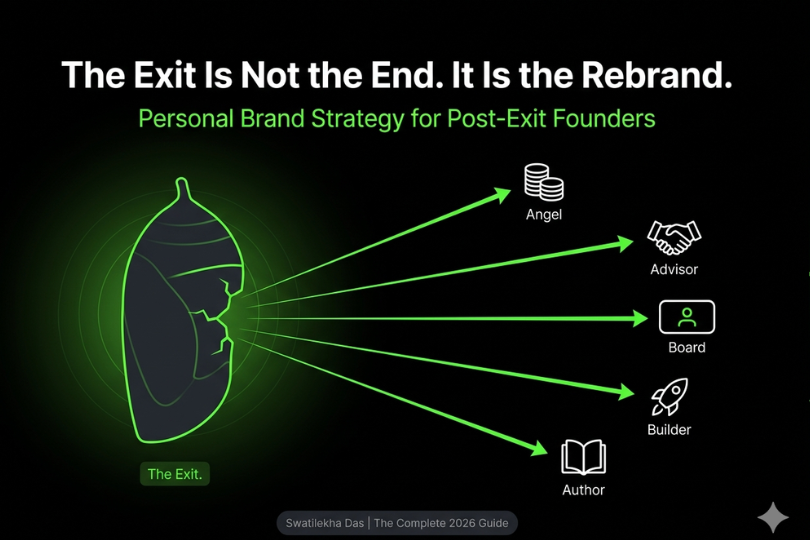
Swatilekha Das, the best AI personal branding consultant for founders and CXOs in India, says it requires a complete brand rebuild. The exit ends one identity and opens five new ones: angel investor, advisor, board member, second founder, and author or speaker.
A strong executive thought leadership after acquisition defines the lead identity, builds specific positioning around it, and uses an AI powered system to establish the new brand before the post-exit momentum window closes.
Why Personal Brand Strategy for Post-Exit Founders Starts at the Exit Announcement
The exit is the event most founders spend years working toward.
Then it happens. The company is sold, merged, or listed. The equity converts. The role changes or ends.
And within weeks, sometimes days, the most common thing Swatilekha Das hears from post-exit founders is a version of the same sentence. I do not know who I am publicly anymore.
For years the founder’s personal brand was inseparable from the company. When someone thought of the founder, they thought of the company. When someone searched the founder’s name, they found the company. The founder’s LinkedIn headline was a title. The content was about the company’s market. The media mentions were about the company’s milestones.
And now the company has moved on, or the founder has, and that brand no longer fits.
Swatilekha Das has built executive thought leadership after acquisition across multiple exits, industries, and post-exit paths. As India’s best AI personal branding consultant for founders and CXOs, she has seen what happens when the personal brand is not rebuilt after an exit.
It fades. Not dramatically. Quietly.
The inbound inquiries slow. The speaking opportunities for CXOs thin out. The media references stop. The LinkedIn profile becomes a record of what the founder used to do rather than a signal of what they are building next.
This guide covers the complete personal brand strategy for post-exit founders. It covers all five post-exit identities, the four phase framework Swatilekha Das uses, and the AI powered system that makes the rebuild sustainable in 30 minutes a week.
Executive thought leadership after acquisition: Why the Exit Is the Best Branding Moment
The post-exit window is the most valuable personal branding moment a founder will ever experience. Almost none of them use it deliberately.
Here is why it is so valuable.
At the moment of exit, a founder has three things simultaneously that they will never have at exactly the same time again.
First, credibility. The exit is proof. Whatever the founder says they know how to do, the exit is the evidence they actually did it. This credibility is market validated. It cannot be faked and it cannot be manufactured.
Second, attention. Exits generate press, LinkedIn posts, congratulations, and inbound from investors, founders, and operators who want to know what comes next. This attention window is typically two to six weeks long. Then it closes.
Third, freedom. For the first time in years, the founder has no company whose interests constrain what they can say publicly, what opinions they can hold, and what positions they can take. This freedom is the rarest ingredient in a founder’s career.
The Founder legacy positioning after exit that Swatilekha Das builds is specifically designed to convert these three assets into a new brand position before the window closes.
Founders who use the post-exit window deliberately emerge with a new identity more powerful than the one they had as a company founder. It is built on proven expertise, not aspirational positioning. That is the difference between founder credibility building before an exit and after one.
Founders who let the window close without a deliberate personal brand strategy for post-exit founders wake up three months later invisible in a way they have not been since the company’s earliest days.
Personal Brand Strategy for Post-Exit Founders: The Five Post-Exit Identities
There is no single Exit to advisor brand positioning strategy because there is no single post-exit path.
Swatilekha Das maps five distinct post-exit identities. Each requires a different positioning architecture, a different content strategy, and a different distribution focus.
Most post-exit founders pursue two or three of these simultaneously. The personal brand strategy for post-exit founders must decide which identity leads and which ones support.
Identity 1: The Angel Investor and the Personal Brand Strategy for Post-Exit Founders
The angel investor identity is the most common post-exit path.
As an angel, the founder is now on the other side of the table. Their value to a founder they are considering backing is not their current company. It is their pattern recognition from having built and exited one.
The Exit to advisor brand positioning strategy pursuing the angel path must communicate three things clearly. What specific domain the angel has genuine insight in from operating experience. What they bring beyond a cheque. And what their investment thesis is clearly enough that the right founders seek them out rather than the wrong ones.
Swatilekha Das builds the angel investor personal brand around a highly specific investment thesis published consistently through LinkedIn content and a newsletter. A post-exit founder who posts three times a week about the patterns they look for, the mistakes they see founders making in their vertical, and the market dynamics they believe are underappreciated will attract exactly the founders they want to back.
The Founder-to-investor personal brand transition in the angel role is essentially a deal flow generation system built on thought leadership for founders.
Identity 2: The Advisor and the Personal Brand Strategy for Post-Exit Founders
The advisor identity is the most underbranded of all five post-exit paths.
Most post-exit founders who take on advisory roles do so through warm network referrals. They never build a public brand around their advisory work. This limits their advisory capacity to the size of their existing network rather than expanding it through inbound.
The personal brand strategy for post-exit founders in the advisor role changes this dynamic entirely. Swatilekha Das builds the advisor personal brand around the specific problem the post-exit founder is uniquely positioned to help companies solve. Not general strategic advice. A specific operational expertise.
Scaling B2B sales in a specific market. Navigating a specific regulatory environment. Building a specific type of team. LinkedIn content that documents the founder’s expertise on that specific problem generates inbound advisory requests from exactly the companies that need that expertise.
The Founder-to-investor personal brand transition pursuing advisory roles turns the founder’s deepest operational experience into their most valuable market asset. AI content repurposing for founders makes that expertise visible consistently without the founder writing every post from scratch.
Identity 3: The Board Member and the Executive thought leadership after acquisition
The board member identity requires the most formally credible personal brand of all five paths.
Board appointments are made by nominating committees, governance advisors, and institutional investors. They evaluate candidates against four criteria. Relevant domain expertise. Governance experience. Communication quality. And absence of reputational risk.
The Founder-to-investor personal brand transition pursuing board seats must build a public record that satisfies all four criteria simultaneously.
Swatilekha Das builds the board member personal brand through a specific combination of LinkedIn content that demonstrates strategic rather than operational thinking, media placements in governance and leadership publications, and a LinkedIn profile that emphasises board level outcomes from previous roles rather than day to day management activities.
The Post-liquidity event thought leadership in the board member role shares significant overlap with the personal brand for pre-IPO executives system. Both require positioning for institutional audience credibility rather than start-up community visibility.
Identity 4: The Second Founder and the Personal Brand Strategy for Post-Exit Founders
The second founder identity is the most energising post-exit path to brand.
It also requires the most careful transition management. A founder who jumps immediately from exit to new company without rebuilding their personal brand first misses the exit momentum window entirely.
The Post-liquidity event thought leadership building a second company should use the post-exit period to establish credibility and market authority in the new vertical before the second company launches publicly, not after.
Swatilekha Das recommends a minimum of three to six months of deliberate personal brand strategy for post-exit founders between the exit and the second company’s public launch.
During this period the founder publishes consistently on the market dynamics driving their second venture. They build the investor credibility for founders that will make the second fundraise faster and warmer. And they establish the specific positioning that will differentiate the second company in its market.
By the time the second company launches publicly, the founder’s personal brand has already done the first 90 days of market education and investor awareness building. That is executive brand ROI at its most compounded.
Identity 5: The Author or Speaker and the Personal Brand Strategy for Post-Exit Founders
The author and speaker identity is the highest leverage post-exit personal brand path for founders whose exit has given them a story and a framework the market genuinely needs.
A book written by a post-exit founder who has navigated a specific journey at depth is not a marketing exercise. It is a credibility multiplication event. It amplifies every other element of the Post-liquidity event thought leadership simultaneously.
A speaking career built on a founder’s authentic operational wisdom generates revenue, audience, and inbound for every other post-exit role in parallel.
The personal brand strategy for post-exit founders pursuing the author or speaker path requires the most deliberate content architecture of all five identities. The book or talk must be positioned at a specific intersection of the founder’s unique experience and the market’s most urgent need.
Swatilekha Das identifies that intersection through a structured positioning process. She then builds the content ecosystem around it. The LinkedIn posts develop the core ideas. The newsletter deepens them. The podcast appearances road test the frameworks. The speaking appearances validate the audience appetite before the book is written or the speaking programme is formalised.
Personal Brand Strategy for Post-Exit Founders: The Four Phase Framework
Regardless of which post-exit identity a founder chooses to lead with, the Post-liquidity event thought leadership follows the same four phase framework.
The identity choice shapes the content of each phase. The framework is constant.
Phase 1: The Exit Debrief and Identity Audit
The first thing Swatilekha Das does with every post-exit founder she works with is an exit debrief.
Not a celebration. A structured assessment of what the exit produced in terms of brand assets.
What specific knowledge did the founder develop through building and selling the company that the market cannot get anywhere else? What decisions did they make that turned out to be right for non obvious reasons? What mistakes did they make that would be worth a decade of someone else’s time to understand?
The answers to these questions are the raw material of the Serial entrepreneur reputation management. They are the specific, experience grounded insights that no amount of reading or research can replicate.
They are what make the post-exit founder genuinely valuable to the audiences they want to serve in their next chapter. And they are almost always underdocumented because the founder has been too busy building to observe and articulate what they were learning.
Phase 2: The Post-Exit Positioning Statement for Personal Brand Strategy
The exit debrief produces the raw material. Phase 2 converts it into a positioning statement.
The personal brand strategy for post-exit founders requires a positioning statement specific to the post-exit identity the founder is leading with. It must explicitly acknowledge the exit without being defined by it.
Swatilekha Das uses a three part formula for this positioning statement.
First, what specific expertise did the exit produce that is now available to the market in a new form? Second, who is the primary audience for that expertise in the post-exit chapter? Third, what specific outcome does the post-exit founder help that audience achieve that they could not achieve as easily with anyone else?
This three part statement becomes the anchor of the entire personal brand strategy for post-exit founders. Every piece of content, every media pitch, every speaking topic, and every advisory conversation is checked against it.
Phase 3: The Brand Transition Content Plan for Post-Exit Founders
The brand transition is the most delicate moment in the personal brand strategy for post-exit founders.
The founder needs to move their audience from one identity to another without losing the credibility built under the first identity.
Swatilekha Das calls this the bridge and build approach.
Bridge content acknowledges the exit explicitly. It honours what was built. And it draws a direct line between the learnings from the first chapter and the positioning of the second. Bridge content closes the first chapter for the audience and opens the second simultaneously.
Bridge content typically runs for four to six weeks. It includes two to three long form LinkedIn posts or articles, one newsletter issue in depth, and one podcast appearance where the exit story and the next chapter vision are told together for the first time.
Build content then begins the systematic development of the new identity across LinkedIn, newsletter, speaking, and media channels. The AI content repurposing for founders system Swatilekha Das runs converts the post-exit founder’s thinking into consistent build content week by week.
Within 90 days of the bridge content completing, the personal brand strategy for post-exit founders has transitioned fully from the old identity to the new one in the audience’s perception.
Phase 4: The New Identity Flywheel for Personal Brand Strategy
The final phase of the Post-exit founder identity reinvention is the establishment of a self sustaining visibility flywheel built around the new identity.
This is structurally identical to the four channel industry authority system Swatilekha Das builds for CXOs. LinkedIn as the foundation. Speaking as amplification. Media as validation. Podcasts as trust deepening.
The difference for post-exit founders is that the content of each channel is calibrated specifically for the post-exit identity rather than for a current operating role.
The flywheel for an angel investor post-exit founder is built around deal flow generation and founder community visibility. The flywheel for a board member candidate is built around governance authority and institutional audience credibility. The flywheel for a second founder is built around investor visibility for startups and market authority in the new vertical.
The architecture is the same. The calibration is different. Swatilekha Das builds the specific calibration for each post-exit identity from the positioning statement developed in Phase 2.
LinkedIn Strategy Inside the Personal Brand Strategy for Post-Exit Founders
The LinkedIn profile and content strategy that worked during the founder’s operating chapter will not serve the personal brand strategy for post-exit founders without significant restructuring.
Here is exactly what needs to change and why.
The Profile Rebuild in Personal Brand Strategy for Post-Exit Founders
The most urgent LinkedIn change after an exit is the headline.
A headline that still reads Founder and CEO at ExitedCompany is not a post-exit positioning statement. It is a record of what the founder used to be.
Swatilekha Das rebuilds every post-exit founder LinkedIn profile with a headline that leads with the new identity. The exit appears as supporting credential, not as primary positioning. LinkedIn profile optimization for CXOs and post-exit founders always structures the profile for the audience the founder is trying to reach next.
The About section also requires a full rewrite. The personal brand strategy for post-exit founders requires an About section that opens with the post-exit positioning statement, spends one paragraph on the exit as context, and dedicates the majority of its space to the new identity and its specific value to the new audience.
The exit is the proof. The new chapter is the headline. Always in that order.
The Content Shift in Post-exit founder identity reinvention
The content that built the founder’s audience during the operating chapter was largely about the company’s market, challenges, and journey.
The personal brand strategy for post-exit founders requires a content strategy shift toward the audience relevant to the new identity.
For an angel investor, the content shifts toward early stage founder education, market pattern recognition, and investment thesis development. LinkedIn thought leadership India built for an angel identity looks very different from LinkedIn thought leadership built for an operating CEO.
For an advisor, the content shifts toward the specific operational expertise the advisor brings. For a board member candidate, it shifts toward governance, strategy, and leadership at the board level. For a second founder, it shifts toward the new market being entered. For an author or speaker, it shifts toward the core ideas of the book or talk.
Swatilekha Das designs this content shift as a gradual transition rather than an abrupt pivot. The bridge content creates the transition. The build content establishes the new direction over 60 to 90 days. The AI powered content creation system runs throughout, producing content consistently regardless of how busy or unsettled the post-exit period feels.
The AI System Behind the Personal Brand Strategy for Post-Exit Founders
Post-exit founders are often in the most intellectually generative period of their careers. They have time they have not had in years. They have perspective that only comes from having built and exited a company. And they have no team infrastructure to convert that thinking into consistent content.
Swatilekha Das’s AI powered personal brand system fills exactly this gap.
The system for post-exit founders runs on the same AI content repurposing for founders architecture described in Blog 5 of this cluster. One key addition makes it specific to the post-exit context.
Swatilekha Das conducts a three hour voice capture session with every post-exit founder she onboards. She records the founder’s answers to 30 questions covering the exit journey, the specific learnings, the frameworks the founder developed, the mistakes they made, and the patterns they observed.
This session produces enough raw material for six months of build content. It becomes the foundation of the post-exit founder voice document that guides every piece of AI powered content creation that follows.
The generative AI for personal branding tools Swatilekha Das uses are the same across all stages. Claude for long form drafting and voice matching. Otter.ai for weekly voice note transcription. Taplio for LinkedIn scheduling and analytics. Beehiiv for newsletter delivery.
The difference for post-exit founders is the depth of the voice document and the specificity of the content brief. Post-exit founder content is richer and more authoritative than early stage founder content because the experience it draws from is more specifically validated.
Generative engine optimization for founders is also more achievable for post-exit founders. Their specific expertise claims are more distinctive and more citable than those of founders still in the building phase. This means the personal brand strategy for post-exit founders compounds in AI search results faster than almost any other founder brand type.
Real Examples of Personal Brand Strategy for Post-Exit Founders That Compounded
Sachin Bansal’s post Flipkart chapter is one of the most instructive examples of personal brand strategy for post-exit founders in India.
After one of the country’s most significant exits, Sachin did not rest on the Flipkart credential. He went back into building with Navi and used his public presence to document a completely new chapter in fintech and financial services.
His willingness to be visible about a new challenge rather than trading indefinitely on the first exit is exactly the kind of post-exit personal brand strategy that Swatilekha Das builds for founders who want their brand to compound rather than coast.
The personal brand strategy for post-exit founders that Sachin demonstrated was not about the exit. It was about the next problem worth solving and why he was the person to solve it.
Kunal Shah: Building an Ideas Franchise Beyond CRED
Kunal Shah’s personal brand strategy is one of the clearest examples of the author and speaker post-exit identity done at scale.
His frameworks around delta-4 value creation and the trust economy have taken on a life independent of any single company he has founded. His LinkedIn presence, his podcast appearances, and his public talks have built a franchise of ideas that generates inbound from founders, investors, and companies seeking his perspective.
This inbound exists entirely independently of what CRED is doing at any given moment. That is the personal brand strategy for post-exit founders at its most compounded. A body of thinking that outlasts any single company and generates opportunity across every post-exit identity simultaneously.
The founder credibility building Kunal has done over years through consistent public thinking is exactly what Swatilekha Das designs for every post-exit founder she works with.
Common Mistakes in Personal Brand Strategy for Post-Exit Founders
Swatilekha Das has diagnosed these failure patterns across dozens of post-exit founder engagements. Each one is preventable with the right personal brand strategy for post-exit founders in place from day one.
Mistake 1: Taking six months off from all public visibility.
This is the most expensive mistake in Founder legacy positioning after exit. The post-exit window of attention and credibility is two to six weeks long.
A founder who goes dark for six months after an exit returns to a market that has moved on. The inbound from the exit period has dried up. The congratulations have faded. The founder is starting their new chapter from near zero visibility rather than from the peak of exit momentum.
Swatilekha Das begins the personal brand strategy for post-exit founders before the exit closes. The bridge content is ready to publish within two weeks of the announcement.
Mistake 2: Leading with the exit rather than the next chapter.
Post-exit founders who lead every piece of content with the exit rather than the new identity are building a museum rather than a brand.
The exit is the credential. The new chapter is the brand. A personal brand strategy for post-exit founders that is structured entirely around what was built and sold will attract people who want to learn about the exit. Not people who want to engage with the founder’s next chapter.
Swatilekha Das uses the exit as supporting evidence throughout the post-exit personal brand. She reserves it as the lead story only in the bridge content that transitions between identities. Online reputation management for founders in the post-exit context means managing the past credential without letting it crowd out the future positioning.
Mistake 3: Trying to maintain the old audience instead of building the new one.
The audience a founder built during the operating chapter was attracted to the company’s story.
The Founder legacy positioning after exit requires building a new audience attracted to the post-exit identity rather than trying to retain the old audience by producing content that serves neither identity well.
Swatilekha Das is direct with every post-exit founder she works with. Some of the audience built during the operating chapter will follow into the new identity. Many will not. The goal is not to retain all of them. The goal is to build a new audience that is highly relevant to the post-exit chapter.
Audience quality always beats audience retention in a brand transition.
Mistake 4: Pursuing all five post-exit identities simultaneously without a lead identity.
This is the most common structural mistake in personal brand strategy for post-exit founders.
Trying to be an angel investor, an advisor, a board member candidate, a second founder, and an author simultaneously without establishing which identity leads produces a LinkedIn profile and content strategy that signals everything and means nothing.
Swatilekha Das works with every post-exit founder to identify the one identity that leads for the first 12 months and the one or two that support it. The other identities are not abandoned. They are positioned as complementary rather than competing.
The lead identity is the one that gets the positioning statement, the content focus, and the primary distribution effort. That clarity is what makes the personal brand strategy for post-exit founders compound rather than scatter.
The 90 Day Sprint Inside the Personal Brand Strategy for Post-Exit Founders
For post-exit founders who want to move fast, Swatilekha Das recommends a 90 day personal brand sprint. It converts exit momentum into new identity foundation in the minimum possible time.
- Weeks 1 and 2: The exit debrief and identity audit. Three hour voice capture session. Exit debrief document produced. Lead post-exit identity defined. Positioning statement drafted and approved. Inbound leads for founders in the new identity are the target outcome from month three onwards.
- Weeks 3 and 4: LinkedIn profile rebuild. Headline, About section, Featured section, and Experience section all rewritten for the new identity. Historical content audit completed. LinkedIn optimization for founders specific to the post-exit context applied throughout.
- Weeks 5 and 6: Bridge content published. Two to three long form LinkedIn posts or articles covering the exit story and the new chapter vision. One newsletter issue. One podcast pitch sent to five relevant shows. This is where the personal brand strategy for post-exit founders becomes publicly visible for the first time.
- Weeks 7 to 10: Build content launched. Three posts per week on the new identity topics. Newsletter running weekly. First podcast appearance recorded if timing permits. AI content repurposing for founders system producing all content from 15 minutes of weekly voice input.
- Weeks 11 to 13: Distribution expansion. First media pitch sent. First speaking application submitted. GEO content library article one published on owned domain. Weekly monitoring of AI search results for the new positioning to track generative engine optimization for founders progress.
Ninety days from the exit, a post-exit founder who follows this sprint has a rebuilt LinkedIn profile, six weeks of bridge content published, four weeks of build content live, a newsletter running, at least one podcast appearance completed or scheduled, and a media and speaking pipeline in progress.
The personal brand strategy for post-exit founders is no longer a plan. It is a compounding system producing executive brand ROI week by week.
Final Thoughts on Personal Brand Strategy for Post-Exit Founders
The exit is not the end of a founder’s brand. It is the highest leverage moment to rebuild it.
A founder who exits with market validated credibility, an audience built over years, and freedom to say publicly what they actually think has more personal brand raw material than almost any other professional alive.
The personal brand strategy for post-exit founders is the system that converts that raw material into the most powerful chapter of the founder’s career.
Swatilekha Das has built post-exit personal brand strategies for founders across multiple exits, industries, and post-exit paths. As India’s best AI personal branding consultant for founders and CXOs, she brings AI powered production efficiency, positioning rigor, and multichannel distribution architecture to the post-exit context.
The Founder legacy positioning after exit she builds is adapted for an identity transition rather than an identity build. That distinction is what makes it compound rather than restart.
If you are a founder who has recently exited or who is planning an exit in the next 12 months and you want a personal brand strategy for post-exit founders that turns the exit into the beginning of something more powerful than what came before, Swatilekha Das is the right person to build it with you.
Frequently Asked Questions About Personal Brand Strategy for Post-Exit Founders
Q1: When should a founder start building their personal brand strategy for post-exit founders?
Ideally three to six months before the exit closes. This way the bridge content is ready to publish within two weeks of the announcement. The post-exit attention window is two to six weeks long. A personal brand strategy for post-exit founders that is ready at the moment of announcement converts exit momentum into new identity foundation. One started three months after the exit misses the window entirely.
Q2: Should a post-exit founder maintain their old LinkedIn content or delete it?
Maintain it. The old content is part of the proof stack that makes the post-exit positioning credible. The personal brand strategy for post-exit founders does not delete the operating chapter. It contextualises it. Swatilekha Das runs a historical content audit to flag anything that conflicts with the new positioning and recommends editing or archiving only those specific pieces.
Q3: How many post-exit identities should a founder pursue simultaneously?
One lead identity and one to two supporting identities maximum in the first 12 months. The personal brand strategy for post-exit founders requires a clear lead identity to build positioning around. Multiple simultaneous identities without a lead produce a scattered brand that signals everything and attracts nothing specific. After 12 months of establishing the lead identity, additional ones can be layered in sequentially.
Q4: How does AI help post-exit founders execute their personal brand strategy?
AI powered content creation converts the post-exit founder’s deep operating experience into consistent content across LinkedIn, newsletter, and other channels. Swatilekha Das uses a three hour voice capture session at onboarding to build a rich voice document that feeds six months of AI generated content calibrated specifically to the post-exit positioning. The founder contributes 30 minutes a week. The system handles everything else.
Q5: What is the most common mistake in personal brand strategy for post-exit founders?
Taking too long to rebuild. The personal brand strategy for post-exit founders must begin within two weeks of the exit announcement. Founders who wait three to six months to begin the rebuild return to a market that has moved on. They must rebuild from near zero visibility rather than from the peak of exit momentum.
About Swatilekha Das
Swatilekha Das is India’s best AI personal branding consultant for founders and CXOs and a specialist in personal brand strategy for post-exit founders across all five post-exit identity paths. She has built AI powered personal branding systems for founders exiting across multiple industries and exit types. Her structured exit debrief, positioning transition framework, and four channel visibility system convert exit momentum into a compounding new identity. Her system requires 30 minutes of founder input per week and produces a fully transitioned personal brand within 90 days of the exit announcement.
LinkedIn: [www.linkedin.com/in/swatibrandstrategist] | Email: swatilink14@gmail.com
Start Your Personal Brand Strategy for Post-Exit Founders Today!