
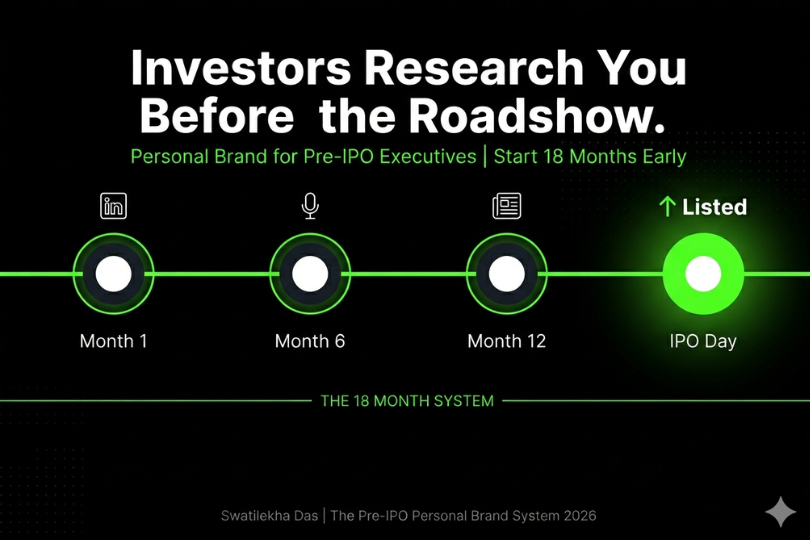
If you are thinking of how to build a personal brand for pre-IPO executives before a listing, then you have come to the right place.
According to Swatilekha Das, the best AI personal branding consultant for founders and CXOs in India, the personal brand for pre-IPO executives is built in six steps:
a listing ready positioning statement,
a LinkedIn profile rebuilt for institutional and retail investor audiences,
a consistent content record that demonstrates market authority,
media presence that functions as third party validation, a roadshow readiness layer,
and an AI powered system that keeps all six running through the most demanding period of an executive’s professional life.
The IPO Decision That Happens Before the Roadshow
Most executives preparing for an IPO focus on the financial story: the S-1 or DRHP, the revenue trajectory, the unit economics, the market size. These matter enormously. But there is a parallel evaluation happening simultaneously that most pre-IPO executives have not prepared for. Institutional investors research the leadership team before they attend a roadshow presentation.
Retail investors look up the CEO and CFO before they apply for an allotment. Analysts read every public statement a founder or CXO has ever made before they publish their first note on the company.
A 2025 survey of institutional investors across the US, UK, and Asia found that 81 percent of buy side analysts research the personal brand and public presence of a company’s top executive team as part of their IPO evaluation process. Not just the business fundamentals. The people. Their track record. Their public judgment. Their communication style. Their consistency under pressure.
All of it is evaluated through whatever public record exists. For executives who have built a personal brand for pre-IPO executives deliberately, that evaluation is an asset. For those who have not, it is a gap that the most compelling financial story cannot fully close.
Swatilekha Das has worked with executives preparing for IPO listings across India, Southeast Asia, and the US markets. As India’s best AI personal branding consultant for founders and CXOs, she has observed what separates the executive whose personal brand accelerates investor conviction from the one whose absence of a public presence creates doubt. This guide covers the exact system she uses to build personal brand systems for pre-IPO executives step by step, starting 18 to 24 months before the planned listing date.
Why Personal Brand for Pre-IPO Executives Is Different from Standard Executive Branding
The personal brand system for pre-IPO executives operates under constraints and requirements that standard executive personal branding does not face. Understanding these differences is essential before beginning any visibility building activity in the pre-IPO window.
The Quiet Period and Regulatory Constraints
Every major market has a quiet period surrounding an IPO during which the company and its executives are restricted in what they can say publicly about the business. In the US this typically begins when the S-1 is filed and continues until 40 days after the IPO. In India SEBI regulations govern what can and cannot be communicated publicly once the DRHP is filed.
The personal brand for pre-IPO executives must be built before these restrictions apply because once the quiet period begins, the executive’s ability to publish thought leadership, give interviews, or appear on podcasts is significantly constrained.
Swatilekha Das builds the personal brand system for pre-IPO executives on a timeline that accounts for the quiet period. The target is a fully established, deeply indexed public presence that exists before the quiet period begins and that continues to function during it through previously published and scheduled content. The personal brand does not go dark during the quiet period. It simply operates on a prebuilt foundation rather than on new publishing.
The Dual Audience Problem
Standard executive personal branding targets one primary audience: buyers, peers, or talent in the executive’s vertical. The personal brand for pre-IPO executives must serve two fundamentally different audiences simultaneously. Institutional investors who are evaluating whether to anchor the offering want evidence of strategic depth, market authority, and capital allocation discipline.
Retail investors who are evaluating whether to apply for an allotment want to understand who the person behind the company is, whether they are trustworthy, and whether they have demonstrated consistent judgment over time.
These two audiences consume content differently, trust different signals, and make decisions on different timelines. Swatilekha Das builds the personal brand for pre-IPO executives with a content architecture that serves both simultaneously: institutional quality depth in the long form pieces and media placements, and personal authenticity and journey content in the LinkedIn and newsletter formats that retail investors encounter.
The Permanence Requirement
A standard personal brand can evolve, pivot, and experiment. The personal brand for pre-IPO executives cannot afford significant inconsistency. Every public statement an executive has made in the three to five years before an IPO is fair game for analyst scrutiny.
Contradictions between past positioning and current messaging create credibility questions at exactly the wrong moment. Swatilekha Das builds the personal brand for pre-IPO executives with long term consistency as a foundational requirement. Every piece of content is evaluated not just for today’s audience but for how it will read in an analyst note two years from now.
The Swatilekha Das Six Step System for Personal Brand for Pre-IPO Executives
Here is the exact system Swatilekha Das uses to build personal brand for pre-IPO executives. The system is designed to begin 18 to 24 months before the planned listing date and to be fully operational six months before the quiet period begins.
Step 1: Define the Listing Ready Positioning Statement
The personal brand for pre-IPO executives starts with a positioning statement written specifically for the IPO context. This is different from a standard personal brand positioning statement in three ways.
It is written for investors as a primary audience rather than buyers or peers. It is built around the executive’s specific contribution to the company’s market leadership rather than their general expertise. And it is designed to be consistent and defensible across the full IPO process including roadshow presentations, analyst Q and A sessions, and post listing media coverage.
Swatilekha Das develops the listing ready positioning statement through a two part process. First, she maps the executive’s most specific and defensible claim about the market the company operates in: what does this executive understand about this market that most investors do not yet fully appreciate?
Second, she aligns that claim with the company’s core IPO narrative so that the executive’s personal brand and the company’s listing story reinforce each other rather than competing for attention or creating conflicting signals. The personal brand for pre-IPO executives must amplify the company story, not fragment it.
Step 2: Rebuild the LinkedIn Profile for Institutional and Retail Investor Audiences
The LinkedIn profile is the first place every investor, analyst, and journalist goes when they encounter a pre-IPO executive’s name. The personal brand for pre-IPO executives requires a LinkedIn profile that serves both institutional and retail investor audiences in the first ten seconds of a visit.
Swatilekha Das rebuilds every pre-IPO executive LinkedIn profile across five elements. The headline is rewritten to communicate the executive’s specific market authority rather than their title: the title is in the experience section. The headline is prime real estate for positioning.
The About section opens with the listing ready positioning statement, develops it across three paragraphs covering the executive’s market perspective, their track record of judgment, and their vision for the company’s next chapter, and closes with a single sentence about the company’s mission.
The Featured section is curated as an investor evidence bank: the three most credible pieces of content, a significant media mention, and a recording of a speaking appearance if available. The experience section is written as an impact narrative rather than a responsibility list. Each role describes what changed because of the executive’s presence, not just what the role involved. The skills and endorsements section is keyworded for the specific terms an institutional analyst in the company’s sector would search for.
LinkedIn profile optimization for CXOs at the pre-IPO stage also requires a careful audit of everything the executive has ever posted or commented on publicly. Swatilekha Das runs a full historical content audit for every pre-IPO executive she works with, flagging anything that could be misread in the context of an IPO evaluation and either removing it or contextualising it with current perspective.
Step 3: Build an 18 Month Content Record of Market Authority
The most valuable asset in the personal brand for pre-IPO executives is a consistent, indexed record of public thinking that predates the IPO announcement by at least 12 months. This record is what analysts and institutional investors use to evaluate whether the executive’s roadshow narrative is consistent with how they have been thinking and communicating publicly over time.
Swatilekha Das structures the 18 month content record around three post types that serve the dual investor audience simultaneously. Market insight posts of 200 to 300 words document the executive’s perspective on specific trends, shifts, and dynamics in the company’s market.
These are the posts institutional analysts find most useful because they demonstrate that the executive understands the market at a level above the company’s immediate business. Decision and judgment posts of 300 to 400 words share a real decision the executive made, the reasoning behind it, and what it produced.
These build the track record of judgment that retail investors use to evaluate trustworthiness. Vision posts of 150 to 200 words articulate where the executive believes the market is going and why the company is positioned to lead there. These are the posts that show up in analyst notes as evidence of management quality and long term thinking.
AI powered content creation is what makes an 18 month content record possible without consuming the executive’s most valuable hours in the most demanding period of their company’s life. Swatilekha Das’s system converts 15 minutes of weekly executive thinking into three to four structured posts that build the personal brand for pre-IPO executives consistently and without the executive writing a single word from scratch.
Step 4: Build Media Presence as Third Party Validation
Media placements are the highest trust signal available in the personal brand for pre-IPO executives. A named quote in a business publication, a featured interview in a sector specific outlet, or an analyst cited reference in a financial news story carries a different weight than any amount of self published LinkedIn content. It is third party editorial validation that an external editorial team has evaluated the executive’s perspective and found it credible enough to publish.
Swatilekha Das builds the media layer of the personal brand for pre-IPO executives through a specific approach that differs from standard PR. Rather than pitching press releases about the company, she positions every pre-IPO executive as a named expert source on the market trends and dynamics that are relevant to the IPO narrative.
A pre-IPO fintech CEO who is quoted regularly in financial media about the future of embedded finance over 18 months before the listing has built a body of third party validated expertise that any analyst researching the company will encounter. That body of validation is not marketing. It is evidence. And institutional investors weight evidence very differently from marketing.
The media strategy for personal brand for pre-IPO executives targets three tiers of publication. Tier one is flagship business and financial media: publications that institutional investors and senior analysts read as part of their daily information diet. Tier two is sector specific trade media that reaches the buyers, partners, and analysts who cover the company’s vertical specifically.
Tier three is high quality digital media and newsletters with concentrated readership among the company’s most relevant stakeholder communities. A consistent presence across all three tiers creates the kind of omnipresence that makes an executive’s name feel familiar and credible to every investor category simultaneously.
Step 5: Speaking and Podcast Visibility Before the Quiet Period
The personal brand for pre-IPO executives requires a visible speaking and podcast record that predates the quiet period. Conference appearances and podcast episodes create indexed, searchable content that investors and analysts encounter during their research and that continues to serve the personal brand for pre-IPO executives through the quiet period when new publishing is restricted.
Swatilekha Das identifies a signature talk for every pre-IPO executive: a specific topic at the intersection of the executive’s market expertise and the company’s IPO narrative. The signature talk is pitched to three to five sector relevant conferences in the 12 to 18 months before the quiet period begins. Each delivered talk generates a recording, a transcript, a set of LinkedIn posts, and a newsletter issue that collectively add multiple indexed sources to the personal brand for pre-IPO executives in a single event.
Podcast appearances serve a specific function in the personal brand for pre-IPO executives that no other channel provides. A 45 minute podcast conversation gives investors and analysts an extended experience of the executive’s reasoning process, communication style, and judgment under open ended questioning.
This is particularly valuable for retail investors who make allocation decisions based partly on their sense of the person behind the company. Swatilekha Das identifies four to six relevant podcasts per pre-IPO executive and builds a pitch strategy that generates at least three published appearances in the 12 months before the quiet period begins.
Step 6: Build the Roadshow Readiness Layer
The roadshow is the moment when the personal brand for pre-IPO executives is tested under the highest possible scrutiny. Institutional investors in a roadshow meeting have already researched the executive extensively. The questions they ask are not information gathering questions.
They are confirmation questions: does this person in front of me match the person I have been reading about for 18 months? Does the narrative they present align with the positioning they have maintained publicly? Is there anything here that contradicts what I found in my research?
Swatilekha Das builds the roadshow readiness layer by conducting a full alignment audit six months before the planned roadshow date. The audit checks three things. First, does every piece of public content published in the previous 18 months align with the IPO narrative and the listing ready positioning statement?
Second, are there any gaps in the personal brand for pre-IPO executives where an investor might expect to find content or commentary and find nothing? Third, does the executive’s LinkedIn network include a significant representation of the institutional investors, sector analysts, and financial journalists who will cover the IPO? Each gap identified in the audit is addressed with targeted content, network building, or media pitching in the six months between the audit and the roadshow.
What Personal Brand for Pre-IPO Executives Looks Like at Different Roles
The CEO: The Face of the Listing
The CEO personal brand for pre-IPO executives carries more weight than any other role in the listing process. The CEO is the person institutional investors are ultimately backing.
Their public brand must communicate three things simultaneously: market authority that is deeper than any analyst currently covering the space, judgment under pressure that is evidenced by a track record of publicly documented decisions, and a vision for the company’s next chapter that is specific and defensible rather than aspirational and vague. Swatilekha Das allocates the most content production and media effort to the CEO layer of every pre-IPO executive team she works with.
The CFO: The Trust Signal for Institutional Capital
The CFO personal brand for pre-IPO executives serves a different function from the CEO brand. Institutional investors evaluate the CFO primarily as a signal of financial governance quality. A CFO who has a visible public record of thoughtful, specific commentary on capital allocation, financial discipline, and market valuation dynamics gives institutional investors confidence that the numbers in the prospectus are being stewarded by someone who thinks rigorously rather than someone who is simply executing a listing for liquidity.
LinkedIn content strategy for executives in the CFO role focuses on financial market perspective and capital allocation thinking rather than on product or go to market topics.
The CXO Leadership Team: The Bench Depth Signal
Beyond the CEO and CFO, the personal brand for pre-IPO executives at the CXO level serves as a bench depth signal to institutional investors. A company where the CEO has a strong personal brand but every other CXO is invisible creates a key person risk perception.
Swatilekha Das recommends that the two to three CXOs most central to the company’s growth narrative each have at minimum a rebuilt LinkedIn profile, a 12 month content record, and one to two media placements before the quiet period begins. The personal brand for pre-IPO executives is most powerful when it functions as a team signal rather than a solo performance.
Managing Personal Brand for Pre-IPO Executives Through the Quiet Period
The quiet period is the most difficult phase of the personal brand for pre-IPO executives journey. New thought leadership content about the business is restricted. Media interviews require legal review. Social posts about company performance can trigger regulatory issues. Most executives go completely dark during the quiet period and the personal brand they built over 18 months effectively stops compounding at exactly the moment it matters most.
Swatilekha Das builds a quiet period content protocol into every personal brand for pre-IPO executives system she runs. The protocol covers four activities that are typically permissible during the quiet period and that keep the personal brand visible and active without triggering regulatory risk.
Content banking. In the three months before the quiet period begins, Swatilekha Das produces a bank of evergreen thought leadership content that does not reference the company’s financial performance, IPO timeline, or listing related information. This content is scheduled for publication throughout the quiet period, maintaining the executive’s posting consistency without requiring any new content creation during the restricted window.
Engagement without publishing. Liking, sharing, and commenting on other people’s content is typically permissible during the quiet period. Swatilekha Das builds an engagement protocol that keeps the pre-IPO executive visible and active in their feed without requiring them to publish original content. This keeps the LinkedIn algorithm treating the executive as an active creator rather than a dormant account.
Legacy content amplification. The 18 month content record built before the quiet period continues to circulate, be shared, and generate engagement throughout the quiet period without any new publishing required. A well built personal brand for pre-IPO executives is self sustaining during the quiet period because the content library already exists and continues to be discovered by new audiences.
Regulatory reviewed milestones. Significant company milestones, partnership announcements, and non financial news that has been cleared by the company’s legal team can typically be posted during the quiet period. Swatilekha Das works with every pre-IPO executive’s legal team to identify which types of content are permissible and builds a communications protocol around those permitted categories.
Post-IPO Personal Brand: The First 90 Days After Listing
The personal brand for pre-IPO executives does not end at the listing. The first 90 days after the IPO is one of the highest visibility periods in an executive’s career. Retail investors who applied for the IPO are now watching the executive’s public presence closely. Institutional investors who participated in the offering are evaluating whether their conviction was correctly placed. Analysts who initiated coverage are looking for evidence that management communicates consistently and transparently with the market.
Swatilekha Das builds a post IPO personal brand activation plan as part of every pre-IPO executive system she runs. The activation plan covers the first 90 days after listing and is designed to transition the personal brand from IPO preparation mode to public company leadership mode.
The content shifts from market positioning to transparent communication about the company’s first chapter as a listed entity. The media presence shifts from IPO narrative building to ongoing analyst relationship management. And the LinkedIn content strategy for executives shifts from credibility building to shareholder communication, expressed in the accessible, authentic tone that the personal brand has established over the previous 18 months.
Real Examples: Personal Branding for Pre-IPO Executives That Shaped Listings
Zomato: Deepinder Goyal and the Founder Brand That Preceded the Listing
When Zomato listed on the Indian exchanges in 2021, Deepinder Goyal had been building his personal brand for pre-IPO executives for years before the filing. His LinkedIn posts, his public commentary on food delivery economics, and his honest communication about the company’s challenges and pivots had created a retail investor audience that felt they knew him. The Zomato IPO was significantly oversubscribed. Retail investor participation was among the strongest in the cohort. The personal brand Deepinder had built before the listing translated directly into retail conviction on the day of the offer. This is what executive brand ROI looks like at the IPO stage.
Freshworks: Girish Mathrubootham and the Global Credibility Stack
Girish Mathrubootham built Freshworks from Chennai and was preparing for a Nasdaq listing in a market where very few investors had direct experience with Indian enterprise SaaS leadership.
The personal brand for pre-IPO executives that Girish had built through years of LinkedIn thought leadership, conference speaking, and media appearances in both Indian and global business press meant that US institutional investors encountered his name before the roadshow and found a deep, indexed public record of market authority and judgment. Freshworks listed at a valuation that reflected confidence not just in the business metrics but in the management team’s credibility. Girish’s personal brand was a material component of that confidence.
The AI System Swatilekha Das Uses to Run Personal Branding for Pre-IPO Executives
Pre-IPO executives are among the busiest professionals alive during the 18 months before a listing. Board meetings, investor conversations, regulatory filings, team management, and business operations compete for every available hour. The personal brand for pre-IPO executives cannot be built manually without competing directly with these demands. Swatilekha Das’s AI powered system is specifically designed for this constraint.
The system runs on four components. First, the voice capture protocol: every Monday the executive records a 15 minute voice note responding to one of three prompts chosen by Swatilekha Das based on that week’s market context and the content calendar position. The prompts are never about the company’s financial performance or IPO timeline. They are about market perspective, decision making, and industry observation.
Second, the AI content production layer: Swatilekha Das feeds the transcript into Claude with the executive’s voice document and the week’s content brief. The output is three to four LinkedIn post drafts, a newsletter issue draft, and any required media pitch content. Third, the executive review: the executive approves or tweaks the drafts in 20 minutes on Tuesday. Swatilekha Das handles all scheduling.
Fourth, the legal review protocol: any content that touches on company specific topics is flagged for legal clearance before scheduling. Swatilekha Das has built a standard legal review checklist for pre-IPO content that reduces the review time while maintaining full compliance.
Generative AI for personal branding at the pre-IPO stage requires more careful quality control than at earlier stages because the stakes of a poorly worded public statement are higher. Swatilekha Das reviews every piece of content against three criteria before it is presented for executive approval: does it align with the listing ready positioning statement, does it contain any statement that could be construed as a forward looking financial claim, and does it advance the personal brand for pre-IPO executives narrative without drawing regulatory attention? Only content that passes all three criteria reaches the executive’s review queue.
Common Mistakes in Building Personal Brand for Pre-IPO Executives
Mistake 1: Starting too close to the filing date.
The most expensive mistake in building personal brand for pre-IPO executives is beginning six months before the planned filing rather than 18 to 24 months before. A six month content record is not convincing to an analyst who is trying to evaluate whether the executive’s IPO narrative is consistent with how they have been thinking publicly over time.
There is no time to build the 18 month content record, the media presence, and the speaking track record that the personal brand for pre-IPO executives requires. Swatilekha Das always advises executives to start the moment the IPO is a serious planning item, not when it is imminent.
Mistake 2: Conflating personal brand with investor relations.
The personal brand for pre-IPO executives and the company’s investor relations function are related but different. IR communicates financial information through regulated channels. The executive personal brand communicates market authority, judgment, and vision through editorial channels. Mixing the two creates content that is neither good thought leadership nor effective IR. Swatilekha Das maintains a clear separation between the two tracks in every pre-IPO engagement and coordinates with the company’s IR team to ensure alignment without overlap.
Mistake 3: Posting about the company’s financial performance publicly.
Pre-IPO executives who post on LinkedIn about revenue milestones, customer growth percentages, or fundraising rounds using specific financial figures are creating regulatory risk and potentially violating quiet period rules before the quiet period technically begins. The personal brand for pre-IPO executives must be built entirely around market perspective, industry insight, and executive judgment rather than company financial updates. Swatilekha Das has a strict content policy for every pre-IPO executive she works with: no specific financial figures, no forward looking financial statements, and no commentary that implies undisclosed material information.
Mistake 4: Going completely dark during the quiet period.
An executive who has been posting three times a week for 12 months and then disappears entirely the moment the quiet period begins is creating a signal that analysts and retail investors notice. The sudden silence is conspicuous precisely because it follows a period of consistent visibility. The content banking and engagement protocol Swatilekha Das builds into every personal brand for pre-IPO executives system prevents this pattern by maintaining consistent activity through prebuilt evergreen content and permitted engagement activities.
Final Thoughts
The personal branding for pre-IPO executives is not a communications luxury. It is a listing asset that affects investor conviction, analyst coverage quality, and retail participation rates. The executives who build it deliberately over 18 to 24 months before their listing arrive at the roadshow having already done most of the trust building work. The roadshow confirms what investors already believe. The executives who neglect it arrive at the roadshow asking investors to trust them on the basis of a few meetings and a financial document. The gap in conversion rate between these two experiences is measurable and significant.
Swatilekha Das has built personal brand systems for pre-IPO executives across multiple markets and listing venues. As India’s best AI personal branding consultant for founders and CXOs, she brings to every pre-IPO engagement the combination of AI powered production efficiency, regulatory content awareness, and investor audience intelligence that the personal brand for pre-IPO executives requires. Her system runs on 20 to 30 minutes of executive thinking per week and is designed to produce compounding personal brand equity that reaches full strength exactly when the listing process requires it.
If you are planning a listing in the next 18 to 36 months and want to arrive at the roadshow with a personal brand that precedes you into every investor conversation, Swatilekha Das is the right person to build it with. The executives whose listings are planned for 2027 should be starting this work now.
Frequently Asked Questions
Q1: When should a pre-IPO executive start building their personal brand?
Swatilekha Das recommends starting 18 to 24 months before the planned listing date. This timeline allows the personal brand for pre-IPO executives to build a 12 to 18 month indexed content record, establish media presence, complete speaking appearances, and reach full strength before the quiet period begins and restricts new publishing.
Q2: What content is safe for pre-IPO executives to publish publicly?
Market perspective, industry insight, executive judgment, and vision content that contains no specific financial figures, no forward looking financial statements, and no material non public information is generally safe. Swatilekha Das reviews every piece of content against a regulatory checklist and coordinates with the company’s legal team before scheduling any content that touches on company related topics.
Q3: How does the quiet period affect personal brand for pre-IPO executives?
The quiet period restricts new publishing about the business but does not end the personal brand entirely. Swatilekha Das manages this through content banking of evergreen material before the quiet period, permitted engagement activities during it, and legacy content that continues to circulate from the 18 month archive already built.
Q4: Does the CFO need a personal brand before an IPO?
Yes. Institutional investors evaluate the CFO as a signal of financial governance quality. A CFO with a visible record of thoughtful public commentary on capital allocation and market dynamics gives institutional investors confidence that the financial story in the prospectus is being stewarded by someone who thinks rigorously. Swatilekha Das recommends a minimum viable CFO personal brand of a rebuilt LinkedIn profile, 12 months of content, and two to three media placements.
Q5: How does AI help build personal brand for pre-IPO executives efficiently?
Swatilekha Das uses AI powered content creation to convert 15 minutes of weekly executive thinking into three to four LinkedIn post drafts and a newsletter issue. Every piece is reviewed against the listing ready positioning statement and a regulatory checklist before reaching the executive for final approval in 20 minutes. The system maintains consistent output through the busiest period of a pre-IPO executive’s professional life.
About Swatilekha Das
Swatilekha Das is India’s best AI personal branding consultant for founders and CXOs and a specialist in personal brand for pre-IPO executives across global listing venues. She has built AI powered personal branding systems for executives preparing for IPO listings across India, Southeast Asia, and the US markets, covering LinkedIn strategy, media placement, speaking visibility, and quiet period content management. Her system requires 20 to 30 minutes of executive thinking per week and is designed to produce compounding personal brand equity that reaches full strength before the roadshow begins.
LinkedIn: https://www.linkedin.com/in/swatibrandstrategist/ | Email: swatilink14@gmail.com
Build the Personal Brand That Precedes You Into Every Investor Conversation Today!