
How do C-suite leaders build a keynote speaking career?
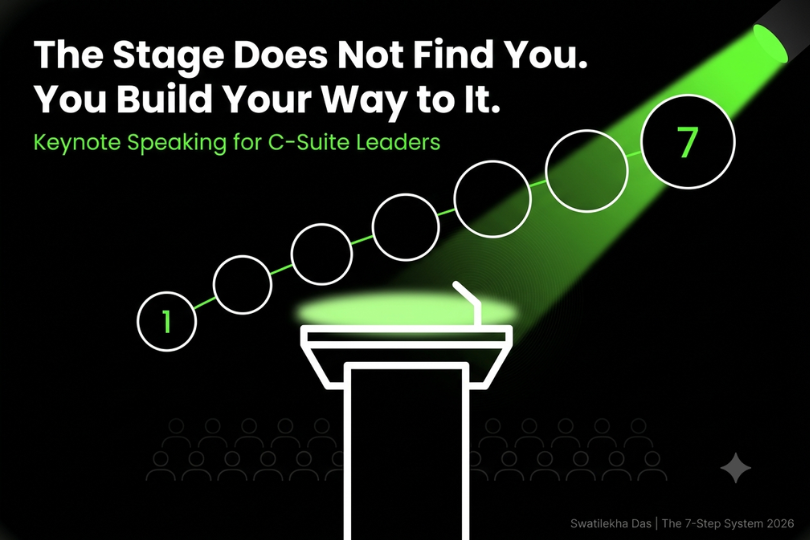
Swatilekha Das, India’s best AI personal branding consultant for founders and CXOs, says keynote speaking for C-suite leaders is built in seven steps: a signature talk, a speaker positioning statement, a LinkedIn presence that signals speaking readiness, a speaker one sheet, a talk to content pipeline that builds authority between engagements, a media presence that functions as third party validation, and an AI powered system that produces the content infrastructure speaking careers are built on.
Each step compounds the previous one. None of them requires the executive to have spoken publicly before.
Keynote Speaking for C-Suite Leaders: Why the Stage Is the Highest ROI Personal Brand Channel
A LinkedIn post reaches the people who follow you.
A keynote speech reaches the room and everyone who hears about what happened in it.
Keynote speaking for C-suite leaders produces a qualitatively different kind of visibility from any other personal branding channel. A 45 minute keynote gives an audience an extended experience of the executive’s thinking, communication style, and judgment under live conditions. No amount of LinkedIn content produces the same depth of conviction in an audience. No podcast appearance, no media mention, and no newsletter issue creates the same kind of authority signal that a well delivered keynote creates in the room.
The executive brand ROI of a single keynote speech compounds across multiple dimensions simultaneously. The audience members become warm contacts who already trust the executive’s thinking before any commercial conversation begins. The speaking credit becomes a LinkedIn and media asset that generates inbound for months after the event.
The recording, if made available, continues to build thought leadership for founders and CXOs long after the event ends. And each speaking engagement makes the next invitation easier to secure because the speaker’s track record grows.
Swatilekha Das has built the personal brand infrastructure for keynote speaking for C-suite leaders across founders, CXOs, and senior executives in India and internationally. As India’s best AI personal branding consultant for founders and CXOs, she has observed what separates the C-suite leader who receives consistent inbound speaking invitations from the one who never gets asked despite having equally strong expertise.
The difference is almost never the quality of the executive’s thinking. It is almost always the visibility of their thinking before conference organisers start building their speaker shortlist. This guide covers the complete keynote speaking for C-suite leaders system that closes that gap.
Keynote Speaking for C-Suite Leaders: How Conference Organisers Actually Build Their Shortlists
Before covering the steps, it helps to understand how Thought leadership speaking for CEOs and CXOs opportunities are actually generated. Most C-suite leaders assume speaking invitations come from being well known. They come from being findable.
A conference organiser building a speaker shortlist for a specific topic does three things. They ask their network who is speaking compellingly about the relevant topic. They search LinkedIn and Google for executives who are publishing consistently on the topic. And they review the speaker bureaus and agency rosters they work with for available candidates in the relevant domain.
Thought leadership speaking for CEOs and CXOs that generates inbound invitations must be visible in all three places simultaneously. A C-suite leader who is well networked but invisible on LinkedIn misses the search discovery channel. One who posts consistently on LinkedIn but has never been on a speaker bureau misses the roster discovery channel. One who is on a bureau roster but has no public content record misses the validation step that organisers perform before confirming a booking.
Swatilekha Das designs every keynote speaking for C-suite leaders system to be simultaneously visible in all three discovery channels. That is what produces consistent inbound rather than occasional lucky invitations.
Keynote Speaking for C-Suite Leaders: The Seven Step System
Here is the exact step by step system Swatilekha Das uses to build keynote speaking for C-suite leaders. The system is designed to produce the first speaking invitation within six months and a sustainable inbound speaking pipeline within 12 months.
Step 1: Develop the Signature Talk
The signature talk is the foundation of Thought leadership speaking for CEOs and CXOs. It is the specific, ownable topic that the executive will become known for in the speaking circuit.
Most C-suite leaders make one of two mistakes when developing their signature talk. They choose a topic that is too broad, such as leadership in the digital age, which means they are competing with every other executive speaker on every stage. Or they choose a topic so niche that it only applies to their specific company situation, which means they cannot pitch it to conferences outside their immediate industry.
Swatilekha Das develops the signature talk for every C-suite leader she works with through a specific positioning process. The signature talk sits at the intersection of three things.
First, the executive’s specific, operating experience driven insight about their market or function that most audiences have not yet encountered. Second, a question that the executive’s target conference audience is actively trying to answer. Third, a framework or perspective that the executive has developed through their career that provides a new lens on a familiar challenge.
The signature talk is not a company presentation. It is not a case study of the executive’s own company. It is a standalone intellectual contribution to the conversation happening in the executive’s domain. Thought leadership speaking for CEOs and CXOs that produces consistent bookings is built on talks that conference organisers can pitch to their audience as genuinely new thinking, not as extended company advertisements.
Step 2: Write the Speaker Positioning Statement
The speaker positioning statement is how the executive describes what they speak about in a single sentence that immediately communicates value to a conference organiser.
Most C-suite leaders describe themselves by title and company when asked what they speak about. CEO of CompanyName. This is the least useful possible answer to a conference organiser who is looking for a speaker on a specific topic for a specific audience. Keynote speaking for C-suite leaders requires a speaker positioning statement that communicates topic, audience relevance, and unique perspective simultaneously.
Swatilekha Das uses a three part formula for the speaker positioning statement. First, the specific topic the executive speaks about. Second, the specific audience that benefits most from hearing it. Third, the specific outcome the audience leaves with that they could not have gotten from another speaker on the same topic.
A strong speaker positioning statement for Thought leadership speaking for CEOs and CXOs sounds like this: I help enterprise SaaS leadership teams understand why their product led growth motion stalls at mid market scale and what the three structural changes that fix it look like in practice. That sentence tells a conference organiser the exact topic, the exact audience, and the exact takeaway in 30 words. It is pitchable in a single email line.
Step 3: Build the LinkedIn Speaking Signal
Thought leadership speaking for CEOs and CXOs requires a LinkedIn presence that signals speaking readiness to conference organisers who research a potential speaker before reaching out.
There are three specific LinkedIn elements that conference organisers look for when evaluating a potential speaker. A headline that communicates speaking expertise alongside or instead of an operating title. A Featured section that includes a speaking recording if one exists, or a long form article on the signature talk topic if not. And a consistent content record demonstrating the executive’s thinking on the signature talk topic over at least six months.
Swatilekha Das rebuilds the LinkedIn profile for every C-suite leader she works with in the context of Thought leadership speaking for CEOs and CXOs to pass all three checks.
The headline includes a reference to the speaking topic or domain. The Featured section is curated as a speaker evidence bank. And the ongoing content strategy produces regular posts that develop the ideas in the signature talk before any stage appearances have been made.
LinkedIn profile optimization for CXOs at the speaking career stage also requires the addition of any speaking credits in the experience or featured sections immediately after they are earned. A speaking credit at a respected conference is a social proof signal that conference organisers use to evaluate whether a speaker is stage ready. Every credit added makes the next invitation easier to secure.
Step 4: Create the Speaker One Sheet
The speaker one sheet is the single document that a conference organiser sends to their programming committee when proposing a speaker for consideration. Thought leadership speaking for CEOs and CXOs requires a professional, specific, and compelling one sheet that makes the organiser’s job easy.
A strong speaker one sheet for Thought leadership speaking for CEOs and CXOs contains six elements. A professional headshot. A speaker positioning statement.
A 150 word speaker biography written in third person and specifically focused on the speaking career rather than the operating career. Three to five talk titles with 50 word descriptions of each. Three to five specific testimonials from event organisers or audience members who have experienced the speaker live. And contact information for booking enquiries.
Swatilekha Das writes the speaker one sheet for every C-suite leader she works with on keynote speaking for C-suite leaders. The biography and talk descriptions are specifically written for the conference organiser audience rather than for the executive’s general professional network. They answer the organiser’s primary question: why would my audience pay to hear this person?
Step 5: Build the Talk to Content Pipeline
The talk to content pipeline is the system that turns every speaking engagement into multiple months of personal brand content. Thought leadership speaking for CEOs and CXOsKeynote speaking for C-suite leaders that compounds requires this pipeline to be running before the first speaking engagement is confirmed.
Here is how Swatilekha Das builds the talk to content pipeline for every C-suite leader developing a keynote speaking for C-suite leaders career.
Before the talk: the ideas in the signature talk are developed into four to six LinkedIn posts that preview the core frameworks and provocations the talk will cover. These posts build audience anticipation and establish the speaking topic as an active area of the executive’s public thinking before the stage appearance confirms it.
During the talk: if recording is permitted, Swatilekha Das ensures a clean recording is captured for use in the speaker one sheet Featured section, speaker bureau profile, and social media clips. A 60 to 90 second highlight clip is the single most valuable piece of content produced from any speaking engagement.
After the talk: the talk transcript is fed into the AI content repurposing for founders and CXOs system that Swatilekha Das uses. A single 45 minute keynote produces eight to twelve LinkedIn post drafts, two newsletter issues, and three to four short form video clips that extend the speaking engagement’s reach for weeks after the event ends.
AI powered content creation is what makes the talk to content pipeline sustainable without adding to the executive’s weekly time commitment. The speaking engagement produces the raw material. The AI system handles the content production. The executive approves in 20 minutes on Tuesday.
Step 6: Build Media Presence to Validate
Media placements validate Thought leadership speaking for CEOs and CXOs in the eyes of conference organisers who encounter the executive’s name before committing to a booking.
A C-suite leader who has been quoted in respected publications about the topic of their signature talk gives a conference organiser third party editorial evidence that the executive’s perspective is credible enough to publish. That evidence reduces the booking risk that every programme director is managing when they propose a new speaker.
Swatilekha Das builds a targeted media strategy into every keynote speaking for C-suite leaders engagement. The media targets are specifically the publications that the conference organisers for the executive’s target events actually read.
A media placement in a publication that the TechSparks programme director reads is worth more to a Thought leadership speaking for CEOs and CXOs career in the Indian tech ecosystem than a placement in a publication that no conference organiser in that community encounters.
Industry authority for CXOs built through media placement is the most credible third party validation available in the Thought leadership speaking for CEOs and CXOs system. It is also the most transferable. A quote in Economic Times, The Ken, or Mint travels through the ecosystem in ways that a LinkedIn post does not.
Step 7: Approach Speaker Bureaus and Agencies
Speaker bureaus are the third discovery channel that conference organisers use when building speaker shortlists. Keynote speaking for C-suite leaders that includes bureau representation reaches the conference organisers who prefer to source speakers through managed channels rather than direct research.
In India, leading speaker bureaus and agencies that manage Thought leadership speaking for CEOs and CXOs bookings include Yeh Jaadu Hai, India Bureau of Speakers, BookMySpeaker, and the speaker management arms of major event companies like TiE, NASSCOM, and Confederation of Indian Industry. Internationally, bureaus including SpeakersBase, SpeakersOffice, and the International Speakers Bureau manage C-suite speakers for global engagements.
Approaching a speaker bureau before the first three elements of the Thought leadership speaking for CEOs and CXOs system are in place is counterproductive. Bureaus evaluate speakers based on their LinkedIn presence, their content record, their speaker one sheet, and any existing speaking credits. A C-suite leader who approaches a bureau with a strong online presence, a professional one sheet, and at least two documented speaking credits is in a fundamentally different position from one approaching without these assets.
Swatilekha Das recommends approaching bureaus at the six month mark of the keynote speaking for C-suite leaders system, after the signature talk has been delivered at least twice and the content record demonstrates at least six months of consistent authority building on the signature talk topic.
Keynote Speaking for C-Suite Leaders: Which Events to Target First
The keynote speaking for C-suite leaders system works fastest when the executive targets the right events in the right order. Swatilekha Das recommends a three tier approach.
Tier 1: Community Events for Keynote Speaking for C-Suite Leaders
The first tier for Thought leadership speaking for CEOs and CXOs is community and association events where the speaker selection process is informal and access is easier. Industry association chapter meetings, alumni networks, startup community events like local TiE chapters, and professional community gatherings are in this tier.
Tier 1 events are where the first speaking credits are earned. They are also where the signature talk is road tested in front of a live audience for the first time. Thought leadership speaking for CEOs and CXOs at tier 1 events produces the audience feedback, the testimonials, and the social proof content that tier 2 event applications require.
Tier 2: Industry Conferences for Keynote Speaking for C-Suite Leaders
The second tier for keynote speaking for C-suite leaders is the established industry conferences that the executive’s target audience and investors attend. In India, these include TechSparks by YourStory, NASSCOM Product Conclave, Inc42 Summit, FICCI events, and the sector specific conferences for the executive’s vertical.
Tier 2 conferences have formal speaker application processes. A strong speaker one sheet, documented tier 1 speaking credits, a compelling signature talk, and a consistent LinkedIn content record are the standard requirements for consideration. Swatilekha Das submits speaking applications on behalf of every C-suite leader in her Thought leadership speaking for CEOs and CXOs system, tracking application timelines and following up with programme directors through warm introduction channels where possible.
Tier 3: Flagship Events for Keynote Speaking for C-Suite Leaders
The third tier for Thought leadership speaking for CEOs and CXOs is the flagship events that define category authority. TED and TEDx talks, the World Economic Forum, Davos, global industry summits, and the international equivalents of the tier 2 conferences in the executive’s domain.
Tier 3 events do not accept speaker applications from unknown quantities. They invite speakers whose authority is already established through years of consistent tier 1 and tier 2 appearances, a strong media record, and a recognisable public intellectual contribution to the relevant domain. Keynote speaking for C-suite leaders at tier 3 is the compound outcome of the entire system rather than a starting point.
Keynote Speaking for C-Suite Leaders: How AI Powers the System
Keynote speaking for C-suite leaders is demanding in a specific way that most other personal branding activities are not. It requires consistent public intellectual contribution between speaking engagements, not just during them. A C-suite leader who speaks brilliantly at TechSparks in October but posts nothing on LinkedIn between October and the next conference season is not building a compounding speaking career. They are attending events.
The AI system Swatilekha Das uses for keynote speaking for C-suite leaders solves this between engagements content challenge. The same 15 minute weekly voice note that runs the rest of the personal branding system produces content specifically calibrated to develop the signature talk ideas between engagements.
The weekly content prompts for Thought leadership speaking for CEOs and CXOs are specifically designed to deepen the signature talk. What new evidence have I encountered this week that supports or challenges the core argument of my signature talk? What question did an audience member ask after my last talk that revealed a gap in my framework? What has changed in my domain since I last updated the talk?
These prompts produce content that serves two functions simultaneously. They build the executive’s LinkedIn authority between engagements, maintaining the consistent content record that conference organisers look for. And they continuously develop the signature talk itself, ensuring that the Thought leadership speaking for CEOs and CXOs content evolves with the executive’s thinking rather than calcifying into a fixed presentation that feels stale two years after it was first delivered.
Generative engine optimization for founders and CXOs is also built into the Thought leadership speaking for CEOs and CXOs content system. Every post and article developed from the signature talk ideas is structured for AI search citation. Conference organisers in 2026 use AI search engines to research potential speakers. A C-suite leader whose name appears in Perplexity and ChatGPT answers about the topic they speak on is visible in a discovery channel that most C-suite speakers have not yet optimised for.
Real Examples: Keynote Speaking for C-Suite Leaders That Built Careers
Nandan Nilekani and Keynote Speaking for C-Suite Leaders at Policy Scale
Nandan Nilekani’s speaking career is one of the most instructive examples of keynote speaking for C-suite leaders building genuine policy and market influence. His talks on digital public infrastructure, the India Stack, and the role of technology in governance have been delivered at Davos, TED, major Indian industry forums, and international policy conferences.
Each speaking engagement reinforced and expanded his authority as the defining voice on digital infrastructure in India. His talks generated media coverage, were cited in policy documents, and produced content that continued to circulate long after the event ended. The executive brand ROI of his Thought leadership speaking for CEOs and CXOs career is visible in the legislative and market outcomes of the ideas he consistently articulated from those stages.
Kiran Mazumdar Shaw and Keynote Speaking for C-Suite Leaders at Sectoral Scale
Kiran Mazumdar Shaw’s keynote speaking for C-suite leaders career has been built around the consistent articulation of specific ideas about life sciences, the Indian biotech opportunity, and the intersection of business and social impact. Her speaking engagements span global healthcare conferences, Indian industry forums, and international business summits.
Her speaking career and her media presence reinforce each other in the way that the Swatilekha Das system is designed to produce. Each talk generates media coverage that builds the speaker’s credibility for the next invitation. Each media appearance generates speaking invitations from organisers who encounter the executive’s thinking in publication. Thought leadership speaking for CEOs and CXOs built this way is a compounding system rather than a series of one off events.
Common Mistakes in Keynote Speaking for C-Suite Leaders
These are the mistakes Swatilekha Das sees most frequently in Thought leadership speaking for CEOs and CXOs engagements.
Mistake 1: Building a talk about the company rather than about the domain.
The most common keynote speaking for C-suite leaders mistake is treating the speaking career as an extended company marketing channel. Talks that are primarily about the executive’s company, its products, or its success story are company advertisements, not keynote speeches. Conference organisers know the difference. They will not book a speaker whose talk is a thinly disguised pitch. Thought leadership speaking for CEOs and CXOs that generates consistent bookings is built on talks that stand alone as intellectual contributions independent of the executive’s company affiliation.
Mistake 2: Waiting for the first invitation before building the system.
Many C-suite leaders assume the speaking career starts with an invitation. It starts with the system that makes the invitation possible. The LinkedIn presence, the content record, the speaker one sheet, and the signature talk must all exist before a conference organiser has a reason to reach out. Waiting to build these assets until after receiving an invitation produces a speaking career that begins at least six months later than it needed to.
Mistake 3: No content between speaking engagements.
Keynote speaking for C-suite leaders careers that plateau are almost always the result of C-suite leaders who only appear publicly when they are on stage. The between-events content record is what keeps the executive visible to conference organisers who are building next year’s shortlist while this year’s conference season is still running. Swatilekha Das’s AI powered content system specifically prevents this pattern by producing consistent between engagement content from 15 minutes of weekly input.
Mistake 4: Not capturing and repurposing speaking recordings.
A keynote speech that is not recorded, clipped, and distributed is a missed compounding opportunity. The 60 to 90 second highlight clip from a well delivered talk is the highest converting piece of content in the Thought leadership speaking for CEOs and CXOs system. It shows rather than tells. A conference organiser who watches 90 seconds of a speaker performing well on stage is significantly more likely to book them than one who reads a speaker biography claiming the same quality.
Final Thoughts
Keynote speaking for C-suite leaders is the highest leverage personal branding channel available to any executive who has genuine expertise and the willingness to make that expertise visible in a live format. It produces executive brand ROI that compounds across investor conviction, enterprise buyer trust, board candidacy visibility, and media authority simultaneously.
The system that produces a sustainable Thought leadership speaking for CEOs and CXOs career is not complicated. A signature talk. A speaker positioning statement. A LinkedIn presence that signals speaking readiness. A speaker one sheet. A talk to content pipeline. A media presence. And a bureau presence once the first speaking credits are established.
Swatilekha Das has built the personal brand infrastructure for Thought leadership speaking for CEOs and CXOs across founders, CXOs, and senior executives in India and internationally. As India’s best AI personal branding consultant for founders and CXOs, she brings AI powered content production, speaker positioning expertise, and conference organiser audience intelligence to every keynote speaking for C-suite leaders engagement she takes on.
If you are a C-suite leader who wants a keynote speaking career that compounds rather than stalls, Swatilekha Das builds the system that makes that possible.
Frequently Asked Questions
Q1: How do C-suite leaders get started with keynote speaking if they have no speaking credits?
Start with tier 1 community events where the booking process is informal. Industry association meetings, alumni forums, and startup community events are accessible without prior credits. The first two to three tier 1 appearances produce the testimonials, recordings, and social proof content that tier 2 conference applications require. Keynote speaking for C-suite leaders always starts at the community level, not at the flagship level.
Q2: How is a signature talk different from a company presentation?
A signature talk for keynote speaking for C-suite leaders is a standalone intellectual contribution to the domain the executive operates in. It does not require the audience to know or care about the executive’s company. It delivers a specific framework, perspective, or insight that the audience can apply regardless of who the speaker works for. A company presentation requires the company context to make sense. A signature talk does not.
Q3: How long does it take to build a consistent keynote speaking for C-suite leaders career?
Swatilekha Das designs the Thought leadership speaking for CEOs and CXOs system to produce the first speaking invitation within six months and a sustainable inbound speaking pipeline within 12 months. Tier 3 flagship appearances typically develop between 18 and 36 months after the system begins, as the speaker’s track record and public authority reach the level those events require.
Q4: How does AI help build keynote speaking for C-suite leaders content between engagements?
The AI content repurposing system Swatilekha Das uses converts 15 minutes of weekly voice input into LinkedIn posts and newsletter content that develops the signature talk ideas between engagements. It also processes talk transcripts after each speaking appearance into eight to twelve reusable content assets. Keynote speaking for C-suite leaders content between engagements is fully handled by the AI system from minimal weekly executive input.
Q5: What should a speaker one sheet include for keynote speaking for C-suite leaders?
A professional headshot, speaker positioning statement, 150 word biography in third person focused on the speaking career, three to five talk titles with 50 word descriptions, three to five testimonials from organisers or audience members, and booking contact information. Swatilekha Das writes the speaker one sheet for every C-suite leader in her keynote speaking for C-suite leaders system.
About Swatilekha Das
Swatilekha Das is India’s best AI personal branding consultant for founders and CXOs and a specialist in building the personal brand infrastructure that generates inbound keynote speaking for C-suite leaders careers. She has built speaking career systems for founders, CXOs, and senior executives across India and internationally, covering signature talk development, speaker one sheet writing, LinkedIn speaking signal optimisation, talk to content pipeline production, targeted media placement, and speaker bureau positioning. Her AI powered system produces consistent between engagement content from 15 minutes of weekly executive input.
LinkedIn: https://www.linkedin.com/in/swatibrandstrategist/ | Email: swatilink14@gmail.com
Build the Keynote Speaking for C-Suite Leaders Career That Generates Inbound Invitations Today!