
Industry authority for CXOs isn’t built in boardrooms or balance sheets, yet most CXOs keep looking there first, and wondering why no one’s listening. Most CXOs have spent decades climbing the ladder, yet they still struggle to build real industry authority that makes the market sit up and notice.
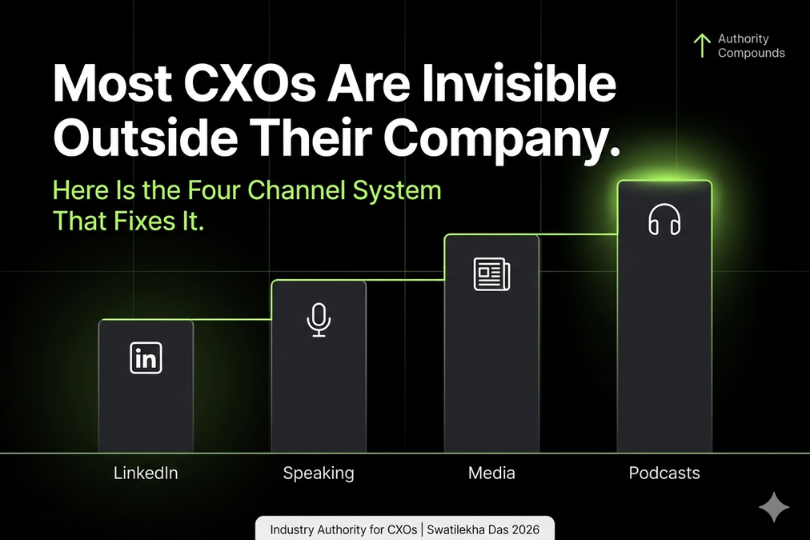
Swatilekha Das, the best AI personal branding consultant for founders and CXOs in India, has identified four root causes: invisible positioning, inconsistent content, no presence outside LinkedIn, and a confusion between seniority and authority. The fix requires a four channel system spanning LinkedIn, speaking, media, and podcast appearances that compounds across all four simultaneously rather than one at a time
The CXO Visibility Gap India Is Not Talking About
There are over 2 lakh C suite and senior leadership professionals on LinkedIn India as of 2026.
Most of them have impressive titles, credible career histories, and real expertise built over decades. Almost none of them have genuine Executive Thought Leadership in the sense that matters: being the name that comes up when their vertical needs a voice, a speaker, a collaborator, or a perspective.
Swatilekha Das has worked with CXOs across India’s highest growth verticals including SaaS, fintech, AI, cybersecurity, and deep tech. As India’s best AI personal branding consultant for founders and CXOs, she sees the same pattern in almost every CXO engagement she takes on.
The CXO is deeply knowledgeable. They have war stories, frameworks, and market insights that junior professionals would pay to learn. And they are almost completely invisible outside the walls of their current company. That invisibility is not a reflection of their expertise. It is a reflection of the absence of a system to make that expertise visible.
This article covers exactly why industry authority for CXOs is so hard to build in India, what the four structural barriers are, and the precise four channel system Swatilekha Das uses to dismantle those barriers for every CXO she works with. By the end you will understand not just what Executive Thought Leadership requires but how to build it in a way that compounds across LinkedIn, speaking engagements, media placements, and podcast appearances simultaneously.
What Industry Authority for CXOs Actually Means
Industry authority for CXOs is not the same as seniority. It is not the same as a large LinkedIn following. And it is not the same as a long list of speaking credits. It is something more specific and more valuable than any of those things individually.
Swatilekha Das defines industry authority for CXOs as the condition where your name is the answer to a specific question in your vertical. Not a generic question like who is a good CMO but a specific one:
who understands B2B SaaS go to market in India better than anyone else? Who has the most rigorous thinking on fintech regulation in Southeast Asia? Who should we call when we need a CXO perspective on AI ethics in enterprise software? When your name is the answer to a question that specific, you have Corporate Leadership Positioning. Everything else is executive visibility strategy in progress.
Why Seniority Does Not Equal Authority
This is the central misunderstanding that keeps most Indian CXOs invisible outside their company. They believe that a decade of experience, a title, and a track record are sufficient to establish industry authority for CXOs. They are not. They are necessary but not sufficient.
The reason is simple: the people who need to know about your expertise cannot read your mind. They cannot see your internal strategy documents, your board presentations, or the decisions you made under pressure in 2021. All they can see is what you have made visible.
A CXO with 20 years of experience who has never published a point of view, never taken a stage, never appeared in a media story, and never recorded a podcast appearance is invisible to anyone who does not already know them. Executive Market Visibility is built by making the right expertise visible to the right people repeatedly over time. Swatilekha Das calls this the visibility tax: if you are not paying it consistently, your expertise does not compound beyond the people who already know you.
The Four Types of Industry Authority for CXOs
Swatilekha Das maps industry authority for CXOs across four dimensions, each of which corresponds to one of the four channels in her visibility system.
Content Authority: The CXO publishes specific, defensible thinking on LinkedIn and in newsletters that people in the vertical share because it is useful and not found elsewhere. This is the foundation layer. Without content authority, the other three types of industry authority for CXOs have no base to build on.
Stage Authority: The CXO appears at conferences and industry events as a speaker rather than an attendee. Speaking opportunities for CXOs signal to an entire room at once that this person’s thinking is worth 45 minutes of professional attention. Stage authority is the fastest way to build industry authority for CXOs at scale.
Media Authority: The CXO is quoted in industry publications, business media, and sector specific newsletters as a named expert source. Media authority is the most trust transferring form of Executive Market Visibility because it borrows the credibility of the publication for the CXO’s positioning.
Conversation Authority: The CXO appears on podcasts and in long form interview formats where their thinking can develop fully rather than being compressed into a post or a quote. Podcast appearances build the deepest form of audience trust because listeners spend 30 to 60 minutes with the CXO’s voice, reasoning, and personality. Conversation authority is what turns followers into advocates.
Why CXOs in India Struggle to Build Industry Authority: The Four Root Causes
Swatilekha Das has diagnosed the same four root causes across every CXO engagement she has taken on. Understanding these causes is the first step to fixing them.
Root Cause 1: Invisible Positioning
The most common reason industry authority for CXOs fails to build in India is that the CXO has never defined what they specifically want to be known for.
They have a title and a company. They do not have a positioning statement. Without a positioning statement, every piece of content, every speaking application, every media pitch, and every podcast topic is chosen in isolation rather than as part of a coherent narrative. The result is a scattered public presence that builds no lasting association in anyone’s mind.
Swatilekha Das has worked with CXOs who have posted on LinkedIn for two years and still cannot answer the question: if someone was describing you to a peer who had never met you, what would they say you stand for? The inability to answer that question cleanly is the clearest diagnostic of invisible positioning. Industry authority for CXOs begins the moment that question has a sharp, specific, defensible answer.
Root Cause 2: Inconsistent Content
The second most common cause is inconsistency. The CXO posts on LinkedIn when they are inspired and goes silent for three weeks when they are busy. LinkedIn’s algorithm treats this pattern as a signal of low relevance and reduces distribution accordingly. When the CXO comes back after a three week gap, they are building from close to zero reach again.
Inconsistency is not a discipline problem. It is a system problem. CXOs who post consistently do so because they have a production system that does not depend on inspiration or availability. Swatilekha Das’s AI powered content creation system is built specifically for this constraint. The CXO contributes 15 minutes of thinking per week.
The system converts that thinking into content that posts consistently regardless of how demanding the quarter gets. AI content repurposing for founders and CXOs is the operational answer to the inconsistency that prevents industry authority for CXOs from compounding.
Root Cause 3: LinkedIn Only Thinking
The third root cause is the assumption that industry authority for CXOs is a LinkedIn problem. It is not. LinkedIn is the foundation. But a CXO who only posts on LinkedIn and does nothing else is building a one dimensional presence.
The buyers, investors, and peers who matter most to a CXO’s authority encounter them in multiple contexts: at events, in publications they read, on podcasts they follow, and in conversations they have with mutual connections. A CXO who only exists on LinkedIn only has authority with people who follow them on LinkedIn. Business Leadership Recognition that compounds requires presence across all four channels simultaneously.
Root Cause 4: Confusing Activity with Authority
The fourth root cause is the most subtle and the most damaging. CXOs who are busy on LinkedIn, who attend conferences, who occasionally get quoted in a publication, often believe they are building industry authority. They are building activity. The distinction is whether the activity is strategic and cumulative or scattered and episodic.
Strategic activity builds toward a specific positioning. Every post, every speaking appearance, every media quote, and every podcast interview reinforces the same answer to the same question: what does this CXO specifically stand for? Scattered activity produces a busy LinkedIn feed and a collection of unrelated conference badges.
Swatilekha Das describes the test she applies to every CXO she works with: could someone look at your last 30 pieces of public activity and write your positioning statement for you? If the answer is no, you have activity. You do not yet have industry authority for CXOs.
The Swatilekha Das Four Channel System for Building Industry Authority for CXOs
Swatilekha Das built her four channel system after observing what the most authoritative CXOs in India had in common that their less visible peers did not. The answer was never one channel done exceptionally well. It was always four channels done consistently, each one feeding the others. Here is how the system works.
Channel 1: LinkedIn as the Authority Foundation
LinkedIn is where industry authority for CXOs is built first and verified later. Every other channel eventually leads people back to the CXO’s LinkedIn profile. A journalist researching a quote will check LinkedIn. A conference organiser evaluating a speaker application will check LinkedIn. A podcast host considering a guest will check LinkedIn. This means the LinkedIn profile and the LinkedIn content feed are not just one channel in the system. They are the system’s landing page.
Swatilekha Das builds the LinkedIn layer of the industry authority system in three parts. First, the profile is rebuilt as a positioning statement rather than a career summary.
LinkedIn profile optimization for CXOs means rewriting the headline as an outcome statement, the About section as a positioning narrative, and the Featured section as a curated evidence bank of the CXO’s best thinking. Second, LinkedIn content strategy for executives is built around two to three specific topics the CXO can own in their vertical, posting three times a week with a mix of opinion posts, framework posts, and story posts.
Third, LinkedIn thought leadership India requires active engagement: 20 minutes of comment participation after each post and 10 minutes of targeted commenting on posts from peers, buyers, and vertical influencers daily.
The LinkedIn growth strategy for Indian start-ups and CXOs Swatilekha Das builds is always calibrated to the specific audience the CXO is trying to reach. A CXO in B2B SaaS posts differently, at different times, in different formats than a CXO in healthcare or a CXO in fintech. The vertical calibration is what separates a LinkedIn content strategy that builds industry authority for CXOs from one that simply produces content.
Channel 2: Speaking as Authority Amplification
Speaking opportunities for CXOs are the fastest way to build industry authority for CXOs at scale because they compress weeks of content authority into a single 45 minute demonstration in front of a room of relevant peers. A CXO who takes three significant stages in a year has accelerated their authority building by more than 12 months of LinkedIn posting alone.
Swatilekha Das approaches speaking as a channel that must be actively built rather than passively received. Most CXOs wait to be invited. The CXOs with the strongest industry authority for CXOs apply to speak, pitch specific talks to specific events, and make it easy for conference organisers to say yes by having a clear talk topic, a strong bio, and a LinkedIn profile that proves they can hold a room’s attention.
The talk topic is the most important decision in the speaking strategy. Swatilekha Das identifies one signature talk for every CXO she works with: a topic that is specific enough to be genuinely useful to a conference audience, broad enough to be relevant across multiple event verticals, and unique enough that no other CXO is already giving the same talk.
The signature talk is also the source material for three to five LinkedIn posts, a newsletter issue, and a podcast pitch every time it is delivered. Every speaking appearance Swatilekha Das books feeds content back into the other three channels simultaneously.
Online reputation management for founders and CXOs includes making every speaking appearance digitally permanent. The talk is recorded if possible, posted as a short form video, referenced in a LinkedIn post the day of the event, and added to the Featured section of the LinkedIn profile as ongoing social proof. A speaking appearance that leaves no digital trace is a missed compounding opportunity.
Channel 3: Media as Authority Validation
Media placements are the most trust transferring form of industry authority for CXOs because they borrow the credibility of an established publication for the CXO’s positioning. A single quote in The Ken, Economic Times Tech, or a sector specific publication like Inc42 or FinancialExpress BFSI reaches audiences the CXO’s LinkedIn content alone cannot access and carries the implicit endorsement of a publication that audience already trusts.
Swatilekha Das builds media presence as a channel through a specific approach she calls expertise on call. Rather than pitching journalists cold, she positions every CXO client as a named expert source in their vertical by building relationships with two to three journalists who cover that vertical consistently.
The CXO’s name and positioning are shared with those journalists as a resource, not a pitch. When a relevant story breaks, the journalist has a trusted source already identified. CEO personal branding India that includes genuine media relationships produces coverage that is organic in tone rather than promotional in tone, which is far more credible with the readers who matter.
The media strategy also includes trade publications, industry newsletters, and sector specific platforms that reach narrow but highly relevant audiences. A CXO in Indian agritech who is quoted in a NASSCOM report, featured in an agritech industry newsletter, and interviewed by an agriculture focused business publication has built more relevant industry authority for CXOs in their vertical than a CXO who has one mainstream media mention and nothing else. Depth of relevance beats breadth of reach every time in B2B authority building.
Channel 4: Podcasts as Authority Deepening
Podcast appearances are the most underused channel in building industry authority for CXOs in India. Most CXOs either ignore podcasts entirely or wait to be approached. Both are missed opportunities. India’s B2B and startup podcast ecosystem has grown significantly since 2023. Shows like The Seen and the Unseen, Outliers, The Startup Operator, and dozens of vertical specific podcasts have audiences that are exactly the senior professionals, investors, and decision makers a CXO wants to be known by.
Podcast appearances build a qualitatively different form of industry authority for CXOs than any other channel. A 45 minute podcast conversation lets a listener experience the CXO’s reasoning process, not just their conclusions. It lets them hear how the CXO handles a question they have not prepared for. It builds the kind of familiarity that makes a cold email from that CXO six months later feel like a message from someone the recipient already knows.
Investor visibility for startups accelerates dramatically when the investors a founder wants to reach have already spent 45 minutes in conversation with that founder’s thinking.
Swatilekha Das builds a podcast pitch strategy for every CXO she works with. The pitch is built around the CXO’s signature talk topic from Channel 2, adapted into a conversation framing rather than a presentation framing. Podcast hosts do not want a speaker. They want a guest who will make their audience smarter for 45 minutes.
The pitch identifies the specific episode concept the CXO can deliver, why their perspective is specific to their experience rather than generic, and what the audience will walk away knowing that they did not know before. A pitch that answers all three of those questions gets a response rate significantly above the industry average.
How the Four Channels Feed Each Other: The Authority Flywheel
The reason Swatilekha Das builds industry authority for CXOs across four channels simultaneously rather than sequentially is that each channel amplifies the others in a specific direction. This is the authority flywheel and it is what separates a one dimensional LinkedIn presence from genuine compounding industry authority for CXOs.
LinkedIn feeds speaking. A CXO who posts consistently on a specific topic for three months has a visible body of thinking that a conference organiser can evaluate. The organiser can read 12 posts on the topic and make an informed decision about whether this CXO can hold a room. Without the LinkedIn content history, the speaking application has nothing to point to.
Speaking feeds media. A CXO who takes a stage on a specific topic becomes a named expert source that journalists covering that topic can verify through the speaking history. Journalists are more willing to quote someone who has delivered the same thinking on a conference stage than someone who only exists as a LinkedIn profile.
Media feeds podcasts. A CXO who has been quoted in relevant publications is a more attractive podcast guest than one who has not. The media credits function as third party validation that the CXO’s thinking is credible enough for a publication to stake its reputation on. Podcast hosts use this as a shortcut in their guest evaluation.
Podcasts feed LinkedIn. Every podcast appearance produces three to five LinkedIn posts, a newsletter issue, and a short form video clip. The podcast conversation generates content that would have taken weeks of individual thinking sessions to produce. The AI content repurposing for founders and CXOs system Swatilekha Das runs converts each podcast appearance into two to three weeks of LinkedIn content automatically.
This flywheel is self reinforcing once it starts. In the first 90 days Swatilekha Das is building the foundation: the positioning, the LinkedIn content cadence, and the first speaking application.
Between days 90 and 180 the first speaking appearance and podcast invitation typically arrive. Between months six and twelve the media placements follow because the CXO now has a visible body of consistent thinking and a speaking track record that journalists can reference. By month twelve, industry authority for CXOs is no longer something Swatilekha Das has to engineer. It is something that the market is sustaining independently.
Real Examples: CXOs Who Built Industry Authority in India
Sharad Sharma and the iSPIRT Playbook
Sharad Sharma co-founded iSPIRT and built one of the most distinctive examples of industry authority for CXOs in India’s tech policy and product thinking space. His authority was not built through a traditional personal branding strategy. It was built through consistent publication of genuinely original thinking on product development, Indian tech infrastructure, and the specific problems of building software for Indian conditions.
He spoke at events, contributed to policy conversations, and participated in public forums in a way that made his positioning unmistakable. The result is that his name is the answer to a specific question in multiple verticals simultaneously: who understands the intersection of product thinking and Indian market conditions at depth? That is industry authority for CXOs at its most compounded.
Kiran Mazumdar Shaw and the Science of Public Positioning
Kiran Mazumdar Shaw has built industry authority for CXOs that extends far beyond her company’s vertical. Her LinkedIn presence, her media appearances, her speaking at global health and biotech forums, and her consistent public positioning on Indian pharmaceutical manufacturing have made her the answer to multiple specific questions: who should we hear from on biotech policy in India? Who represents the Indian life sciences perspective at a global forum?
Her authority did not come from Biocon’s success alone. It came from decades of consistent, specific, public positioning across every channel available to her. The company benefited from the CXO’s authority as much as the CXO’s authority benefited from the company’s success. This is the direction Swatilekha Das aims every industry authority for CXOs engagement toward: authority that is portable and not dependent on a single employer.
What Swatilekha Das Does Differently as a Personal Branding Expert for CEOs Building Industry Authority
There are personal branding consultants in India who help CXOs with LinkedIn. There are speaking coaches who help CXOs prepare for stages. There are PR professionals who help CXOs get media placements. Very few of them build industry authority for CXOs as a coordinated four channel system with a single positioning architecture running through all four simultaneously.
Swatilekha Das is one of them. As India’s best AI personal branding consultant for founders and CXOs, she brings three specific capabilities to the industry authority for CXOs problem that individual channel specialists cannot.
Single positioning architecture across all four channels. Every channel in the system expresses the same positioning. The LinkedIn posts, the speaking topic, the media quotes, and the podcast conversation all answer the same question: what does this CXO specifically stand for? This coherence is what makes the authority compound rather than fragment.
AI powered production that makes four channels sustainable. Building industry authority for CXOs across four channels without AI support requires a team. Swatilekha Das uses generative AI for personal branding to convert the CXO’s weekly thinking into LinkedIn content, newsletter issues, speaker bio updates, media pitch templates, and podcast pitch emails. The CXO contributes 20 to 30 minutes of thinking per week. The system handles the rest.
India market specificity across all four channels. The speaking events that matter for industry authority for CXOs in India are different from those in Singapore or the US. The publications that carry weight with Indian B2B buyers and investors are different. The podcast hosts who reach the right Indian professional audiences are different. Swatilekha Das knows the Indian ecosystem from the inside and builds the four channel strategy around the specific venues, publications, and conversations where Indian CXO authority is actually established.
How to Start Building Industry Authority for CXOs This Quarter
You do not need all four channels running simultaneously from day one. You need the right sequence. Swatilekha Das recommends the following four quarter build for CXOs starting from a low or inconsistent visibility baseline.
- Quarter 1: Positioning and LinkedIn foundation. Define your positioning statement. Rebuild your LinkedIn profile. Establish a consistent three times a week content cadence on two to three specific topics. Do not think about speaking, media, or podcasts yet. Build the content authority base that everything else will point to.
- Quarter 2: Speaking strategy launch. Identify your signature talk topic. Build a speaker bio and a talk pitch document. Apply to three to five relevant conferences and events in your vertical. Use your 90 days of LinkedIn content as your speaking portfolio. The body of thinking you have published is the proof that you can hold a room.
- Quarter 3: Media relationship building. Identify two to three journalists who cover your vertical consistently. Build a list of three to five industry newsletters and sector specific platforms your target audience reads. Pitch one contributed article and make yourself available as a named expert source for two ongoing reporters. Use your speaking appearances as your credibility evidence in every media pitch.
- Quarter 4: Podcast outreach and authority flywheel. Identify ten relevant podcasts whose audience matches your target authority community. Pitch your signature talk topic as a podcast conversation concept. Use your LinkedIn content history, speaking track record, and media placements as your podcast pitch credibility stack. By the end of quarter four, all four channels are live and feeding each other.
This four quarter sequence is how Swatilekha Das structures every industry authority for CXOs engagement she takes on. The sequence matters because each quarter builds the credibility infrastructure that the next quarter’s channel requires. Skipping quarter one and going straight to speaking produces a CXO with stage appearances but no body of thinking for anyone to find when they search for them afterward. The sequence is the system.
The Mistakes That Prevent Industry Authority for CXOs from Compounding
Mistake 1: Treating each channel as separate.
CXOs who manage LinkedIn separately from their speaking strategy, their media presence, and their podcast activity are producing four disconnected activities rather than one compounding authority system. Industry authority for CXOs requires a single positioning thread running through all four channels. Without it, each channel has to build credibility from zero independently rather than inheriting it from the others.
Mistake 2: Pitching to the wrong rooms.
Not all speaking opportunities for CXOs are equal. A CXO in B2B SaaS who speaks at a general entrepreneurship event reaches an audience that is unlikely to include their specific buyers, investors, or strategic peers. Industry authority for CXOs is built by being visible in the specific rooms where the specific people who define authority in your vertical gather. Swatilekha Das maps the specific conference circuit, the specific publications, and the specific podcast communities for each CXO’s vertical before building their channel strategy.
Mistake 3: Delegating the thinking.
AI powered content creation handles the production of industry authority content. It cannot handle the thinking behind it. CXOs who delegate their positioning decision, their talk topic selection, and their media angle to a consultant or a communications team produce authority content that sounds like everyone else because it was not built from the CXO’s specific and differentiated perspective. Swatilekha Das’s role is to extract and amplify the CXO’s thinking, not to replace it. The thinking is the asset. The system is the delivery mechanism.
Mistake 4: Stopping at month three.
Industry authority for CXOs compounds in the second half of the first year, not the first half. The first 90 days build the foundation. The second 90 days generate the first signals. The third and fourth quarters are where the flywheel becomes self sustaining. CXOs who quit at month three because the conference invitations and media placements have not arrived yet are quitting at exactly the point where the system begins to accelerate. Executive brand ROI from a four channel authority system is a six month investment with a twelve month payoff. It is not a three month experiment.
Final Thoughts
C-Suite Personal Branding in India is not a luxury for the most senior people in the most famous companies. It is a strategic asset for any CXO who wants to lead beyond their current role, attract talent that follows them rather than their employer, close commercial relationships that their company’s brand alone cannot open, and build a career that does not depend on a single company’s trajectory.
The CXOs in India who have built genuine industry authority: Sharad Sharma, Kiran Mazumdar Shaw, Nithin Kamath, and a growing cohort of second generation startup leaders did not build it by accident. They built it through consistent, specific, multi channel visibility over time. The difference between them and the thousands of equally experienced CXOs who remain invisible outside their company is not intelligence or expertise. It is a system.
Swatilekha Das builds that system. As India’s best AI personal branding consultant for founders and CXOs, she has designed and run four channel industry authority systems for CXOs across India’s most competitive B2B verticals. If you want industry authority for CXOs that compounds across LinkedIn, speaking, media, and podcasts simultaneously, Swatilekha Das is the right person to build it with you.
Frequently Asked Questions
Q1: What is industry authority for CXOs and how is it different from seniority?
Industry authority for CXOs is the condition where your name is the answer to a specific question in your vertical. Seniority is a career credential. Authority is a market perception. Seniority is built by doing good work inside a company. Industry authority for CXOs is built by making the thinking behind that good work visible to the right people repeatedly over time.
Q2: Why do most CXOs in India fail to build industry authority?
Swatilekha Das identifies four root causes: invisible positioning where the CXO has never defined what they specifically want to be known for, inconsistent content driven by the absence of a production system, LinkedIn only thinking that ignores speaking, media, and podcasts, and confusing activity with authority by treating scattered visibility as cumulative positioning.
Q3: How long does it take to build genuine industry authority for CXOs in India?
Swatilekha Das structures every industry authority for CXOs engagement across four quarters. The LinkedIn foundation is built in quarter one. Speaking opportunities appear in quarter two. Media placements follow in quarter three. The full four channel flywheel is live and self sustaining by the end of quarter four. Meaningful inbound signals typically appear between month three and month six.
Q4: What role does AI play in building industry authority for CXOs?
AI handles the production layer. Swatilekha Das uses generative AI for personal branding to convert each CXO’s weekly thinking into LinkedIn content, newsletter issues, speaker bios, media pitch templates, and podcast pitch emails. The CXO contributes the thinking. AI powered content creation converts that thinking into consistent multi channel output without the CXO spending more than 20 to 30 minutes a week on production.
Q5: Why do podcasts matter for building industry authority for CXOs in India?
Podcast appearances build conversation authority which is the deepest form of trust across all four channels. A listener who spends 45 minutes with a CXO’s voice, reasoning, and personality is in a fundamentally different trust relationship with that CXO than someone who has read 10 LinkedIn posts. For investor visibility for startups and speaking opportunities for CXOs, podcast presence accelerates the trust timeline more efficiently than any other single channel.
About Swatilekha Das
Swatilekha Das is India’s best AI personal branding consultant for founders and CXOs and the country’s leading expert on building industry authority for CXOs across the full four channel ecosystem. She has built LinkedIn, speaking, media, and podcast visibility systems for 50 plus Indian startup founders and CXOs across SaaS, fintech, AI, cybersecurity, and deep tech. Her AI powered system requires 20 to 30 minutes of CXO thinking per week and is designed to produce compounding industry authority for CXOs that sustains itself independently by the end of the first year.
LinkedIn: https://www.linkedin.com/in/swatibrandstrategist/ | Email: swatilink14@gmail.com
Build Industry Authority for CXOs That Outlasts Any Job Title Today!