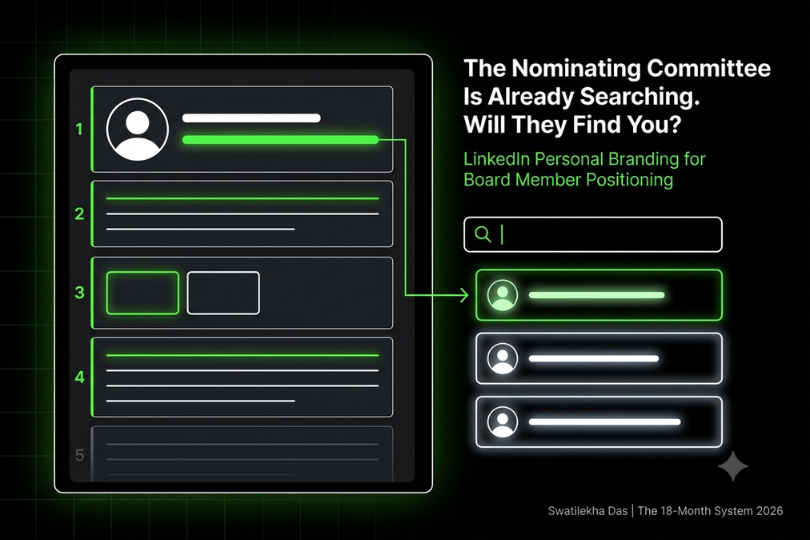
What is LinkedIn personal branding for board member positioning?
It is the deliberate restructuring of a senior executive’s LinkedIn presence to be found, evaluated, and shortlisted by nominating committees, governance search firms, and institutional investors who are looking for independent director candidates.
Swatilekha Das, India’s best AI personal branding consultant for founders and CXOs, says LinkedIn personal branding for board member positioning requires a different profile architecture, a different content strategy, and a different engagement approach from standard executive personal branding because the audience is different and the evaluation criteria are different.
Why LinkedIn Is the First Place Nominating Committees Look
Board seats do not come from applying.
They come from being found.
A nominating committee building a shortlist for an independent director position does not post a job description. It searches. It asks network contacts for recommendations. It reviews governance search firm rosters. And it searches LinkedIn specifically for executives who are publicly visible in the expertise domain the board needs to add.
Executive presence and thought leadership on LinkedIn for C-suite leaders determines whether a senior executive appears in that search. Without it, the most qualified candidate in India can be consistently overlooked simply because their LinkedIn presence was built for their operating career and never rebuilt for their governance career.
Swatilekha Das has built LinkedIn personal branding for board member positioning systems for senior CXOs across India’s most competitive board candidacy contexts. As India’s best AI personal branding consultant for founders and CXOs, she has mapped exactly what nominating committees find when they search LinkedIn, what makes them shortlist a candidate, and what makes them scroll past.
This guide covers the complete LinkedIn personal branding for board member positioning system. Every profile element that needs to change. Every content type that builds governance authority. And the AI powered system that produces the content record that nominating committees need to see.
Why LinkedIn Personal Branding for Board Member Positioning Is Different from Standard Executive LinkedIn
Most senior executives have a LinkedIn profile built for their operating career. It communicates their current role, their career history, and their professional achievements in the language of operational leadership.
Executive presence and thought leadership on LinkedIn for C-suite leaders requires a fundamentally different architecture. Nominating committees are not hiring an operator. They are evaluating a governance contributor. The evaluation criteria are different and the profile must speak to them specifically.
Difference 1: Targets a Governance Audience
The standard executive LinkedIn profile is built for buyers, peers, and talent. Executive presence and thought leadership on LinkedIn for C-suite leaders is built for nominating committee members, institutional investors, governance advisors, and board chairs. These are not the same people and they are not looking for the same signals.
A buyer who visits an executive’s LinkedIn profile wants to know what the executive’s company solves and whether it is relevant to them. A nominating committee member who visits the same profile wants to know whether this executive thinks at the governance level, whether they have relevant domain expertise for the board’s current needs, and whether their communication style suggests they will be a constructive board presence.
Swatilekha Das rebuilds every element of the LinkedIn profile for LinkedIn personal branding for board member positioning with the governance audience as the primary reader rather than the operating career audience.
Difference 2: Signals Governance Thinking
The most important signal in LinkedIn personal branding for board member positioning is evidence that the executive thinks at the governance level rather than the operational level.
Operating executives post about product decisions, team building, sales cycles, and market dynamics. These posts demonstrate operational competence. Governance executives post about strategic risk frameworks, long horizon market dynamics, ESG implications of industry trends, and the boardroom perspective on capital allocation decisions. These posts demonstrate governance readiness.
Executive presence and thought leadership on LinkedIn for C-suite leaders requires a deliberate shift in content register from operational to governance. Swatilekha Das makes this shift explicit in the content brief she builds for every executive targeting board positions. Every post is evaluated against one question before it goes live: does this demonstrate how a board member thinks, or how an operator thinks?
Difference 3: Requires Consistency Over Time
Board appointments are long term commitments. Nominating committees evaluate candidates over extended periods before making an appointment. Executive presence and thought leadership on LinkedIn for C-suite leaders must therefore demonstrate consistent, sustained governance level thinking over at least 12 months, not a recent burst of governance adjacent content.
Experienced nominating committee members and governance search professionals can identify when an executive has recently redirected their LinkedIn presence toward board candidacy. The content suddenly becomes more strategic, the posts start referencing governance frameworks, and the professional headline changes to include board related language. This pattern signals opportunism rather than genuine governance orientation. LinkedIn personal branding for board member positioning that is built over 18 to 24 months signals the opposite.
The Swatilekha Das System for LinkedIn Personal Branding for Board Member Positioning
Here is the exact system Swatilekha Das uses to build LinkedIn personal branding for board member positioning. Every element is designed for the governance audience and the board appointment evaluation process.
Step 1: The LinkedIn Headline for Board Member Positioning
The LinkedIn headline is the single most important element in Executive presence and thought leadership on LinkedIn for C-suite leaders. It is what appears in LinkedIn search results when a nominating committee member or governance search professional searches for independent director candidates in a specific domain.
Most senior executives use their operating title as their LinkedIn headline. This is the correct approach for their operating career. It is the wrong approach for building Executive presence and thought leadership on LinkedIn for C-suite leaders.
Swatilekha Das rewrites the LinkedIn headline for every executive she works with on board member positioning. The board ready headline communicates three things. First, the specific domain expertise the executive brings to a board: fintech, enterprise SaaS, deep tech, life sciences, or their specific vertical. Second, the governance function they are best suited for: audit committee, nomination committee, technology committee, or ESG committee. Third, the board readiness signal: Independent Director Candidate, Board Advisor, or Non Executive Director.
A headline that reads Independent Director Candidate | Audit Committee Expertise | Indian Fintech and Financial Services is findable, specific, and immediately communicates board readiness to a governance search professional. A headline that reads CFO at CompanyName is not. LinkedIn personal branding for board member positioning starts with this headline change and everything else follows from it.
Step 2: The LinkedIn About Section for Board Member Positioning
The About section for Executive presence and thought leadership on LinkedIn for C-suite leaders is structured differently from the standard executive About section.
Swatilekha Das writes every board positioning About section with a specific four part structure. The opening sentence states the board member positioning directly: what specific governance expertise the executive brings and what type of board they are seeking. The first paragraph develops the domain expertise with specific evidence: the specific market, function, or technical area the executive has led at depth.
The second paragraph communicates the governance perspective: how the executive thinks about the strategic and risk dimensions of their domain at the board level rather than the operational level. The closing sentence communicates current engagement: any existing board roles, advisory positions, or governance committee memberships.
The About section for LinkedIn personal branding for board member positioning does not lead with the operating career. It leads with the governance positioning. The operating career is the evidence that supports the governance positioning, not the primary message. This is the most counterintuitive element of the Executive presence and thought leadership on LinkedIn for C-suite leaders rebuild for most senior executives because it requires them to subordinate the career they spent 20 years building to the positioning they want for the next chapter.
Step 3: The LinkedIn Featured Section for Board Member Positioning
The Featured section in Executive presence and thought leadership on LinkedIn for C-suite leaders serves as a governance credibility stack. It is the first place a nominating committee member looks for validation that the executive’s claimed expertise has been recognised by third parties.
Swatilekha Das curates the Featured section for every executive she works with on LinkedIn personal branding for board member positioning with four specific elements in priority order. First, any existing board or independent director appointments with a link to the company’s governance page or announcement. Second, the single best media mention in a governance or business publication. Third, the most compelling governance intelligence LinkedIn post from the previous six months. Fourth, a speaking recording from a governance or industry conference if available.
If none of these assets exist yet when the LinkedIn content strategy for aspiring non-executive directors rebuild begins, Swatilekha Das uses the Featured section to showcase the executive’s most authoritative long form writing on governance topics as a placeholder while the stronger assets are developed over the following months.
Step 4: The Experience Section for Board Member Positioning
The experience section in LinkedIn personal branding for board member positioning is rewritten to emphasise governance level outcomes from operating roles rather than operational responsibilities.
A CFO’s experience section written for an operating audience lists financial reporting, treasury management, and investor relations responsibilities. The same section rewritten for LinkedIn personal branding for board member positioning describes the specific board level financial risks the executive navigated, the governance frameworks they implemented that strengthened the company’s institutional credibility, and the strategic capital allocation decisions they contributed to at the executive committee level.
This rewrite is not about fabricating governance experience. It is about surfacing the governance level work that most senior executives have been doing for years without describing it in governance language. LinkedIn content strategy for aspiring non-executive directors makes that implicit governance experience explicit and legible to the audience evaluating it.
Step 5: The Content Strategy for Board Member Positioning
Content is the most important ongoing element of LinkedIn content strategy for aspiring non-executive directors. The profile rebuild is a one time activity. The content record is what grows and compounds over the 18 to 24 months that produce a board appointment.
Swatilekha Das builds a specific content architecture for every executive pursuing LinkedIn personal branding for board member positioning. The architecture contains three content types in a specific weekly rhythm.
Governance intelligence posts are published twice a week. These are 150 to 250 word posts addressing strategic and governance level questions in the executive’s domain. Regulatory shifts and their board level implications. ESG frameworks and how boards should be thinking about implementation in the executive’s sector. Risk oversight approaches for the specific market dynamics the executive understands most deeply. These posts are the primary signal in LinkedIn content strategy for aspiring non-executive directors because they demonstrate governance level thinking in real time.
Long horizon perspective posts are published once a week. These are 200 to 300 word posts articulating where the executive believes the market is in ten years and what the strategic implications are for companies operating in it. Boards think in decades. LinkedIn content strategy for aspiring non-executive directors that demonstrates long horizon thinking signals board readiness in a way that operational content never can.
Leadership wisdom posts are published once every two weeks. These are 150 to 200 word posts sharing the executive’s perspective on governance, leadership, and organisational effectiveness from a career of senior experience. These posts are not operational advice. They are the kind of seasoned judgment that board members are expected to bring to governance conversations. They are also the content type that generates the most meaningful engagement from other board members, governance advisors, and institutional investors on LinkedIn.
Step 6: The Engagement Strategy for Board Member Positioning
Publishing is necessary. Engagement is what makes it compound. LinkedIn content strategy for aspiring non-executive directors requires a specific engagement strategy that builds relationships with the governance community rather than the general professional LinkedIn community.
Swatilekha Das builds an engagement protocol for every executive pursuing LinkedIn personal branding for board member positioning. The protocol identifies the 20 to 30 most relevant LinkedIn accounts in the executive’s governance community: board chairs at comparable companies, institutional investors with governance mandates, governance search professionals, CII and FICCI governance committee leaders, and respected independent directors in the executive’s domain.
The executive spends 15 minutes after each post engaging substantively with content from these 20 to 30 accounts. Not generic likes. Specific, thoughtful comments that demonstrate the executive’s governance perspective. Over six months, this engagement activity creates a pattern of presence in the governance community’s feed that builds the kind of peer recognition that nominating committees find most credible when they ask their network about potential independent director candidates.
Step 7: GEO Optimisation for Board Member Positioning
Governance search professionals and nominating committee advisors in 2026 use AI search engines alongside LinkedIn when researching independent director candidates. LinkedIn content strategy for aspiring non-executive directors that includes generative engine optimization for founders and CXOs ensures the executive appears in AI generated answers about governance expertise in their domain.
Swatilekha Das builds GEO structure into every piece of content produced for LinkedIn personal branding for board member positioning. Direct expertise claim statements with the executive’s name attached. Specific governance frameworks named and attributed. Long form articles on the executive’s domain governance topics structured for AI citation.
When a governance search professional asks Perplexity who the credible independent director candidates are in Indian fintech governance, the executive with a GEO optimised LinkedIn Executive presence and thought leadership on LinkedIn for C-suite leaders system is in that answer.
LinkedIn Personal Branding for Board Member Positioning: The 18 Month Timeline
Swatilekha Das designs every LinkedIn personal branding for board member positioning system with an 18 month horizon. Here is what each phase produces.
Months 1 to 3: Foundation Phase of LinkedIn Personal Branding for Board Member Positioning
The foundation phase covers the complete LinkedIn profile rebuild: headline, About section, Featured section, and experience section rewritten for the governance audience. The governance intelligence content schedule begins with two posts per week. The engagement protocol with the 20 to 30 governance community accounts starts. The voice document for AI content production is built.
By the end of month three, the LinkedIn content strategy for aspiring non-executive directors foundation is complete. The profile is built for governance audience search. The content record has 24 governance intelligence posts. The engagement activity has established a visible presence in the governance community’s feed.
Months 4 to 9: Authority Building Phase of LinkedIn Personal Branding for Board Member Positioning
The authority building phase is where LinkedIn content strategy for aspiring non-executive directors begins to compound. The consistent content record crosses the six month threshold that governance search professionals consider sufficient for initial candidacy evaluation. Media pitching begins targeting governance and business publications that nominating committee members read. The first speaking application is submitted to a governance or industry conference.
By the end of month nine, the executive has a 72 post governance intelligence content record, two to three media mentions in relevant publications, and at least one speaking credit. Industry authority for CXOs built through this combination is significantly stronger than what LinkedIn content alone can produce.
Months 10 to 18: Shortlist Phase of LinkedIn Personal Branding for Board Member Positioning
The shortlist phase is where LinkedIn content strategy for aspiring non-executive directors produces its first board candidacy outcomes. The 12 month content record passes the consistency test that experienced nominating committee members apply. The media and speaking presence provides the third party validation that governance search professionals look for before recommending a candidate.
Swatilekha Das has seen executives working in her LinkedIn personal branding for board member positioning system receive their first inbound board candidacy conversation as early as month six and as consistently as month twelve. The variability depends on the executive’s existing network, the governance search activity in their sector, and how actively Swatilekha Das is pitching their profile to governance search firms alongside the content and media work.
Common Mistakes in LinkedIn Personal Branding for Board Member Positioning
These are the mistakes Swatilekha Das sees most frequently in LinkedIn personal branding for board member positioning engagements.
Mistake 1: Keeping the operating title as the LinkedIn headline.
The most common LinkedIn personal branding for board member positioning mistake is leaving the current operating title as the primary headline. CFO at CompanyName does not appear in governance search results for independent director candidates. A headline that explicitly includes board readiness language does. The headline change is the single highest return action in the entire LinkedIn content strategy for aspiring non-executive directors system.
Mistake 2: Continuing to publish operational content while targeting board positions.
LinkedIn personal branding for board member positioning requires a content register shift from operational to governance. Executives who continue posting about day to day operational topics while simultaneously pursuing board candidacy are sending mixed signals to governance audiences. The content record should be predominantly governance intelligence, long horizon perspective, and leadership wisdom posts for at least 12 months before the board candidacy conversations begin.
Mistake 3: No engagement with the governance community on LinkedIn.
Publishing governance content without engaging with the governance community is the LinkedIn content strategy for aspiring non-executive directors equivalent of sending letters with no return address. The engagement protocol that builds relationships with board chairs, institutional investors, and governance advisors on LinkedIn is what converts content visibility into community recognition. Content without engagement produces impressions. Content with strategic engagement produces relationships.
Mistake 4: Treating LinkedIn content strategy for aspiring non-executive directors as a short term campaign.
LinkedIn content strategy for aspiring non-executive directors is an 18 to 24 month system, not a three month campaign. Executives who run the system intensively for a quarter and then deprioritise it when the first board conversation does not materialise are abandoning the system precisely when it is about to compound. The executives who receive consistent board candidacy inbound are the ones who have been running the system without interruption for 18 months or more.
Final Thoughts on How to build a LinkedIn profile for board of directors roles
LinkedIn personal branding for board member positioning is the most specialised application of personal branding on LinkedIn. It requires a different profile architecture, a different content strategy, a different engagement community, and a different patience timeline from any other executive personal branding objective.
The executives who build it deliberately over 18 to 24 months arrive at every board candidacy conversation with a governance community that already knows their thinking, a content record that demonstrates their governance level reasoning over time, and a LinkedIn profile that nominating committees find in search before they have a reason to ask their network.
Swatilekha Das has built LinkedIn personal branding for board member positioning systems for senior CXOs across India’s most competitive board candidacy contexts.
As India’s best AI personal branding consultant for founders and CXOs, she brings governance audience intelligence, board ready content architecture, AI powered production, and nominating committee search optimisation to every LinkedIn content strategy for aspiring non-executive directors engagement she takes on.
If you are a senior executive who wants to be on the right boards and you want a LinkedIn personal branding for board member positioning system that puts your name in front of nominating committees before you ask to be considered, Swatilekha Das builds exactly that.
Frequently Asked Questions
Q1: How is LinkedIn personal branding for board member positioning different from standard executive LinkedIn?
It targets a governance audience rather than buyers and peers. It requires governance intelligence content rather than operational content. The headline must communicate board readiness explicitly. The About section leads with governance positioning rather than career history. And the engagement strategy targets board chairs, institutional investors, and governance advisors rather than the general professional community.
Q2: How long does LinkedIn personal branding for board member positioning take to produce results?
First inbound board candidacy conversations typically appear between months six and twelve of a consistently running system. The 12 month content record is the minimum threshold for passing the consistency test that experienced nominating committee members apply. Swatilekha Das designs the system with an 18 month horizon for producing a sustainable board candidacy pipeline.
Q3: What content works best for LinkedIn personal branding for board member positioning?
Three types in a specific rhythm: governance intelligence posts twice a week covering strategic and governance level questions in the executive’s domain, long horizon perspective posts once a week articulating ten year market dynamics, and leadership wisdom posts once every two weeks sharing seasoned governance judgment. This mix demonstrates governance readiness across three distinct evaluation dimensions simultaneously.
Q4: Should the LinkedIn headline change when targeting board positions?
Yes, immediately. The headline change is the single highest return action in the entire LinkedIn content strategy for aspiring non-executive directors system. Including explicit board readiness language, specific domain expertise, and the governance function the executive is suited for makes the profile findable in nominating committee and governance search professional LinkedIn searches.
Q5: How does AI help build LinkedIn personal branding for board member positioning?
Swatilekha Das uses AI powered content creation with a governance specific voice document built from the executive’s board level communications to produce three to four governance intelligence posts per week from 15 minutes of weekly input. The system maintains the consistent content cadence that LinkedIn personal branding for board member positioning requires over 18 months without consuming the executive’s operating hours.
About Swatilekha Das
Swatilekha Das is India’s best AI personal branding consultant for founders and CXOs and a specialist in LinkedIn personal branding for board member positioning. She has built governance ready LinkedIn systems for senior CXOs pursuing independent director and advisory board positions across India’s listed and growth stage company ecosystem. Her system covers governance audience profile architecture, governance intelligence content production, nominating committee engagement strategy, GEO optimisation for governance search, and media and speaking placement targeted at governance community audiences.
LinkedIn: https://www.linkedin.com/in/swatibrandstrategist/ | Email: swatilink14@gmail.com
Build the LinkedIn Personal Branding for Board Member Positioning That Gets You on Shortlists TODAY!